Pepper Spray Laws in California 2026 and the Size Cap
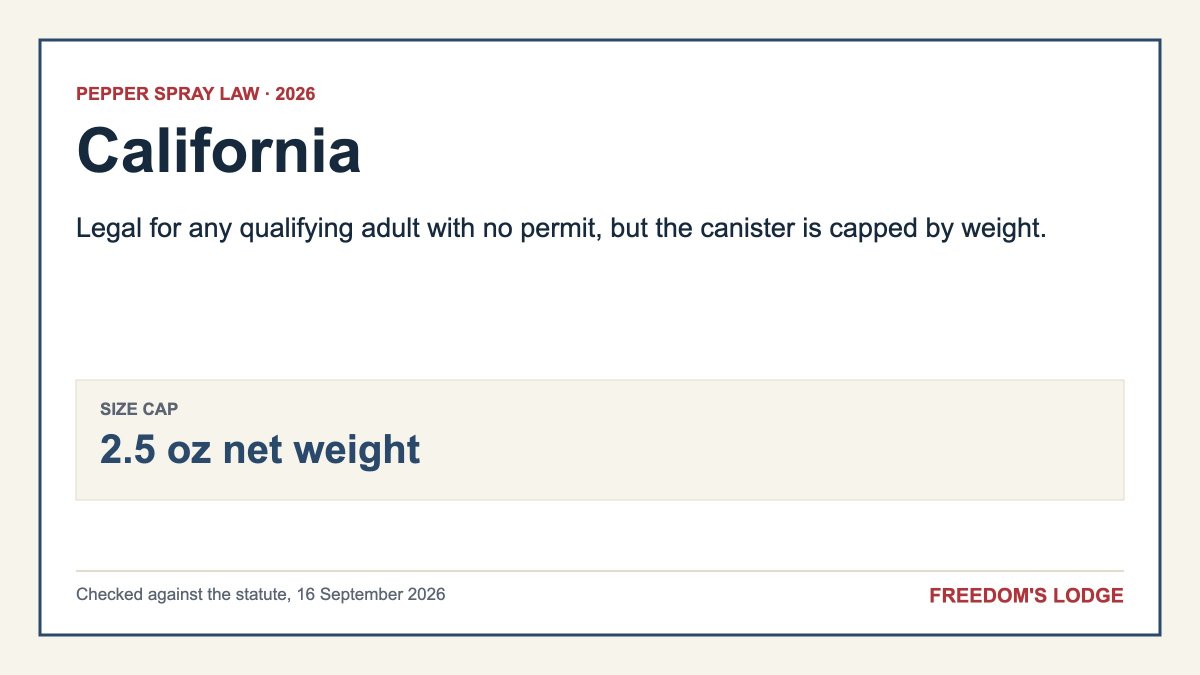
Yes, pepper spray is legal in California for an ordinary adult, and you will not need a permit or a background check to buy one. The condition that trips people up sits inside the California pepper spray laws as a hard number: your canister may not hold more than 2.5 ounces net weight of aerosol spray, and a unit that fires a projectile, or works by any method other than an aerosol spray, falls outside the exemption no matter how small it is.
California pepper spray at a glance, checked against the statute on 16 September 2026. Swipe the table sideways for every column.
| Legal for adults | Yes, for self-defense only. No permit. |
|---|---|
| Size or strength cap | 2.5 ounces net weight. No limit on strength. |
| Minimum age | 18, binding seller and possessor separately. 16 with a parent present or written consent. |
| Felony or conviction bar | Yes. A felony, any assault crime, prior tear gas misuse, or narcotic addiction. |
| Where you still cannot carry it | State and local public buildings, including any containing a courtroom, open public meetings, jails and prisons. Airport cabins, by federal rule. |
| Controlling statute | Cal. Penal Code 22810, against Penal Code 22900. |
The 2.5-ounce cap, and what “net weight” actually means
California regulates the container rather than the chemistry. Penal Code 22810(e)(1) bars three things in one sentence: a tear gas weapon that expels a projectile, a device that releases the chemical by any method other than an aerosol spray, and any unit holding more than 2.5 ounces net weight. Notice the unit. Net weight means the weight of what is inside the can, not fluid ounces and not the filled canister on a scale. Retail sprays mostly run between half an ounce and 2 ounces net, but home-defense foggers and bear sprays sail past the cap easily. (I have seen a 9-ounce fogger racked beside a legal 2-ounce unit, and nothing on either package tells a shopper which one is a crime to carry.)
Here’s the part most summaries drop: there is no strength limit at all. California names no chemical and sets no percentage of oleoresin capsicum. It reaches “tear gas.” Penal Code 17240(a) defines that term by effect rather than ingredient, as any substance intended to produce temporary physical discomfort or permanent injury through being vaporized or dispersed in the air. A 2-ounce can of the hottest formula sold is lawful, and a 3-ounce can of something gentle is not.
The age rule, and who it binds
Eighteen is the line, and California writes it from both directions so neither party can point at the other. Penal Code 22810(c) binds the seller: “No person shall sell or furnish any tear gas or tear gas weapon to a minor.” Penal Code 22810(d) binds the possessor: “No minor shall purchase, possess, or use tear gas or any tear gas weapon.” That double drafting matters, because a seventeen-year-old handed a canister by a worried parent has committed the possession offense (even though no sale ever happened).
Now, there is a real exception. Penal Code 22815 drops both halves to sixteen where a parent or guardian is involved. A minor who has turned sixteen may buy and possess spray while accompanied by that adult or carrying written consent. Subdivision (c) then places civil liability for any non-self-defense use on the adult who signed, jointly and severally with the minor.
Who may sell it, and what has to be on the package
California requires no dealer license for self-defense aerosols and no limit on how many you buy at once (which surprises people who expect this state to paper every transaction). It regulates the product instead, and four duties attach to every lawful canister: a label reading “WARNING: The use of this substance or device for any purpose other than self-defense is a crime under the law. The contents are dangerous — use with care,” a second label disclosing when its useful life expires, printed instructions at purchase, and an insert covering directions, first aid, storage, and misuse.
Remember that the label is doing real work, because misuse carries its own charge. Penal Code 22810(g)(1) makes any use of tear gas except in self-defense a public offense (with no recklessness element to argue about), and exposure reaches sixteen months or two or three years, a year in county jail, or a $1,000 fine.
Where you still cannot carry it
Penal Code 171b(a)(4) makes it a public offense to bring or possess “any unauthorized tear gas weapon” inside any state or local public building, or at any meeting required to be open to the public under the Brown Act or Bagley-Keene. Subdivision (c) defines that building as one owned or leased by state or local government where public employees regularly work. It expressly includes any building that contains a courtroom. Your county courthouse is closed, and so is the DMV counter. Penal Code 22840 adds jails and prisons.
What about schools? The school-grounds weapon statute does not list tear gas, and 171b(c)(2) carves campus buildings out of the public-building offense, so the code does not reach a canister in a backpack. That is not the same as being clear, because districts and employers write their own rules. (Airports are federal ground, and TSA keeps spray out of the cabin regardless of what Sacramento says.)
What the pepper spray laws in California actually say
I read the statute itself rather than a summary, and the architecture deserves a look. California does not simply permit pepper spray. Penal Code 22900 criminalizes tear gas outright, and 22810 hands back a carve-out. Every freedom you have here comes out of that exemption.
Notwithstanding any other provision of law, any person may purchase, possess, or use tear gas or any tear gas weapon for the projection or release of tear gas if the tear gas or tear gas weapon is used solely for self-defense purposes, subject to the following requirements.
Cal. Penal Code 22810. Read it at California Legislative Information. The requirements that follow are the bars: subdivision (a) covers a felony, any crime involving an assault “under the laws of the United States, the State of California, or any other state, government, or country,” and prior tear gas misuse. Notice the fourth one most write-ups miss, because subdivision (b) bars any person addicted to a narcotic drug.
Common questions about pepper spray laws in California
Can I carry pepper spray in my purse in California?
Yes. The state says nothing about how a qualifying adult carries a lawful canister, so a purse, a coat pocket, a glove box, or a keychain clip are all fine. There is no concealment rule. The limits run to the can, your record, and the buildings above.
Is bear spray legal to carry in California?
Bear spray cans almost always run far past 2.5 ounces net weight, which puts them outside the exemption at Penal Code 22810(e)(1). Carrying one in the backcountry against wildlife raises a different question from clipping one to your belt downtown, and the second is where people meet this statute.
Does a felony conviction from another state bar me?
Yes, and the statute says so plainly. Subdivision (a) reaches convictions from any other state, government, or country, so an out-of-state felony or assault conviction disqualifies you exactly as a California one would. A foreign conviction counts too.
Let’s put this state in context. California is strict about the canister and loose about the paperwork, so most adults can be carrying legally within five minutes while a minority are barred by a record they may never connect to a drugstore purchase. To see how that compares, read the pepper spray laws in all 51 jurisdictions, and our California gun laws page is the authoritative one on permits, reciprocity, and sensitive places.
Checked against the statute on 16 September 2026. This is a plain-language summary, not legal advice.