Pepper Spray Laws in Florida 2026 and the Two Ounce Cap
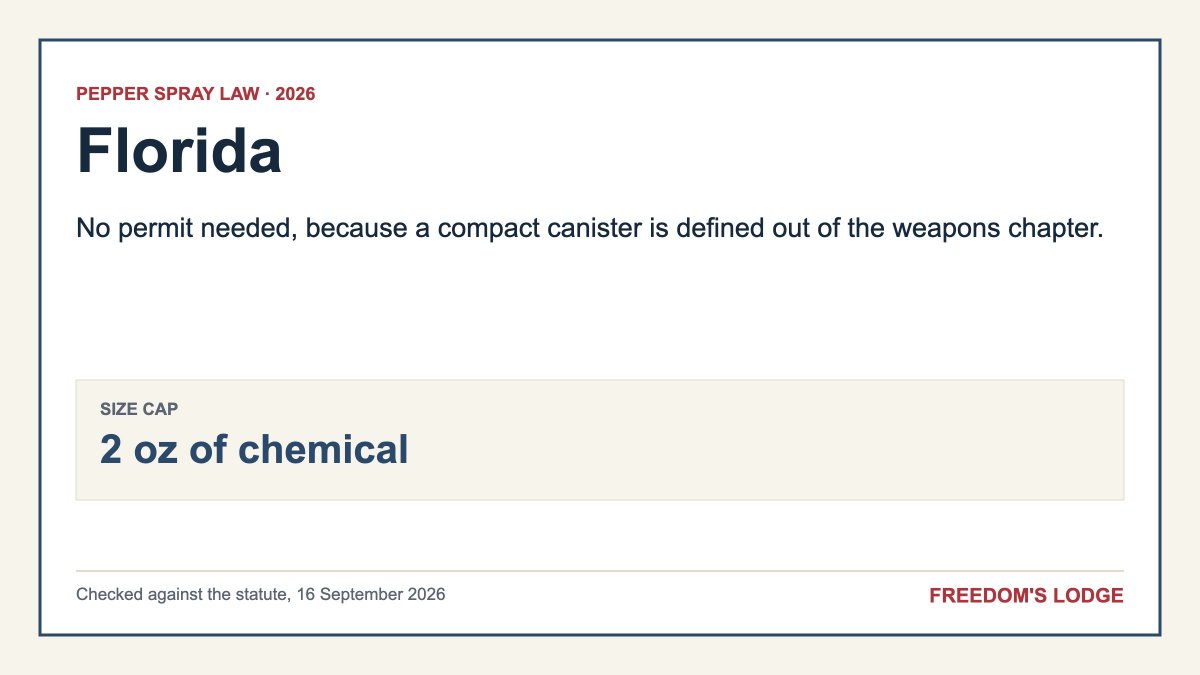
Yes, pepper spray is legal in Florida for any adult, with no permit, no license, and no paperwork of any kind. What makes the Florida pepper spray laws unusual is the mechanism, because the state does not exempt sprays from a weapons crime the way California and New Jersey do. It defines them out of the regulated category before the crime ever reaches them, and the condition that trips people up is the number inside that definition: not more than two ounces of chemical.
Florida pepper spray at a glance, checked against the statute on 16 September 2026. Swipe the table sideways for every column.
| Legal for adults | Yes. No permit, no license, no registration. |
|---|---|
| Size or strength cap | Not more than two ounces of chemical, in a device compact enough to carry on or about the person. No strength cap. |
| Minimum age | None in Chapter 790. Retailers set their own policy, which is usually 18. |
| Felony or conviction bar | Fla. Stat. s.790.23(1) bars listed persons from carrying a concealed chemical weapon, but a qualifying self-defense chemical spray is defined out of that category. |
| Where you still cannot carry it | No spray-specific ban. Using it on an on-duty law enforcement officer is a third-degree felony. Airport cabins, by federal rule. |
| Controlling statute | Fla. Stat. s.790.001(4)(b). |
Two ounces of chemical, and the words around the number
Florida’s whole scheme turns on a single definition. Section 790.001(4)(b) says that “self-defense chemical spray” means “a device carried solely for purposes of lawful self-defense that is compact in size, designed to be carried on or about the person, and contains not more than two ounces of chemical.” Notice that the number is not alone. Three conditions travel with it: the purpose must be lawful self-defense, the device must be compact, and it must be designed for carry on the person. Miss any one of them and the exclusion stops applying (which is how an oversized canister quietly changes category).
Notice also what the unit is. The statute says “two ounces of chemical,” which points at the quantity of the agent rather than at the weight of the whole canister or a fluid measure, and Florida never defines the basis any further. Most retail defense sprays sit comfortably under it, while bear spray and home foggers do not (by a wide margin, in both cases). (A 9-ounce fogger is still lawful to own in Florida, but it is no longer a self-defense chemical spray for statutory purposes, so it falls back into the weapon category and the concealed-carry rules that come with it.)
There is no strength limit. Florida names no chemical at all, not oleoresin capsicum, not CS, not CN, so heat and percentage are matters for the manufacturer rather than the Legislature.
The age rule, or rather the absence of one
Chapter 790 sets no minimum age for self-defense chemical spray. I went through the whole chapter looking for one, following every occurrence of “chemical spray,” “tear gas,” “chemical weapon,” and “spray.” None of them attaches an age to the product. The age restrictions in Chapter 790 are aimed at firearms (and at nothing else).
So does that mean a fifteen-year-old may carry it? As a matter of state criminal law, the statute does not say otherwise. In practice you will still meet an eighteen-year-old minimum at the register, because retailers and payment processors set that policy themselves, and a school will have its own rule that has nothing to do with Chapter 790. Remember that a store policy is not a criminal statute and neither one substitutes for the other.
Who may sell it, and why the paperwork is empty
Florida requires no dealer license to sell self-defense chemical spray, no point-of-sale record, no per-sale quantity limit, and no labeling or warning mandate. A gas station may stock it beside the phone chargers, and plenty of them do. That is the practical consequence of the definitional approach (a product outside s.790.001 never picks up the duties Chapter 790 attaches to weapons).
So here’s the thing that follows from the same logic, and it is the most useful point on this page. Section 790.23(1) makes it unlawful for a convicted felon and certain other listed persons “to carry a concealed weapon, including a tear gas gun or chemical weapon or device.” Read that against the definition, though. Section 790.001(4)(b) says “chemical weapon or device” means such a weapon “except a device known as a ‘self-defense chemical spray.'” A qualifying canister is therefore not a chemical weapon or device, and the felon-in-possession bar does not appear to reach it.
Where you still cannot carry it
The same definitional exclusion runs through the place restrictions. Florida’s school-property offense at s.790.115(2)(a) bars possession of “any firearm, electric weapon or device, destructive device, or other weapon as defined in s. 790.001,” and the “weapon” definition at s.790.001(20) covers a “tear gas gun, chemical weapon or device.” That phrase in turn excludes a self-defense chemical spray. So the school statute does not appear to reach a compliant canister, though every district and campus writes its own conduct policy and will enforce it.
There is one genuine use offense. Section 790.054 makes it a third-degree felony to knowingly and willfully use a self-defense chemical spray, a stun gun, or a dart-firing stun gun against a law enforcement officer engaged in the performance of duties. Notice that Florida has no general reckless-discharge crime for sprays, so this single victim-specific offense carries the whole weight. Airports are federal ground, and the Transportation Security Administration keeps spray out of the cabin.
What the pepper spray laws in Florida actually say
I read Chapter 790 itself rather than a summary, and this is the sentence that does all the work.
“Self-defense chemical spray” means a device carried solely for purposes of lawful self-defense that is compact in size, designed to be carried on or about the person, and contains not more than two ounces of chemical.
Fla. Stat. s.790.001(4)(b). Read the full section at the Florida Senate, the Legislature’s own site.
Common questions about pepper spray laws in Florida
Do I need a concealed weapons permit for pepper spray in Florida?
No. A qualifying self-defense chemical spray is not a weapon under s.790.001, so the concealed-weapon licensing scheme does not reach it. You may carry it openly or concealed, in a purse, a pocket, or a car, without a license of any kind.
Can a convicted felon carry pepper spray in Florida?
The statute points that way, because s.790.23(1) reaches a concealed “tear gas gun or chemical weapon or device” and s.790.001(4)(b) writes self-defense chemical spray out of that phrase. That is a definitional argument rather than an express permission, and a canister over two ounces would lose the protection immediately. If you are a prohibited person, get advice from a Florida attorney before relying on it.
Is bear spray legal in Florida?
Owning it is lawful, but a bear spray canister almost always exceeds two ounces of chemical, so it is not a self-defense chemical spray under the statute. That pushes it back into the general weapon definition, and the concealed-carry and school-property rules follow it there. For carry against people, buy something under the cap.
Florida is the friendliest of the four big states on this subject, and the reason is structural rather than political, because a product defined out of the weapons chapter never picks up its restrictions. To see how that compares, read the pepper spray laws in all 51 jurisdictions, and our Florida gun laws page is the authoritative one on permits, reciprocity, and sensitive places.
Checked against the statute on 16 September 2026. This is a plain-language summary, not legal advice.