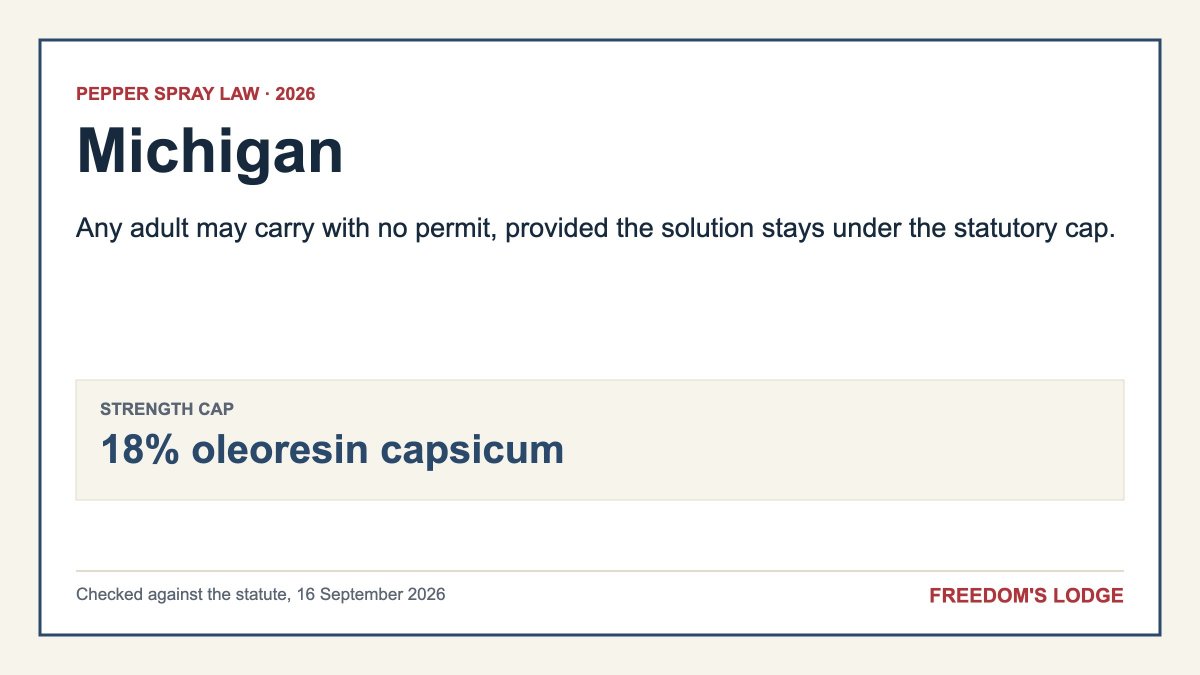
Pepper Spray Laws in Michigan 2026 and the 18 Percent Cap
Yes, an ordinary adult may buy and carry pepper spray in Michigan, and no permit, registration or background check is involved. Michigan pepper spray laws are built as a felony with a hole cut in it, because MCL 750.224(1)(e) makes possessing a gas-ejecting incapacitating device a five-year felony, and MCL 750.224(3)(a) then exempts a self-defense spray or foam device as defined in section 224d. The condition that trips people up is a percentage, because your canister may contain no more than 18% oleoresin capsicum, and the statute never says eighteen percent of what.
Michigan pepper spray at a glance, checked against the statute on 16 September 2026. Swipe the table sideways for every column.
| Legal for adults | Yes. No permit, no registration, no background check. |
|---|---|
| Size or strength cap | Not more than 18% oleoresin capsicum. A CS device is capped at 35 grams of CS and inert ingredients combined. |
| Minimum age | The statute bans sale to a minor and binds the seller only. Michigan sets majority at 18 by general law. |
| Felony or conviction bar | None. No status-based disqualification attaches to a spray. |
| Where you still cannot carry it | No possession ban anywhere. A weapon free school zone is the live risk. Airport cabins are closed by federal rule. |
| Controlling statute | MCL 750.224d, read against MCL 750.224(1)(e). |
The 18 percent cap, and what that percentage does not tell you
Here’s the number that decides whether your canister is lawful property or a five-year felony, and I read the statute itself, not a summary. MCL 750.224d(1)(a)(ii) permits “a solution containing not more than 18% oleoresin capsicum,” and (1)(a)(iii) permits the same solution with an ultraviolet marking dye added. A tear gas device takes a different measure at (1)(a)(i), allowing not more than 35 grams of orthochlorobenzalmalononitrile and inert ingredients combined.
Now, notice what the percentage clause leaves out. It does not say percent by weight, percent by volume, or percent of total capsaicinoids, which is the figure that actually tracks heat. Two cans both labeled 18% can therefore differ substantially in what they do to a person. There is also no limit on container size, so a large canister at a conforming concentration is fine while a small one above it is not. (Michigan capped the chemistry and left the volume entirely alone, which is the opposite of what California did.)
One more requirement hides in subdivision (1)(b): the device must not eject anything else capable of disabling or injuring a person, so a blended formula falls back under the felony.
The age rule, and who it binds
Michigan wrote this rule in one direction only. MCL 750.224d(4) says a person shall not sell a self-defense spray or foam device to a minor, and a seller who does commits a misdemeanor carrying up to 90 days or a $500 fine. (Nothing in the section makes it an offense for a minor to possess or carry one.)
Notice also that 224d never states a number. It uses the bare word “minor,” and the figure comes from general law at MCL 722.52, which makes a person eighteen or older an adult for all purposes. So a seventeen-year-old cannot lawfully be sold a canister, but a parent who buys one and passes it along breaks no rule here.
Who may sell it, and what has to be on the package
The minor ban is the only seller duty there is. Michigan requires no dealer license for self-defense sprays, no point-of-sale record, no per-customer quantity cap and no labeling mandate, which I confirmed by searching the Legislature’s own full-text database for each of those terms.
That last absence matters more here than in most states. Because your canister is lawful only at or under 18% oleoresin capsicum, and no statute requires the figure on the front to be accurate or independently measured, you are relying on a marketing claim to stay on the right side of a felony line. Remember to buy from a maker that publishes its concentration and the measurement basis.
Where you still cannot carry it
Michigan has no place-based possession ban for spray. (That puts it well ahead of Illinois or California.) The one exception is the weapon free school zone, and it is a tangle worth untangling. MCL 750.237a(2) lists section 224d among the offenses that become an enhanced misdemeanor when committed in such a zone. (That zone is defined at 237a(6) as school property and any school vehicle.)
Read further, though. Subsection 237a(3) says those enhancements do not apply where the conduct is otherwise exempted or authorized under the chapter, so a lawful self-defense use protected by 224d(5) should not become a school-zone offense. The looser risk is 237a(4), which makes possessing “a weapon” in such a zone a 93-day misdemeanor, and defines weapon only as including a pneumatic gun. That open definition is where a canister in a student’s bag could land. (Airports run on federal rules, and TSA keeps spray out of the cabin whatever Lansing says.) Preemption will not shield you from a local ordinance either, because MCL 123.1102 covers firearms, pneumatic guns, ammunition and firearm components, and never mentions sprays.
What the pepper spray laws in Michigan actually say
The definition is the whole game, because everything lawful about your canister depends on fitting it. Here is the operative list.
The device is capable of carrying, and ejects, releases, or emits 1 of the following: (i) Not more than 35 grams of any combination of orthochlorobenzalmalononitrile and inert ingredients. (ii) A solution containing not more than 18% oleoresin capsicum. (iii) A solution containing an ultraviolet dye and not more than 18% oleoresin capsicum.
MCL 750.224d(1)(a). Read it at the Michigan Legislature’s own site. Notice which agents are named and which are missing. Orthochlorobenzalmalononitrile is CS and oleoresin capsicum is OC, while CN, the older agent sold as chemical mace, appears nowhere. A CN device is therefore not a self-defense spray or foam device, and it stays under the felony at 750.224(1)(e).
Common questions about pepper spray laws in Michigan
Is it a crime to use pepper spray on an attacker in Michigan?
No, and the drafting here is genuinely strange. MCL 750.224d(2) makes it a misdemeanor punishable by up to two years or a $2,000 fine to use a conforming device on another person at all, and subsection (5)(b) then carves out reasonable use in protecting a person or property where the circumstances would justify physical force. Self-defense is an exception to an offense rather than an unqualified right.
What does 18% oleoresin capsicum mean on a Michigan label?
Less than most buyers assume. The statute states the percentage bare, without saying whether it is measured by weight, by volume or against total capsaicinoids, so two compliant cans can behave differently. Treat it as a legal ceiling rather than a measure of how well a spray works.
Can a 17-year-old buy pepper spray in Michigan?
No. MCL 750.224d(4) forbids selling to a minor and Michigan sets majority at eighteen, so the store commits the offense if it sells. The minor handed one by a parent commits no offense, since nothing here reaches possession.
Is pepper gel or a foam device legal in Michigan?
Yes. The statute reads “self-defense spray or foam device” throughout, so a gel or foam is covered like an aerosol, provided it stays at or under 18% oleoresin capsicum and ejects nothing else that would disable or injure.
Let’s put Michigan in context. This state is relaxed about where you carry and strict about what is inside the can, so the concentration printed on the label is what stands between you and a five-year felony statute. To compare, read the pepper spray laws in all 51 jurisdictions, and our Michigan gun laws page is authoritative on permits, reciprocity and sensitive places.
Checked against the statute on 16 September 2026. This is a plain-language summary, not legal advice.