Pepper Spray Laws in New Jersey 2026 and the Ounce Rule
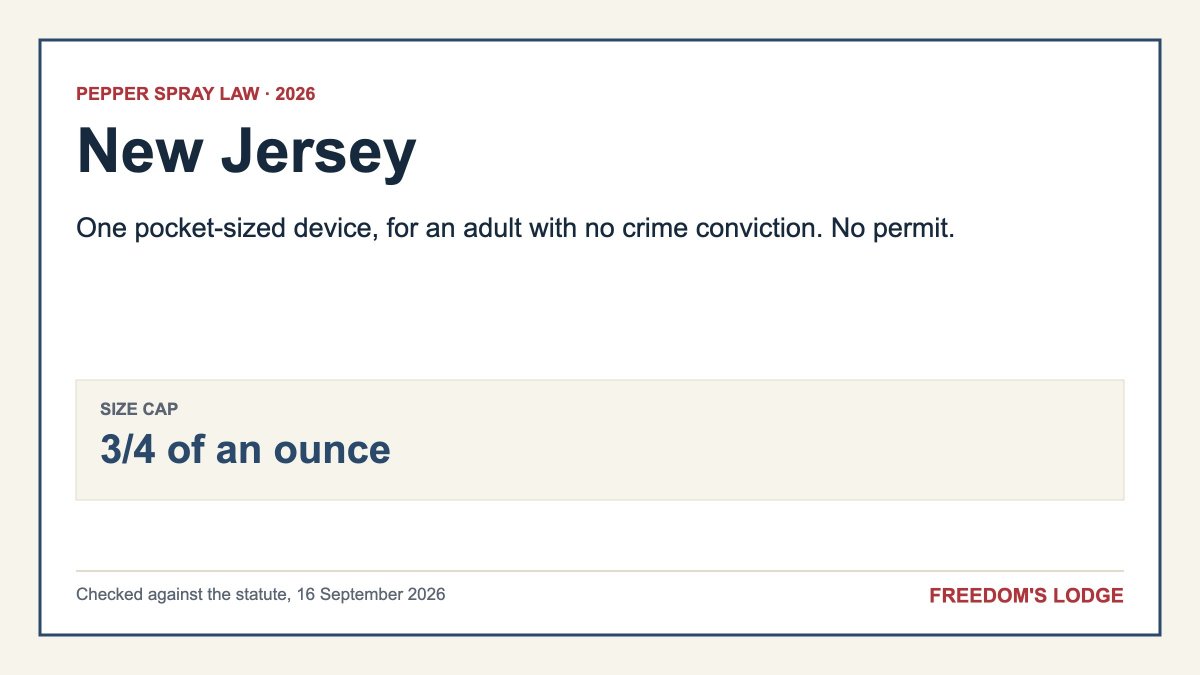
Yes, an ordinary adult may buy and carry pepper spray in New Jersey without a permit, but the New Jersey pepper spray laws reach that answer through an exemption rather than a permission, and the difference decides real cases. The condition that trips people up is a two-part one: your device must be pocket-sized and must contain and release no more than three-quarters of an ounce of chemical substance, and you must not have been convicted of a crime, which in New Jersey means any indictable offense rather than a felony in the ordinary sense.
New Jersey pepper spray at a glance, checked against the statute on 16 September 2026. Swipe the table sideways for every column.
| Legal for adults | Yes, for personal self-defense, one pocket-sized device. No permit. |
|---|---|
| Size or strength cap | Not more than three-quarters of an ounce of chemical substance. No strength or percentage cap. |
| Minimum age | 18. It binds the possessor, since the exemption is written as a condition on the person carrying. |
| Felony or conviction bar | Broader than a felony bar. The exemption reaches only a person “who has not been convicted of a crime.” |
| Where you still cannot carry it | Buildings and grounds of any school, college, or university without written authorization. Airport cabins, by federal rule. |
| Controlling statute | N.J.S.A. 2C:39-6(i)(1), exempting you from N.J.S.A. 2C:39-5(d). |
Three-quarters of an ounce, and the unit the statute never defines
New Jersey caps the quantity of chemical. It does so with a measurement basis that is unusual. The exemption covers “one pocket-sized device which contains and releases not more than three-quarters of an ounce of chemical substance.” Notice what the Legislature did not write. It is not net weight ounces, not fluid ounces, not milliliters, and not grams. The statute says “ounce” bare and leaves the basis alone. In practice retailers size to the number and stock 0.5-ounce and 0.75-ounce canisters, which is why the New Jersey shelf looks different from the shelf one state over. (A can marked 1.5 ounces, perfectly legal in Pennsylvania, is a fourth-degree crime across the Delaware.)
Here’s the second thing worth knowing: there is no strength limit anywhere in the statute. New Jersey sets no percentage of solution, no cap on capsaicinoid content, and no heat rating. The only qualitative test is that the substance must be “not ordinarily capable of lethal use or of inflicting serious bodily injury” and must be intended to produce temporary discomfort or disability. So a hot formula in a small can is lawful, and a mild formula in a large can is not.
The age rule, and who it binds
Eighteen is the line, and New Jersey binds only one party with it. The exemption protects “any person who is 18 years of age or older and who has not been convicted of a crime,” which makes the age a condition on the possessor rather than a duty on a store clerk. There is no statute telling a retailer to check identification (and no penalty aimed at the sale itself).
What happens to a seventeen-year-old carrying a canister? They are simply outside the exemption, so the underlying possession offense applies. That is the fourth-degree crime at N.J.S.A. 2C:39-5(d) rather than a fine on a shopkeeper. Remember that New Jersey has no parental-consent path here, unlike California and Massachusetts, so there is no way for a parent to make it lawful for a minor.
Who may sell it, and the product spec that replaces a license
New Jersey imposes no dealer license, no paperwork, no per-sale quantity limit, and no labeling mandate. It regulates the item instead of the transaction. N.J.S.A. 2C:39-9(d) makes it a fourth-degree crime to manufacture, ship, sell, or dispose of any device that releases tear gas, then carves out a device that “is for the purpose of personal self-defense, is pocket-sized and contains not more than three-quarters of an ounce of chemical substance.”
So here’s the thing about that drafting. The same three-quarter-ounce number governs both ends of the chain, which means an oversized canister is a crime for the shop that sold it and a crime for you to hold. A New Jersey store that stocks a 2-ounce unit is not merely selling you something you cannot carry. It is committing its own fourth-degree offense (on the shelf, before anyone buys anything).
Where you still cannot carry it
The one place restriction that clearly reaches spray is educational property. N.J.S.A. 2C:39-5(e)(2) makes it a fourth-degree crime to possess certain weapons on the buildings or grounds of any school, college, university, or other educational institution without the written authorization of the governing officer. Read it carefully, because it names paragraphs (3) and (4) of the weapon definition while sprays live at paragraph (5), so they arrive through the catch-all clause covering “any other weapon under circumstances not manifestly appropriate for such lawful use as it may have.” That is a softer hook than the enumerated list, but it is a hook (and campus policy usually settles the matter before a prosecutor does).
Beyond schools, the statutes are quiet. New Jersey has no courthouse or government-building spray offense. That surprises people who assume the strictest weapons state in the region regulates everything. (Courthouses run screening and will confiscate a canister at the door, which is building policy rather than a charge.) Airports are federal ground, and TSA keeps spray out of the cabin.
What the pepper spray laws in New Jersey actually say
I read the statutory text on the Legislature’s own database rather than a summary, and the shape matters. A spray is a “weapon” by definition under N.J.S.A. 2C:39-1(r)(5), so possession starts out as a crime and the exemption gives it back.
Nothing in N.J.S.2C:39-5 shall be construed to prevent any person who is 18 years of age or older and who has not been convicted of a crime, from possession for the purpose of personal self-defense of one pocket-sized device which contains and releases not more than three-quarters of an ounce of chemical substance not ordinarily capable of lethal use or of inflicting serious bodily injury.
N.J.S.A. 2C:39-6(i)(1). Read the full section in the New Jersey statutes database. A person who falls outside the exemption is a disorderly person subject to a fine of not less than $100. The separate possession crime at 2C:39-5(d) is a fourth-degree offense.
Common questions about pepper spray laws in New Jersey
Can I keep pepper spray in my car in New Jersey?
Yes, if the canister qualifies and you do. The exemption protects possession for personal self-defense without saying where you keep the device, so a glove box, a bag, or a pocket are all covered. What matters is the can and your record, not the location.
Does a disorderly persons conviction count as being “convicted of a crime”?
No. New Jersey uses “crime” as a term of art for indictable offenses, the first through fourth degrees, and it treats disorderly persons offenses as a separate and lower category. A shoplifting disorderly persons offense therefore does not bar you, while a fourth-degree conviction does, even though many states would call that a misdemeanor.
Can I carry more than one canister?
Notice the number in the statute, because the exemption covers “one pocket-sized device.” Carrying a second canister on your person puts you outside the plain words, and there is no published guidance softening that reading. Keep one on you.
New Jersey is a hard state on weapons generally and a workable one on spray, provided you respect the two numbers that define the carve-out. To see how it compares elsewhere, read the pepper spray laws in all 51 jurisdictions, and our New Jersey gun laws page is the authoritative one on permits, reciprocity, and sensitive places.
Checked against the statute on 16 September 2026. This is a plain-language summary, not legal advice.