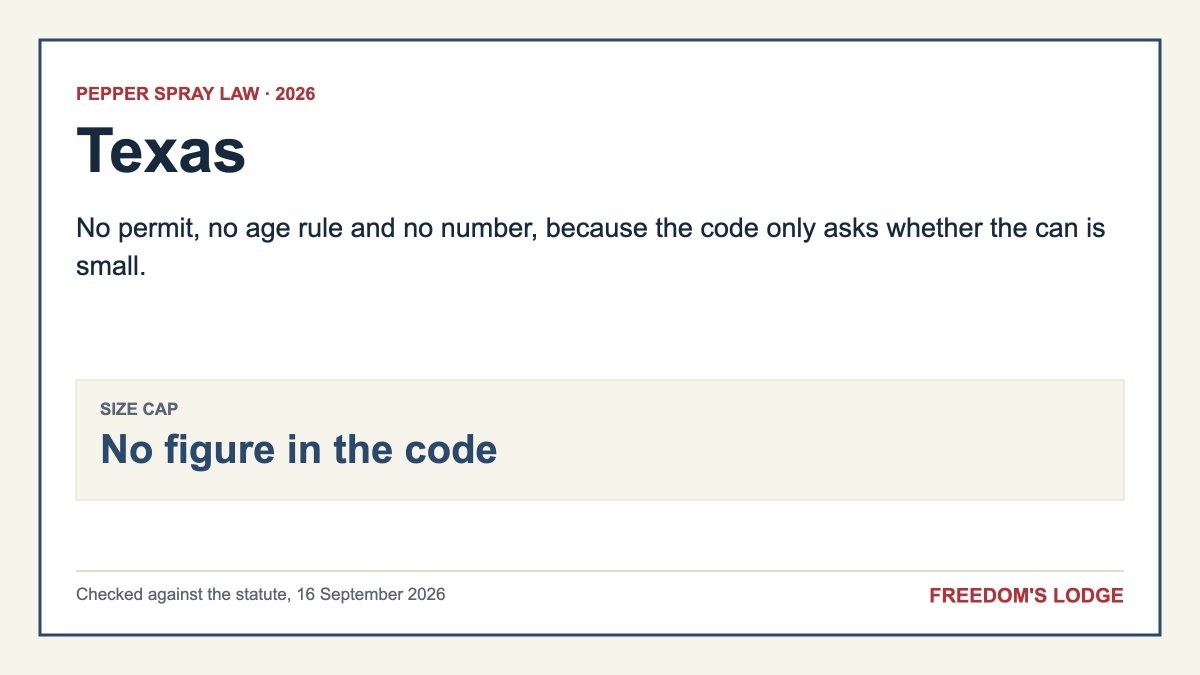
Pepper Spray Laws in Texas 2026 and the Missing Size Cap
Yes, an ordinary adult may buy and carry pepper spray in Texas, and there is no permit, no registration and no waiting period in the way. Texas pepper spray laws work by subtraction rather than by permission, because the weapons chapter defines the ordinary personal-protection canister out of the prohibited-weapon list instead of granting anyone a right to carry one. The condition that trips people up is the word the Legislature chose to draw that line, which is “small,” and the Penal Code never says how small.
Texas pepper spray at a glance, checked against the statute on 16 September 2026. Swipe the table sideways for every column.
| Legal for adults | Yes. No permit, no registration, no purchase paperwork. |
|---|---|
| Size or strength cap | No figure anywhere. The only test is a “small chemical dispenser sold commercially for personal protection.” |
| Minimum age | None. No age provision in the weapons chapter binds a buyer, a seller or a carrier of a spray. |
| Felony or conviction bar | None reaching a personal-protection dispenser. |
| Where you still cannot carry it | No state place restriction reaches it, not even schools or courthouses. Airport cabins are closed by federal rule. |
| Controlling statute | Tex. Penal Code 46.01(14), read against 46.05(a)(3). |
The size limit that is not written as a number
Texas sets no ounce figure, no gram figure and no percentage of oleoresin capsicum. I read the statute itself rather than a summary, and the whole question turns on a short clause buried inside a definition. Penal Code 46.01(14) defines a “chemical dispensing device” as a device, other than a small chemical dispenser sold commercially for personal protection, designed, made or adapted to dispense a substance capable of causing an adverse effect on a human being. Notice what that clause does. The canister on the drugstore shelf never becomes a prohibited weapon at all, so the felony at 46.05(a)(3) has nothing left to bite on.
So here’s the thing about a test with no number in it. Two phrases do all the work, and neither is defined in the code. “Small” is left to a judge and a jury, and “sold commercially for personal protection” describes how a product is marketed rather than what sits inside it. A keychain or purse canister sits comfortably inside the exclusion, while a large fogger bought from a police supplier is a much harder argument to win. (Texas is generous here, and the generosity runs out at precisely the point where nobody can tell you where the edge sits.)
The age rule, and the fact that Texas never wrote one
There is no minimum age for pepper spray in Texas. I searched the full text of Penal Code chapter 46, and every age provision attaches to something else: eighteen for a location-restricted knife at 46.02(a-4), eighteen for selling a firearm or knife to a child at 46.06(a)(2), and seventeen for the firearm-access offense at 46.13. (Sprays appear in none of them.)
Now, that is a statement about the Penal Code and not about the store. A retailer may refuse a sale to a teenager for its own reasons, and a school district may discipline a student whatever Austin says. Remember that a parent handing a canister to a fourteen-year-old breaks no weapons law here, which is a different answer from the one Illinois gives.
Who may sell it, and what has to be on the package
Nothing, and nothing. Texas requires no dealer license for self-defense sprays, no point-of-sale record, no quantity cap and no warning label. The same search that found no age rule found no labeling duty. (That puts this state at the opposite end of the country from California and its four package requirements.)
One provision in 46.05 does run to chemical dispensers, and it is easy to misread as a licensing scheme. Subsection (f) gives a defense to prosecution to a security officer trained through the Texas Commission on Law Enforcement or the Texas Private Security Board. It matters only for the full-size device that really is a prohibited weapon.
Where you still cannot carry it
Here’s the part that reads strangely the first time through. Penal Code 46.03 is the sensitive-places statute, and it opens by naming exactly which items it governs: a firearm, a location-restricted knife, a club, or a prohibited weapon listed in Section 46.05(a). A personal-protection dispenser is none of those four, because 46.01(14) lifted it out of the prohibited-weapon list before 46.03 could reach it. On the face of the statute, school premises, polling places, court offices and racetracks are open to a lawful canister.
Take that as a description of criminal exposure rather than as a green light. Schools can expel or fire you without any charge being filed, a judge may control the courtroom by order, and TSA keeps spray out of the passenger cabin whatever the Penal Code says. (I would still leave mine in the car outside a courthouse, and I say that having just read the statute that does not require it.) Preemption will not settle it either, because Local Government Code 229.001(a)(1)(A) lists firearms, knives and ammunition, and never mentions sprays.
What the pepper spray laws in Texas actually say
Two sentences run this entire state. The first is the offense at Penal Code 46.05(a), which makes it a third-degree felony to intentionally or knowingly possess, manufacture, transport, repair or sell a chemical dispensing device. The second is the definition that hollows it out.
“Chemical dispensing device” means a device, other than a small chemical dispenser sold commercially for personal protection, that is designed, made, or adapted for the purpose of dispensing a substance capable of causing an adverse psychological or physiological effect on a human being.
Tex. Penal Code 46.01(14). Read it at the Texas Legislature’s own statutes site. Notice that no chemical is named. (Not oleoresin capsicum, not capsaicin, not CS or CN.) Texas wrote the definition around what a device does rather than what it contains, so a manufacturer changing its formula cannot quietly turn your canister into contraband.
Common questions about pepper spray laws in Texas
Is there a size limit on pepper spray in Texas?
No figure appears in the Penal Code. The statute asks only whether the unit is a “small chemical dispenser sold commercially for personal protection,” so a keychain or purse canister is plainly covered. A fogger sold to agencies rather than consumers is where the argument begins, and it carries felony exposure.
Can a 16-year-old carry pepper spray in Texas?
The weapons chapter sets no minimum age for a spray, so state criminal law does not stand in the way. School rules are stricter, and a store may still decline the sale on its own policy.
Can I bring pepper spray into a Texas courthouse or school?
Penal Code 46.03 governs firearms, location-restricted knives, clubs and prohibited weapons, and a personal-protection dispenser sits on none of those lists. That is a statement about charges rather than about the door, because building security and campus policy can still turn you away.
Is bear spray legal to carry in Texas?
Bear spray is sold for protection against wildlife rather than personal protection, and the cans run far larger than anything on a drugstore rack. Clipping one to your belt downtown is where a prosecutor would start asking what the word “small” was meant to exclude.
Let’s put Texas in context. This is one of the loosest states in the country on paper, and the looseness arrives with a soft edge instead of a bright line, so your real risk is a definition nobody can measure for you in advance. To see how other states draw theirs, read the pepper spray laws in all 51 jurisdictions, and our Texas gun laws page is authoritative on permits, reciprocity and sensitive places.
Checked against the statute on 16 September 2026. This is a plain-language summary, not legal advice.