ATF “New Era of Reform”: How to Comment on the Proposed Rules
Status note, 21 September 2026: the early-August comment windows described below have closed, including the 4 August deadline in the title of the original version of this article. One New Era rule is still open: Fingerprint and Photograph Requirements for Firearms Applications (RIN 1140-AA63), published 6 July 2026, where comments close 5 October 2026 at regulations.gov. The method below still works; only the dates have moved.
The ATF New Era of Reform is here. The Department of Justice and the ATF released 34 notices of final and proposed firearms rulemaking on April 29, 2026, launching what the agency calls its “New Era of Reform” — and the public-comment window on those proposals is open right now, with the first deadlines arriving August 4.
For gun owners, that second sentence matters more than the first. The reform package is the broadest rollback of federal firearms red tape in a generation. But proposed rules are not final rules. Each one moves through a notice-and-comment process, and the record built during that window is the record a court will scrutinize later. This is the rare moment when an ordinary citizen’s signature carries real legal weight.
Here is what changed, what it means for you, and exactly how to lock it in before the comment period closes.

What Is the ATF New Era of Reform?
The ATF New Era of Reform is a package of final and proposed regulatory changes the ATF and DOJ unveiled on April 29, 2026. According to the DOJ Office of Public Affairs press release that day (Press Release No. 26-417), the Department released “34 notices of final and proposed rulemaking” following a top-to-bottom review of existing regulations.
That review produced the ATF New Era of Reform. It was ordered by Executive Order 14206, “Protecting Second Amendment Rights,” signed February 7, 2025. The order directed the Attorney General to examine every regulation, guidance document, and agency action for “ongoing infringements” of the right to keep and bear arms and to bring a plan to fix them.
“The Second Amendment is not a second-class right,” Acting Attorney General Todd Blanche said in the announcement. ATF Director Robert Cekada, confirmed by the Senate the same week, added that the agency’s “enforcement focus from here on out is on willful violators and criminal actors, not inadvertent compliance issues by responsible owners and licensees.”
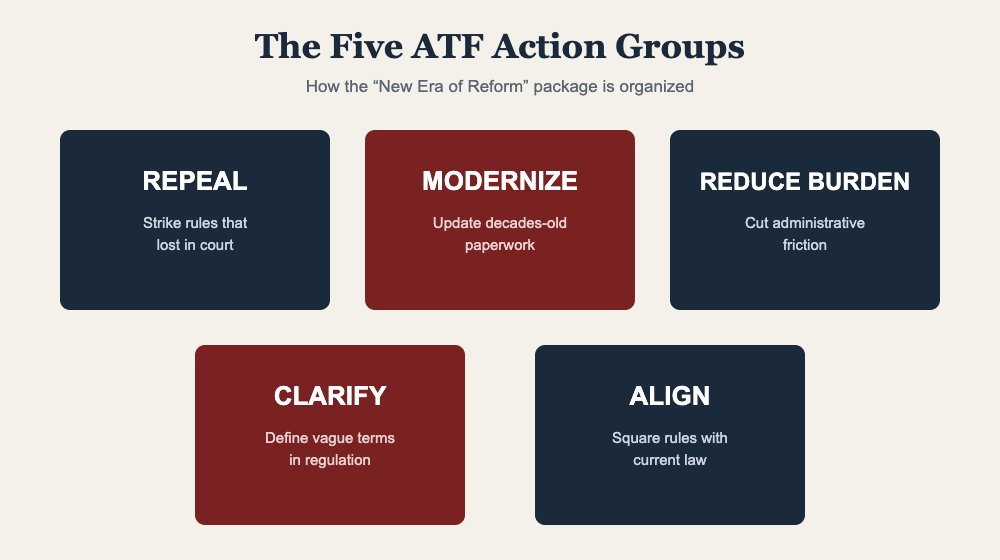
The ATF organizes the package into five action groups: Repeal, Modernize, Reduce Burden, Clarify, and Align. Each tackles a different category — striking rules that lost in court, updating decades-old paperwork, cutting administrative friction, defining vague terms, and squaring regulations with current law.


How Many Rules Are in the ATF New Era of Reform Package — 21, 27, or 34?
The ATF New Era of Reform has been counted several ways. You will see different counts in the coverage, and the confusion is worth clearing up. The DOJ’s own press release puts the figure at 34 notices of final and proposed rulemaking. Some Second Amendment organizations have described a smaller subset — the Second Amendment Foundation, for example, framed its initial review around the proposed rules specifically rather than the full set, which is why a number like 21 appears elsewhere.
The honest answer: 34 is the count of total notices DOJ released, combining final rules and proposed rules. The proposed-rule subset open to public comment is smaller. And the ATF has been explicit that this is “the first in a series” — more proposals are coming as legal reviews finish. So the practical takeaway is not a single tidy number; it is that more than two dozen separate actions are in play, several of them open for your comment as you read this.
What the ATF New Era of Reform Actually Changed for Gun Owners
Most of the ATF New Era of Reform is administrative housekeeping, but several proposals would meaningfully change daily life for lawful owners. Here is a plain-language list of the changes drawing the most attention:
- Stabilizing brace rule, repealed. The ATF formally moved to remove the 2023 “Factoring Criteria for Firearms With Attached ‘Stabilizing Braces'” rule that reclassified millions of braced pistols as short-barreled rifles. Federal courts had already vacated or enjoined that rule across multiple jurisdictions.
- Traveling with NFA firearms, simplified. A proposed rule would eliminate the requirement to seek advance ATF approval before transporting an NFA item — such as a suppressor or short-barreled rifle — across state lines, for trips of 365 days or fewer. Permanent relocation or longer travel would still involve notification, but not a wait for permission.
- Form 4473 overhaul. The ATF is revising the Firearms Transaction Record to make it faster to complete, with proposed support for electronic forms, digital attachments, and auto-population fields.
- “Engaged in the business” rescission. The proposal rolls back provisions of the 2024 dealer-definition rule that critics said stretched toward universal background checks by regulation, while keeping the statutory definition Congress wrote.
- FOPA travel protections, clarified. A proposed rule would formally recognize that overnight stops, refueling, vehicle maintenance, and emergency medical stops are part of lawful “transport” under the Firearm Owners’ Protection Act — a direct help to travelers crossing restrictive states.
- A definition of “willfully.” Codifying this term aims to prevent the “zero tolerance” inspection regime that revoked dealer licenses over minor, inadvertent paperwork errors.
- Record-retention reform. The ATF proposes returning to a 20- or 30-year retention period for certain dealer and out-of-business records, rather than indefinite retention.
The NFA-related items have a clear through-line with reforms suppressor owners have followed closely. For background on how the tax-stamp landscape shifted, see our earlier reporting on the legal fight over NFA registration and the tax stamp and on what the 2026 NFA changes mean for short-barreled rifle owners.
Does This Reform Package Make Suppressors or Braced Pistols “Legal”?
Not in a categorical sense, and it is important to be precise here. In its own Questions and Answers, posted to ATF.gov and last updated May 7, 2026, the agency stresses that whether a firearm is regulated as a short-barreled rifle “depends on the statutory definition enacted by Congress, codified at 26 U.S.C. 5845, not an ATF rule.”
What the brace proposal does is remove regulatory language courts found unlawful. It does not rewrite the statute. Suppressors remain NFA-regulated items requiring a tax stamp; the travel proposal would ease how you move a suppressor you already own lawfully, not eliminate registration. The reforms cut friction. They do not repeal the National Firearms Act — that would take an act of Congress.
That distinction is the strongest argument for treating this package as a foundation to build on rather than a finish line.
When Does the ATF New Era of Reform Comment Period Close?
Each rule in the ATF New Era of Reform has its own clock. The ATF says comment periods will “generally be open for 90 days from the date of publication, but may vary.” The agency’s instruction is blunt: read the “DATES” section of each individual proposal, because the deadlines are not uniform.
A concrete, verified example: the proposed rule “Selecting Biological Sex on ATF Forms” (RIN 1140-AA64, Docket No. ATF-2026-0010) was published in the Federal Register on May 6, 2026, at 91 FR 24462. Its “DATES” section states that comments “must be submitted on or before . . . August 4, 2026,” and that the e-rulemaking portal “will not accept comments after midnight Eastern Time on the last day of the comment period.”
Because many New Era proposals were published in the same early-May batch, a large share of the comment windows cluster around that early-August date. The rule of thumb for any gun owner asking “what is the deadline to comment on the ATF rules near me” is the same nationwide: there is no local deadline — find the RIN and read its DATES section. Do not assume. Confirm.
| Step | What you do | Where |
|---|---|---|
| 1. Find the rule | Search the proposal by its RIN (every New Era RIN begins with 1140) | federalregister.gov |
| 2. Confirm the deadline | Read the “DATES” section — periods vary; the early-May batch closed on or near August 4, 2026, so check the section for any rule still open | The rule’s Federal Register page |
| 3. Open the docket | Click through to the matching docket and select “Comment” | regulations.gov |
| 4. Write and submit | Reference the RIN, state your support and reasons, attach any supporting data | regulations.gov online form |
How Do You File a Public Comment on the ATF Rules?
Commenting on the ATF New Era of Reform is free, takes a few minutes, and does not require a lawyer. The ATF’s Q&A lays out the process directly.
Go to Regulations.gov and search using the rule’s RIN — every New Era RIN starts with “1140.” Find the matching docket, click “Comment,” and complete the online form. You may attach supporting documents, data, or analysis as PDF or Word files. Comments can also be mailed to the ATF address printed in each Federal Register notice, though the agency says electronic submission is faster and more reliable. Hand-delivered comments are not accepted.
One privacy note worth repeating: anything you type into the comment body is posted publicly. The online form’s separate name, email, city, and phone fields are not published, but personal information written into the comment itself will be. If you need to include sensitive material, the ATF instructs you to place it in a separate attachment marked “CUI//PRVCY.”
Why Should an Ordinary Gun Owner Bother to Comment?
Because the comment record is not decoration — it is the legal spine of every final rule in the ATF New Era of Reform. In its own Q&A, the ATF acknowledges that “courts have repeatedly vacated rules where agencies failed to genuinely engage with public comments.” A thin or one-sided record is a rule that is easier to challenge and easier for a future administration to unwind.
A strong, detailed comment does the opposite. It builds the administrative record that defends each reform when — not if — it is litigated. Anti-gun organizations and restrictive-state attorneys general are filing comments against these proposals. Every well-reasoned comment from a lawful owner is a counterweight in that file.
A useful comment is specific. It identifies the RIN, states clear support, and explains a concrete reason — how a rule reduces a real burden, squares with a court ruling, or fixes a process that never improved public safety. Comments do not have to be long. They have to be substantive. For more on the broader legal terrain these rules sit in, see our running coverage of the Second Amendment fights shaping federal policy.
What Happens After the Comment Window Closes?
The ATF New Era of Reform does not end when commenting closes. According to the ATF’s Q&A, once a comment period ends, “ATF’s regulatory and legal staff review the full comment record.” The agency then prepares a final rule that responds to the significant issues raised, explains any changes from the proposal, and sets an effective date. The final rule is published in the Federal Register, and the Code of Federal Regulations is updated.
The timeline between close and final rule varies with the volume and complexity of comments. The ATF also notes that more proposals are still coming as legal reviews wrap up — so gun owners searching for “ATF public comment deadline 2026” should plan to check the Federal Register periodically, not just once.
This is also why the deregulation story connects to the broader culture of getting suppressors into law-abiding hands. Our sister publication’s ongoing 100 Days of Silence project at Popular Suppressors has tracked, day by day, how a friendlier NFA process changes what suppressor ownership actually looks like.
The ATF New Era of Reform: The Bottom Line for Freedom’s Lodge Readers
The “New Era of Reform” is a genuine win — the kind of structural rollback that gun owners have asked for across years of letters, lawsuits, and elections. But a proposed rule is a promise, not a guarantee. The comment window is the mechanism that turns a promise into durable law.
If you have ever wished you could do more than complain about federal overreach, this is the most direct, lowest-friction option you will get all year. Find the RIN. Read the DATES section. Write the comment. For readers tracking how easing the NFA process plays out in practice, our coverage of life after the $200 stamp shows what is at stake.
Frequently Asked Questions
What is the ATF New Era of Reform?
The ATF New Era of Reform is a package of 34 final and proposed firearms rulemaking notices the Department of Justice and ATF released on April 29, 2026. It followed a regulatory review ordered by Executive Order 14206, “Protecting Second Amendment Rights.” The ATF sorts the changes into five groups — Repeal, Modernize, Reduce Burden, Clarify, and Align — aimed at cutting red tape for law-abiding gun owners and dealers.
When is the deadline to comment on the ATF rules?
Comment periods generally run 90 days from publication, but they vary by rule, so each must be checked individually. As a verified example, the “Selecting Biological Sex on ATF Forms” proposal, published May 6, 2026, closed August 4, 2026. Many New Era proposals were published in the same early-May batch, so a large share of those windows closed near that early-August date. Always confirm in the rule’s “DATES” section.
How do I submit a public comment on a proposed ATF rule?
Go to Regulations.gov and search for the rule using its RIN, which begins with 1140. Open the matching docket, click “Comment,” and complete the online form. You can attach supporting PDF or Word files. Comments may also be mailed to the ATF address in each Federal Register notice, but the agency prefers electronic filing. Avoid putting private information in the comment body, since it posts publicly.
Does the New Era of Reform make pistol braces legal?
Not categorically. The proposal repeals the 2023 stabilizing-brace rule that courts had already vacated or enjoined, removing regulatory language found unlawful. It does not rewrite the statute. Whether a specific firearm is a short-barreled rifle still depends on the definition Congress enacted at 26 U.S.C. 5845. The reform removes a failed rule rather than declaring every braced firearm exempt.
Will these changes affect suppressor owners?
Yes, in practical ways. A proposed rule would eliminate the requirement to get advance ATF approval before transporting an NFA item, including a suppressor, across state lines for trips of 365 days or fewer. The reforms ease how you handle a suppressor you already own lawfully. They do not repeal the National Firearms Act or eliminate the tax stamp, which would require action by Congress.
Why does my public comment matter?
Because the comment record is the legal foundation of the final rule. The ATF itself notes that courts have vacated rules where agencies failed to engage genuinely with public comments. A detailed, well-reasoned comment from a lawful gun owner strengthens the record that defends each reform in future litigation. Anti-gun groups are filing against these proposals, so supportive comments serve as a direct counterweight.
Who ordered the ATF to review its regulations?
The review traces to Executive Order 14206, “Protecting Second Amendment Rights,” signed February 7, 2025. It directed the Attorney General to examine all federal firearms regulations, guidance, and agency actions for infringements of the right to keep and bear arms. The April 2026 release of 34 rulemaking notices was the first formal product of that directive, with ATF saying more proposals will follow.
Is this the complete list of ATF reforms?
No. In its Questions and Answers, the ATF states this package is “simply a compilation of those regulations for which all reviews and clearances were achieved” and that additional proposals will be released for public comment as they become ready. Gun owners should monitor the Federal Register and ATF.gov over the coming months rather than assuming the April 2026 release was final.
A closing note: the comment window does not stay open forever. The “New Era of Reform” arrived because gun owners spent years making their voices impossible to ignore — and on August 4, the agency stops listening to this round. The signature you file before then is the difference between a reform that holds and a promise that fades.


Reader Favorites
- Hot Take: Viridian V-Series Long-Range Illuminators
- Officer Justifiably Shoots Good Guy: Lessons For Armed Citizens
- Honored American Veterans Afield & NSSF Raise Funds For Disabled Vets
- Be Your Own AR-15 Armorer With This Kit
- Mossberg Celebrates Century With New CCW Pistol
- CCW Central: Check Out Concealed Carry Expo this May in Pittsburgh
Gun-owner reference desk
Plain-English references worth bookmarking — NFA rules, carry law, and the gear terms behind every review.
| 2026 at a glance | |
|---|---|
| NFA tax stamp | $0 |
| Permitless carry | 29 states |
| Suppressors legal | 42 states |
50+ NFA, carry and gun-law terms in plain English, updated for 2026.
Open the glossary → Network| Term | Category |
|---|---|
| Striker-fired | Action |
| MOA | Optics |
| Twist rate | Ballistics |
30 gun, ammo and optics terms, from Guns & Gadgets Daily.
View full chart →