Why Suppressor Ownership Just Got Easier — and What the 2A Movement Should Do Next
Silencer Central‘s 100 Days of Silence is presented by Silencer Central as the anchor sponsor of PopularSuppressors.com. Freedom’s Lodge covers this campaign because suppressor ownership sits squarely on our beat — the right to keep and bear arms.
Last updated: October 10, 2026 · Originally published May 21, 2026
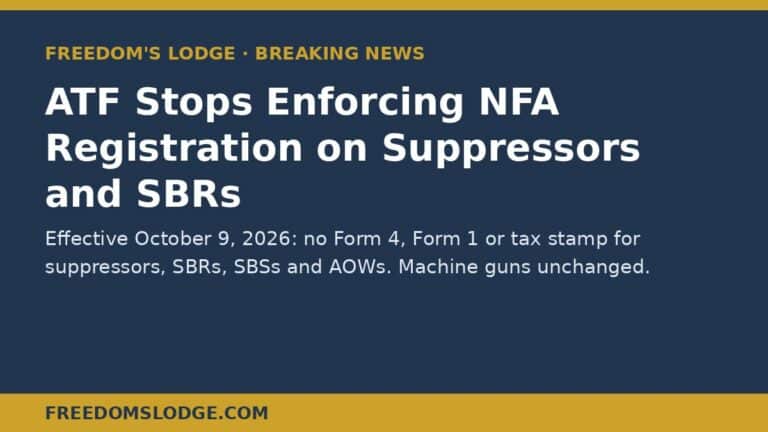
Update, October 10, 2026: On October 9, ATF stopped requiring a Form 4, Form 1, federal registration or a tax stamp for suppressors, SBRs, SBSs and AOWs, for everyone nationwide. State law still applies. What ATF’s October 9 guidance changes.
Suppressor ownership in America has carried a price tag since 1934, when the federal tax on a suppressor was set at $200 — the same year the average American worker earned roughly $1,600. Adjusted for inflation, that tax has hovered near the price of a used car for nine decades. On January 1, 2026, it dropped to zero.
That single line in federal law did more for hearing-safe shooting than any marketing campaign ever could. And it raises a question the gun-rights movement should be asking out loud: if the barrier just fell, what do we build in its place?

What changed for suppressor ownership on January 1, 2026?
The One Big Beautiful Bill Act — H.R. 1 of the 119th Congress, signed in 2025 — eliminated the $200 National Firearms Act transfer and making tax on suppressors, short-barreled rifles, short-barreled shotguns, and Any Other Weapons. The change took effect January 1, 2026.
That is a real win. It is not, however, full deregulation. Suppressors remain NFA-regulated items. A lawful buyer still files an ATF Form 4, still passes a background check, and still waits for approval before taking possession.
Think of it this way: the toll booth is gone, but the road is the same road. The registry stands. The paperwork stands. What disappeared is the punitive tax that, for ninety years, treated a piece of hearing-safety equipment like a luxury good.


Why was suppressor ownership ever NFA-restricted?
Here is the part most people get wrong. Suppressors were not regulated because anyone studied them and found them dangerous. They were swept into the National Firearms Act of 1934 alongside machine guns and sawed-off shotguns during a Depression-era panic over organized crime.
According to the historical record, lawmakers of that era worried about poachers taking game quietly and criminals firing undetected. There was no hearing-health debate, no acoustic data, no testing regimen. A muffler for a rifle was lumped in with a Tommy gun and taxed accordingly.
Strip away the 1934 framing and a suppressor is what engineers always knew it was: a device that captures expanding gas and lowers the sound signature of a gunshot. It is closer to a car muffler than to anything fearsome. The law simply never caught up to the physics.
Is suppressor ownership really about hearing protection?
Yes — and that is the heart of why this matters to a rights-and-health audience. An unsuppressed centerfire rifle produces a muzzle blast in the 160-decibel range. Permanent hearing damage begins around 140 decibels. A single unprotected shot can cause lasting injury.
Foam plugs and earmuffs help, but they come off in the field, they muffle range commands, and they cut a hunter off from the sounds that keep him safe and aware. A suppressor works at the source. It does not eliminate the report — Hollywood lied about that — but a quality suppressor pulls 20 to 30 decibels off the top, moving a rifle out of the instant-injury zone.
That reframes the entire conversation. Hearing loss is cumulative and irreversible. A tool that prevents it is not a toy and not a threat. It is preventive health equipment that happens to be threaded onto a barrel. The 2A movement should say so plainly, because the opposition will not.
For a fuller look at how the regulatory ground shifted this year, our colleagues covered the practical fallout in what happened after the $200 stamp died.
The legislation reshaping suppressor ownership: HR 404 and HR 3228
Killing the tax was step one. Two bills in the 119th Congress aim to finish the job by removing suppressors from the NFA entirely.
- H.R. 404 — the Hearing Protection Act: Amends the Internal Revenue Code to strike silencers from the federal definition of “firearm,” which would lift them out of NFA registration and treat them like an ordinary firearms accessory at point of sale.
- H.R. 3228 — the Constitutional Hearing Protection Act: Introduced by Rep. Andrew Clyde of Georgia, it likewise removes silencers from NFA regulation and from the IRC firearm definition, with language framed around constitutional grounds.
Both bills pursue the same destination: a world where buying a suppressor looks like buying a scope. Neither has crossed the finish line as of this writing. The tax repeal proved the political coalition exists. These two bills are the test of whether that coalition can convert a budget-reconciliation win into permanent, standalone law.
This is where the movement’s next move lives. Reconciliation is a blunt instrument that runs once a cycle. Standalone deregulation is durable. If you want suppressors permanently out of the NFA, H.R. 404 and H.R. 3228 are the vehicles, and they move on constituent pressure — calls, letters, and a clear public record of where members stand.
Where the courts stand on suppressor ownership while Congress moves
Legislation is one front in the fight over suppressor ownership. Litigation is the other. With the $200 tax now at zero, a long-running legal question moves into sharper focus: if the NFA’s constitutional footing always rested on Congress’s power to tax, what holds the registration scheme up once the tax is gone?
That argument is working its way through the federal courts, and we have tracked it in our reporting on the NFA registration challenge after the tax repeal. The short version: a registry created as a tax-collection mechanism faces a real question once there is no tax to collect. Congress and the courts may well arrive at the same place from opposite directions.
The same dynamic is reshaping short-barreled rifles. If you own or are considering an SBR, the 2026 landscape changed there too — see our breakdown of SBR ownership under the new NFA rules.
How does a 100-day giveaway fit into a rights conversation?
Policy wins are abstract until suppressor ownership reaches a lawful owner’s hands. That is the practical gap a campaign like Silencer Central’s 100 Days of Silence is built to close.
The campaign, hosted at PopularSuppressors.com, awards a suppressor every day for 100 consecutive days. It is a straightforward proposition: each day, one lawful, eligible entrant can win a quality suppressor without paying retail — and, now, without the tax that used to sit on top of it.
Today’s prize, the Day 35 award for Thursday, May 21, 2026, is the BANISH VRMT 223 SS from BANISH Suppressors. Full details on the prize and entry are in the official Day 35 giveaway article.
One clarification worth making, because accuracy matters on this beat: BANISH Suppressors and Silencer Central are independent companies. Silencer Central anchors the campaign as its sponsor; the BANISH VRMT 223 SS is BANISH’s product. We keep those straight.
BANISH VRMT 223 SS — the prize, by the numbers
The BANISH VRMT 223 SS is a centerfire suppressor built for the 5.56 and .223 crowd — predator hunters, varmint shooters, and anyone running a .223 bolt gun or AR who wants the muzzle blast tamed.
| Specification | BANISH VRMT 223 SS |
|---|---|
| MSRP | $579 |
| Calibers | 5.56 NATO / .223 Remington |
| Length | 5.96 in |
| Diameter | 1.61 in |
| Weight | 13.0 oz |
| Material | 17-4 PH stainless steel |
| Baffles | 6 laser-welded baffles |
| Mount | HUB (1.375×24), ships with 1/2×28 direct-thread adapter |
| Sound reduction | ~25 dB average (~130.4 dB at the muzzle, 20″ .223 bolt gun) |
| Full-auto rated | No |
The numbers tell the hearing-safety story cleanly. A roughly 25-decibel average reduction takes a centerfire .223 from the instant-injury zone down toward a level the human ear can tolerate without permanent loss. The 17-4 PH stainless construction and laser-welded baffles speak to durability; the HUB mount keeps it future-proof across hosts. It is not full-auto rated — a fact worth knowing before mounting it on a select-fire host.

Who can enter, and what the campaign does not promise
A giveaway is not a loophole, and we will not pretend otherwise. The 100 Days of Silence has clear eligibility rules. Entrants must be 21 or older and U.S. residents. The promotion is void in New York, Florida, California, and Rhode Island, and in states where suppressor ownership is prohibited.
Winning does not bypass federal law. Any prize suppressor still transfers through a licensed dealer and still requires ATF approval before the winner takes possession. The tax is gone; the process is not. That is the honest frame, and it is the right one.
Suppressor ownership: what the 2A movement should do next
The tax repeal is a milestone for suppressor ownership, not a destination. Three moves keep the momentum honest and durable.
- Push the standalone bills. A reconciliation win can be unwound by the next reconciliation bill. H.R. 404 and H.R. 3228 make deregulation permanent. Constituent pressure is the fuel.
- Win the language war. Every time a suppressor is called a “silencer” in a thriller, the public picture drifts further from the physics. Hearing protection is accurate. Use it.
- Put suppressors in lawful hands. Ownership normalizes ownership. A neighbor who shoots suppressed at the range is the most persuasive argument the movement has — more persuasive than any op-ed.
The BANISH VRMT 223 SS giveaway is a small, concrete version of that third point: one more lawful owner, one more quieter rifle, one more person who can speak from experience instead of fear.
Frequently asked questions
Do I still need a tax stamp to buy a suppressor in 2026?
The $200 federal transfer tax on suppressors was eliminated effective January 1, 2026, under the One Big Beautiful Bill Act. You no longer pay that tax. However, suppressors remain NFA-regulated. You still file an ATF Form 4, pass a background check, and wait for approval before you can take possession.
Are suppressors legal to own?
Suppressors are legal to own in the large majority of U.S. states for residents who pass a federal background check and complete the ATF transfer process. A handful of states prohibit civilian ownership. Always confirm your own state’s law before purchasing, because federal eligibility does not override a state ban.
What does the Hearing Protection Act actually do?
H.R. 404, the Hearing Protection Act, would amend the Internal Revenue Code to remove silencers from the federal definition of “firearm.” That change would lift suppressors out of National Firearms Act registration entirely, allowing them to be sold like a standard firearms accessory. As of this writing, the bill has not become law.
How much hearing protection does a suppressor provide?
A quality centerfire suppressor typically reduces the report of a gunshot by 20 to 30 decibels. The BANISH VRMT 223 SS averages roughly 25 decibels of reduction. That moves a centerfire rifle from the immediate-hearing-damage range toward a level the ear can tolerate, though shooters should still treat any gunfire with care.
What is the BANISH VRMT 223 SS?
The BANISH VRMT 223 SS is a stainless-steel suppressor from BANISH Suppressors built for 5.56 NATO and .223 Remington. It measures 5.96 inches, weighs 13.0 ounces, uses six laser-welded baffles, and carries a $579 MSRP. It ships with a HUB mount and a 1/2×28 direct-thread adapter. It is not full-auto rated.
Will suppressors ever come off the NFA registry completely?
That depends on Congress and the courts. H.R. 404 and H.R. 3228 would remove suppressors from NFA regulation by statute. Separately, litigation argues the registry’s legal basis weakens now that the underlying tax is zero. Neither path has concluded, but both are active in the 119th Congress and the federal courts.
Hearing loss does not announce itself. It arrives one unprotected shot at a time, and it never leaves. For ninety years, the law taxed the cure. This year, the toll booth came down — and the only question left is how fast the rest of the road clears.


Reader Favorites
- Virginia’s Gun-Hating Governor vs. Virginia
- Los Angeles Gun-Grabbers Confused, Terrified by Bill of Rights
- Why Do Anti-Gunners Love Red Flag Laws So Much?
- Gun Companies Fight to End COVID-19; Gun Grabbers Fight to End THEM
- Sunshine State Showdown: “No Guns Under 21” Law Challenge Moves Forward
- Guns at Coronavirus Quarantine Protests: Listen For the Loudest Scream
Gun-owner reference desk
Plain-English references worth bookmarking — NFA rules, carry law, and the gear terms behind every review.
| 2026 at a glance | |
|---|---|
| NFA tax stamp | $0 |
| Permitless carry | 29 states |
| Suppressors legal | 42 states |
50+ NFA, carry and gun-law terms in plain English, updated for 2026.
Open the glossary → Network| Term | Category |
|---|---|
| Striker-fired | Action |
| MOA | Optics |
| Twist rate | Ballistics |
30 gun, ammo and optics terms, from Guns & Gadgets Daily.
View full chart →