Constitutional Carry States: All 29, With the Minimum Age
Twenty-nine states are constitutional carry states, where a law-abiding adult can carry a concealed handgun with no permit at all. The other twenty-one, plus the District of Columbia, still make you get one first.
Last updated: September 16, 2026 · Originally published June 25, 2026
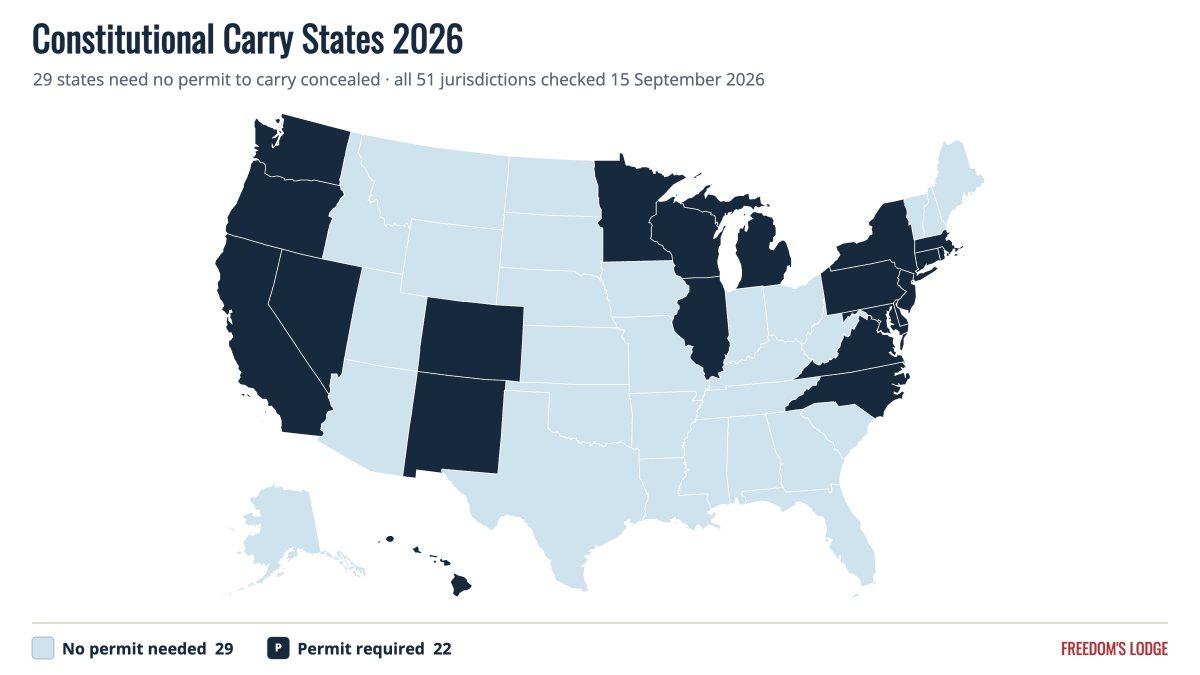
Data updated September 2026. All 51 jurisdictions read against their own statute or state police page on 15 September 2026.
Twenty-nine states are constitutional carry states as of 15 September 2026, and that number has not moved since Louisiana joined on 4 July 2024. What HAS moved, and what almost every list still gets wrong, is how old you have to be. West Virginia dropped to 18 on 12 June 2026. Wyoming dropped to 18 on 1 July 2026. Iowa dropped to 18 the summer before that. If a page tells you those three are 21, it was written before the ink dried.
Now, plenty of people read constitutional carry as carry anywhere, and that is where they get themselves in trouble. Only three of the 29 let you onto a public university campus without a permit. Arizona will let an 18-year-old carry openly and charge that same 18-year-old for carrying concealed. Pick your state and read the rule you are going to be standing in.
Pick a layer, then click a state. Every answer here is also printed as plain text further down the page.
Do you need a permit to carry concealed
- No permit needed 29
- Permit required 22
Where the country stands today
29 states let a qualifying adult carry a concealed handgun with no permit. The other 22 jurisdictions, including the District of Columbia, still require one.
- Youngest age
- 18 in 15 of the 29 states, 19 in 2, 21 in 12
- Loaded handgun in your own car
- No permit needed in 26 of the 29; 3 attach a condition
- Public university campus
- Open without a permit in only 3 of the 29
- Changed in 2026
- 8 of the 29 states
Pick a state on the map, or choose one above, for its own rules. Checked 15 September 2026.
The credit paragraph sits in your own page’s HTML, outside the frame, so readers and search engines can both see it.
What the constitutional carry states actually let you do
All 29 constitutional carry states show green here; red means the state still requires a permit. The age column is the youngest you can carry WITHOUT a permit, which in several states is not the permit age.
Concealed carry without a permit, by jurisdiction, checked 15 September 2026. Freedom’s Lodge. Swipe the table sideways for every column.
| Jurisdiction | Permit needed to carry concealed | Youngest age without a permit | Loaded handgun in your own car | Public university campus | Statute, and the official page |
|---|---|---|---|---|---|
| Alabama | No | 19 | Allowed, no permit | Each institution decides | Ala. Code 13A-11-74.1 |
| Alaska | No | 21 | Allowed, no permit | Locked vehicle only | Alaska Stat. 11.61.220 |
| Arizona | No | 21 | Allowed, no permit | Locked vehicle only | Ariz. Rev. Stat. 13-3102 |
| Arkansas | No | 18 | Allowed, no permit | Permit holders only | Ark. Code 5-73-119 |
| California | Yes | not available | Permit required | Permit holders only | Cal. Penal Code 25400 |
| Colorado | Yes | not available | Permit required | Permit holders only | C.R.S. 18-12-203 |
| Connecticut | Yes | not available | Permit required | Permit holders only | Conn. Gen. Stat. 29-28 |
| Delaware | Yes | not available | Permit required | Permit holders only | Del. Code tit. 11 |
| District of Columbia | Yes | not available | Permit required | Permit holders only | D.C. Code 22-4506 |
| Florida | No | 21 | Allowed at 21 and over; 18 to 20 must keep it encased | Prohibited | Fla. Stat. 790.01 |
| Georgia | No | 21 | Allowed, no permit | Allowed, no permit | O.C.G.A. 16-11-125.1 |
| Hawaii | Yes | not available | Permit required | Permit holders only | Haw. Rev. Stat. 134-9 |
| Idaho | No | 18 | Allowed, no permit | Permit holders only | Idaho Code 18-3302 |
| Illinois | Yes | not available | Permit required | Permit holders only | 430 ILCS 66 |
| Indiana | No | 18 | Allowed, no permit | Each institution decides | Ind. Code 35-47-2-1.5 |
| Iowa | No | 18 | Allowed, no permit | Prohibited | Iowa Code 724.4 |
| Kansas | No | 21 | Allowed, no permit | Allowed, no permit | K.S.A. 21-6302 |
| Kentucky | No | 21 | Allowed, no permit | Each institution decides | KRS 237.109 |
| Louisiana | No | 18 | Allowed, no permit | Prohibited | La. R.S. 14:95(M) |
| Maine | No | 21 | Allowed, no permit | Each institution decides | 25 M.R.S. 2001-A |
| Maryland | Yes | not available | Permit required | Permit holders only | Md. Code |
| Massachusetts | Yes | not available | Permit required | Permit holders only | Mass. Gen. Laws ch. 140 |
| Michigan | Yes | not available | Permit required | Permit holders only | Mich. Comp. Laws 28.425f |
| Minnesota | Yes | not available | Permit required | Permit holders only | Minn. Stat. 624.714 |
| Mississippi | No | 18 | Allowed, no permit | Permit holders only | Miss. Code 97-37-1 |
| Missouri | No | 19 | Allowed, no permit | Each institution decides | RSMo 571.030 |
| Montana | No | 18 | Allowed, no permit | Prohibited | Mont. Code Ann. 45-8-316 |
| Nebraska | No | 21 | Allowed, no permit | Locked vehicle only | Neb. Rev. Stat. 28-1201 |
| Nevada | Yes | not available | Permit required | Permit holders only | Nev. Rev. Stat. 202.3657 |
| New Hampshire | No | 18 | Allowed, no permit | Each institution decides | RSA 159:6 |
| New Jersey | Yes | not available | Permit required | Permit holders only | N.J.S.A. 2C:58-4 |
| New Mexico | Yes | not available | Permit required | Permit holders only | N.M. Stat. 29-19-4 |
| New York | Yes | not available | Permit required | Permit holders only | N.Y. Penal Law 400.00 |
| North Carolina | Yes | not available | Permit required | Permit holders only | N.C. Gen. Stat. 14-415.11 |
| North Dakota | No | 18 | Allowed, no permit | Locked vehicle only | N.D.C.C. 62.1-04-02 |
| Ohio | No | 21 | Allowed, no permit | Locked vehicle only | Ohio Rev. Code 2923.111 |
| Oklahoma | No | 21 | Allowed at 21 and over; 18 to 20 must keep it unloaded | Locked vehicle only | Okla. Stat. tit. 21 |
| Oregon | Yes | not available | Permit required | Permit holders only | Or. Rev. Stat. 166.291 |
| Pennsylvania | Yes | not available | Permit required | Permit holders only | 18 Pa.C.S. 6106 |
| Rhode Island | Yes | not available | Permit required | Permit holders only | R.I. Gen. Laws 11-47-11 |
| South Carolina | No | 18 | Allowed, no permit | Locked vehicle only | S.C. Code 16-23-20 |
| South Dakota | No | 18 | Allowed, no permit | Permit holders only | SDCL 23-7-7 |
| Tennessee | No | 21 | Allowed, no permit | Locked vehicle only | Tenn. Code Ann. 39-17-1307(g) |
| Texas | No | 18 | Allowed, no permit | Permit holders only | Tex. Penal Code 46.02 |
| Utah | No | 21 | Allowed, no permit; long guns must be unloaded | Allowed, no permit | Utah Code 76-11-202 |
| Vermont | No | 18 | Allowed, no permit | Each institution decides | 13 V.S.A. 4003 |
| Virginia | Yes | not available | Permit required | Permit holders only | Va. Code 18.2-308.02 |
| Washington | Yes | not available | Permit required | Permit holders only | Rev. Code Wash. 9.41.050 |
| West Virginia | No | 18 | Allowed, no permit | Permit holders only | W. Va. Code 61-7-7(c) |
| Wisconsin | Yes | not available | Permit required | Permit holders only | Wis. Stat. 175.60 |
| Wyoming | No | 18 | Allowed, no permit | Permit holders only | Wyo. Stat. Ann. 6-8-104 |

How old you have to be, across all 29
Here is the number worth quoting: of the 29 constitutional carry states, 15 let an 18-year-old carry concealed, 2 set the line at 19, and 12 hold it at 21. Three of those 15 arrived in the last fifteen months.
Youngest age to carry a concealed handgun with no permit, across the 29 constitutional carry states, checked 15 September 2026. Corrected 16 September 2026: Tennessee is 21, not 18 — the 2025 statute lowered that state’s permit age, not its permitless age. Freedom’s Lodge. Swipe the table sideways for every column.
| Youngest age | How many states | Which ones |
|---|---|---|
| 18 | 15 | Arkansas, Idaho, Indiana, Iowa, Louisiana, Mississippi, Montana, New Hampshire, North Dakota, South Carolina, South Dakota, Texas, Vermont, West Virginia, Wyoming |
| 19 | 2 | Alabama, Missouri |
| 21 | 12 | Alaska, Arizona, Florida, Georgia, Kansas, Kentucky, Maine, Nebraska, Ohio, Oklahoma, Tennessee, Utah |
| All ages | 29 | Median age across the 29 states: 18 |
What changed for constitutional carry states in 2026
Three states moved this year and none of them added a state to the list. The near misses matter too, because one is a single vote away.
Constitutional carry changes and near misses in 2026. Freedom’s Lodge. Swipe the table sideways for every column.
| State | When | Bill | What it did |
|---|---|---|---|
| Utah | 6 May 2026 | HB 84 | No permit needed to carry concealed at a public college. Open carry there was barred. |
| West Virginia | 12 June 2026 | HB 4106 | Youngest age dropped from 21 to 18. A license is still needed on a public campus. |
| Wyoming | 1 July 2026 | HB 96 | Youngest age dropped from 21 to 18, for permit and permitless carry alike. |
| Kentucky | 14 April 2026 | HB 312 | A new license for 18 to 20-year-olds, passed over a veto. The permitless age stays 21. |
| North Carolina | still pending | SB 50 | Passed both chambers, vetoed, Senate overrode. The House has calendared its own override vote eleven times without holding it. |
| Pennsylvania | did not pass | SB 357 | Tabled 25 June 2026. |
| Wisconsin | did not pass | AB 609 | Died 23 March 2026. |
| Michigan | did not pass | HB 5653 to 5657 | No hearing. |
How I counted the constitutional carry states
A state joins the constitutional carry states if its own law lets an ordinary adult who is not otherwise barred from owning a gun carry a CONCEALED handgun in public without applying for anything. That is the whole test. Open carry is a separate question and a more permissive one in a lot of places, which is why I keep it on its own map.
Two states get on the list by an odd route. Mississippi never passed a permitless carry law; it redefined what counts as concealed, so a handgun in a holster or a purse needs no license. Vermont never had a permit system to repeal. Both belong, because the answer at the roadside is the same.
Worked by hand, so you can check it: 15 states at 18, plus Alabama and Missouri at 19, plus 12 states at 21. 15 plus 2 is 17. 17 plus 12 is 29. Add the 21 permit-required states and the District of Columbia and you get 51 jurisdictions, which is every state plus D.C.
Questions people ask about constitutional carry states
Which states are constitutional carry?
Twenty-nine: Alabama, Alaska, Arizona, Arkansas, Florida, Georgia, Idaho, Indiana, Iowa, Kansas, Kentucky, Louisiana, Maine, Mississippi, Missouri, Montana, Nebraska, New Hampshire, North Dakota, Ohio, Oklahoma, South Carolina, South Dakota, Tennessee, Texas, Utah, Vermont, West Virginia and Wyoming.
Can I carry my firearm in all 50 states?
No. Twenty-one states and the District of Columbia require a permit, and a permit from your home state only works in another state if that state has agreed to recognize it. Vermont is the odd one out in the other direction: it issues no permits at all, so Vermonters carrying at home have nothing to show a state that wants to see a permit.
What states allow you to carry a gun without a license?
The same 29. Do not read that as no rules. Every one of them still bars carrying while prohibited, and 26 of the 29 restrict a public university campus in some way.
Does constitutional carry mean I do not need a permit at all?
Not quite. A permit still buys you recognition when you drive into a permit state, access to places the permitless are kept out of, and in seven of the 29 it is the only way onto a public campus.
Is my state about to become the 30th?
North Carolina is the closest. Senate Bill 50 passed both chambers, the Governor vetoed it on 20 June 2025 and the Senate overrode that veto on 29 July 2025. The House has put the override on its calendar eleven times and pulled it every time, so as of today it is still not law. Pennsylvania, Michigan and Wisconsin all had bills die this year.
Take the age column if you take nothing else. It moved under people’s feet this year, and it is the one that gets a twenty-year-old arrested on a road trip. Check the statute for the state you are standing in.
James Nicholas writes the firearms coverage on Freedom’s Lodge. This page is a plain-language summary of published law, not legal advice, and it is not a substitute for reading your own state’s statute or asking a lawyer licensed there.

Reader Favorites
- Virginia’s Gun-Hating Governor vs. Virginia
- Los Angeles Gun-Grabbers Confused, Terrified by Bill of Rights
- Why Do Anti-Gunners Love Red Flag Laws So Much?
- Gun Companies Fight to End COVID-19; Gun Grabbers Fight to End THEM
- Sunshine State Showdown: “No Guns Under 21” Law Challenge Moves Forward
- Guns at Coronavirus Quarantine Protests: Listen For the Loudest Scream
Gun-owner reference desk
Plain-English references worth bookmarking — NFA rules, carry law, and the gear terms behind every review.
| 2026 at a glance | |
|---|---|
| NFA tax stamp | $0 |
| Permitless carry | 29 states |
| Suppressors legal | 42 states |
50+ NFA, carry and gun-law terms in plain English, updated for 2026.
Open the glossary → Network| Term | Category |
|---|---|
| Striker-fired | Action |
| MOA | Optics |
| Twist rate | Ballistics |
30 gun, ammo and optics terms, from Guns & Gadgets Daily.
View full chart →