
NFA Unconstitutional: Jensen v. ATF Ends 91-Year Gun Tax
Quick Answer
Last updated: October 10, 2026 · Originally published November 13, 2025
The National Firearms Act (NFA) has not been struck down — it is still the law, and suppressors and short-barreled rifles still require ATF registration. Its legal footing is under attack in Jensen v. ATF, a federal lawsuit in the Northern District of Texas backed by the NRA, Second Amendment Foundation, Firearms Policy Coalition, and American Suppressor Association. After the One Big Beautiful Bill zeroed out the NFA transfer tax on January 1, 2026, the plaintiffs argue Congress can no longer justify the registration scheme as a “tax.” As of early 2026 the case is still being litigated and undecided.
Is the NFA unconstitutional? Key questions
Is the NFA unconstitutional?
No court has ruled it unconstitutional, so the NFA remains in force. Jensen v. ATF asks a federal court in Texas to strike down its registration requirements, but the case is undecided as of 2026 and the U.S. Department of Justice is defending the statute.
What is Jensen v. ATF?
It is a 2025 federal lawsuit in the U.S. District Court for the Northern District of Texas, backed by the American Suppressor Association, NRA, Second Amendment Foundation, and Firearms Policy Coalition, arguing the NFA exceeds Congress’s enumerated powers and violates the Second Amendment.
How did the One Big Beautiful Bill change the NFA?
It eliminated the NFA making and transfer tax — long set at $200 — on suppressors, short-barreled rifles and shotguns, and “any other weapons,” effective January 1, 2026. The registration and ATF-approval requirements were left in place, which is the crux of the new legal challenge.
Do I still have to register a suppressor or SBR?
Yes. Even with the tax at $0, the NFA’s registration and ATF approval process remains in effect while the courts consider Jensen v. ATF. The requirements for lawful ownership have not changed yet.


NFA Unconstitutional: Jensen v. ATF Ends 91-Year Gun Tax

The NFA lawsuit gun owners had been waiting on has been decided. In Jensen v. ATF, consolidated with Silencer Shop Foundation v. ATF, a federal judge in Texas held that the National Firearms Act’s registration requirements for suppressors and short-barreled rifles (SBRs) cannot rest on the taxing power now that the One Big Beautiful Bill Act has set the transfer tax to zero.
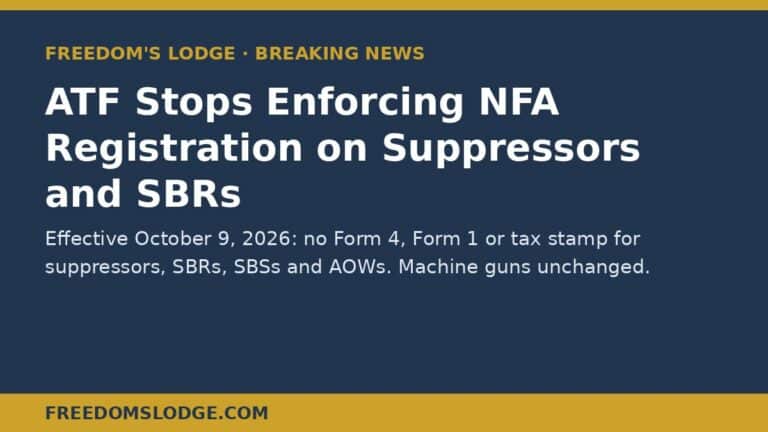
Update, October 10, 2026: On October 9, ATF stopped requiring a Form 4, Form 1, federal registration or a tax stamp for suppressors, SBRs, SBSs and AOWs, for everyone nationwide. State law still applies. What ATF’s October 9 guidance changes.
What that changes, and for whom, is narrower than most of the coverage suggests. The order binds ATF as to the plaintiffs, their members and the customers of the plaintiff businesses — not every gun owner in the country. The statute is still on the books, the dealer background check still applies, and every state ban is untouched. Born in the gang-ridden 1930s, the NFA’s tax facade has cracked. Cracked is not gone.
From Prohibition-era deceptions to Bruen’s historical hammer, we’ll explore the NFA’s flawed foundations, the surge of allied lawsuits, real-world impacts on Americans, and a clear roadmap to repeal. If you’re battling NFA red tape, this is your blueprint for freedom.
Update (August 17, 2026): The court has ruled, and the injunction is now in effect. On August 5, 2026, Judge Wesley Hendrix (N.D. Tex.) ruled that NFA registration requirements for suppressors, short-barreled rifles, and short-barreled shotguns exceed Congress’s constitutional authority now that the transfer tax on them has been zeroed out. The government did not file a stay within the court’s one-week deadline, so the injunction took effect August 13, 2026.
This is not a nationwide repeal of the NFA. Coverage is limited to: named plaintiffs in the consolidated Jensen v. ATF and Silencer Shop Foundation v. ATF cases; members of the Texas State Rifle Association, Citizens Committee for the Right to Keep and Bear Arms, FPC Action Foundation, and several other named plaintiff organizations; and customers of the named plaintiff businesses (including Silencer Shop and Hot Shots Custom). Machine guns, destructive devices, and other NFA items are untouched. As of this writing the Department of Justice has not filed an appeal, but still has weeks left to do so, and the injunction could be stayed or dissolved with little notice. If you want the clearest path to coverage, joint membership with a covered organization (TSRA/NRA offers one option) is worth looking into — talk to your FFL and consult an attorney before relying on this for a specific transaction.
NFA’s Unconstitutionality Traced to Prohibition: A History of Deceptive Gun Control
The NFA’s story begins in the shadowed alleys of 1930s America, where bootleggers and mobsters wielded machine guns like Al Capone’s infamous Thompson submachine guns during the 1929 St. Valentine’s Day Massacre. Seven men gunned down in cold blood ignited public fury, pressuring Congress to act without directly assaulting the Second Amendment.
Enter the workaround: On June 26, 1934, President Franklin D. Roosevelt signed the National Firearms Act, imposing a prohibitive $200 transfer tax—equivalent to about $4,500 in today’s dollars—on “gangster weapons” including short-barreled rifles (SBRs), short-barreled shotguns (SBSs), suppressors (derisively called “silencers”), machine guns, and destructive devices. Registration was pitched as a mere tax-collection tool, but it was always about control.
Surprisingly, the NRA endorsed early drafts, viewing it as a narrow anti-crime measure. The Supreme Court upheld it in United States v. Miller (1939), ruling it targeted arms not “typically possessed by law-abiding citizens for lawful purposes.” But that era’s collective rights theory has since been demolished by District of Columbia v. Heller (2008) and McDonald v. Chicago (2010), affirming individual rights to self-defense arms.
Over decades, the NFA ballooned into a regulatory monster. By the 1960s, amid rising crime fears, it expanded under the Gun Control Act of 1968. Today the registry is far bigger than most people picture. ATF’s own NFRTR figures put the total at 6,957,598 registered NFA items as of 28 February 2026, of which 5,595,651 were silencers — just over 80 percent of everything in the registry — and silencers alone passed 6.6 million by 4 August 2026. Wait times have gone the other way since the tax hit zero; our running tracker of ATF approval times carries the current numbers rather than a figure that goes stale in a month. This evolution reveals the NFA unconstitutional at its core: a perpetual infringement dressed as fiscal policy.
“The NFA was never about revenue—it was a backdoor to disarmament, now laid bare as unconstitutional.” – Legal scholars post-Bruen analysis
Why the NFA is Unconstitutional: Bruen’s Historical Test Exposes Flaws
The Supreme Court’s 2022 New York State Rifle & Pistol Association v. Bruen decision revolutionized Second Amendment jurisprudence, discarding subjective “balancing tests” for a rigorous historical tradition analogue. Gun laws must now echo regulations from 1791 (ratification) or 1868 (14th Amendment)—or they’re toast.
Applying Bruen to the NFA? It’s a mismatch. Suppressors, far from criminal tools, safeguard hearing for 40 million annual hunters and range users. SBRs provide compact home defense, akin to colonial pistols. No Founding-era evidence exists for taxing or registering such “bearable arms”—a fatal flaw rendering the NFA unconstitutional.
Pre-Bruen challenges faltered under intermediate scrutiny, but post-Bruen, courts have invalidated “may-issue” licensing and magazine bans in over 1,000 rulings. Legal experts predict the NFA’s demise: “It will likely not survive” this standard, as one Missouri Law Review article asserts, lacking any 18th-century tax on self-defense tools.
Compounding this, OBBBA (signed July 4, 2025) eliminated the $200 tax on suppressors, SBRs, SBSs, and any other weapons (AOWs), effective January 1, 2026. Without its taxing power pretext (Article I, Section 8), the registration regime is a naked Second Amendment assault. As FPC President Brandon Combs warns: “The illusion of legitimacy is shattered—control, not safety, was always the game.”
- No Historical Precedent: Bruen requires analogues; colonial laws taxed imports, not personal arms.
- Tax Facade Crumbles: OBBBA strips the revenue cover, exposing pure regulation.
- Individual Rights Ignored: Post-Heller, the NFA’s collective focus is obsolete.
- Broad Infringement: Delays and fees turn presumptive rights into privileges.
Inside the NFA Lawsuit: How Jensen v. ATF Was Argued and Won
The floodgates opened November 12, 2025, when Jensen v. ATF plaintiffs—Firearms Policy Coalition (FPC), Citizens Committee for the Right to Keep and Bear Arms (CCRKBA), Texas State Rifle Association (TSRA), and individuals like John Jensen—filed for summary judgment in U.S. District Court, Northern District of Texas (Amarillo Division). Attorneys from Cooper & Kirk and Cooper & Scully demand permanent injunctions against NFA enforcement on tax-free items.
CCRKBA Chairman Alan Gottlieb: “The time has come to eliminate these previously-taxed items from NFA regulation—their unconstitutionality is plain under Bruen.” This joins a barrage: Second Amendment Foundation (SAF) filed its motion the same day; NRA launched a parallel suit October 9, 2025; and Gun Owners of America (GOA) pressed summary judgment by November 6.
These cases argue the NFA exceeds Congress’s enumerated powers, violating both taxing authority and the Second Amendment. Separately, ATF has proposed easing the paperwork itself. Removing CLEO Notification Under the National Firearms Act (RIN 1140-AA65) would drop the requirement to notify your chief law enforcement officer. It was published 6 May 2026, its comment period closed 6 July 2026 after 282 comments, and it is still a proposal, not a final rule. Do not plan around it yet.
NFA Unconstitutionality in Numbers: Real Impacts on Gun Owners
- 3.5M+ registered items, but 90% are suppressors—peaceful tools, not threats.
- Average wait: 26 days eForm, up to 91 days paper; OBBBA cuts taxes but not delays.
- Cost to owners: $10M+ annually in fees pre-OBBBA.
- Lawsuits pending: 5+ major challenges since Bruen.
For everyday Americans, the NFA unconstitutional burden means felony risks for DIY builds or family heirlooms. Hunters lose hearing protection; defenders face cumbersome long guns. Victory here restores normalcy.
Roadmap to Expose and End NFA Unconstitutionality: Timeline and Tactics
This section was written before the case was decided. Here is where the fight actually stands, updated 21 September 2026:
- District court — decided. On 5 August 2026, Judge James Wesley Hendrix (N.D. Tex.) granted summary judgment in Silencer Shop Foundation v. ATF, consolidated with Jensen v. ATF, holding that the NFA’s registration provisions cannot stand on the taxing power once the tax is zero. He entered a permanent injunction and paused it seven days. Nobody froze it, and it has been in force since 13 August 2026.
- Appeal — still not filed. As of 21 September 2026 the docket shows no notice of appeal, no motion to stay and no Fifth Circuit docket for the case. The government’s 60-day window closes in early October. Everything below this line depends on whether it files.
- Supreme Court — nothing pending. Certiorari only becomes a live question if the government appeals and the circuits end up split. There is no case on the Court’s docket today.
- Legislative. Congress already did the decisive part: the One Big Beautiful Bill Act set the making and transfer tax to $0 effective 1 January 2026, and that is what knocked the foundation out from under the registry. Rep. Eric Burlison’s NFA Repeal Act (H.R. 335) would strike what is left of it. It has not passed.
- Parallel suits still matter. The August injunction is not nationwide. It protects the plaintiffs, their members and the customers of the business plaintiffs, and nobody else. Another case is what widens it.
Beyond the courtroom the picture is messier than the cheering suggests, and it is worth getting right. Only two amicus briefs were filed in this case, and both argued against the gun owners — one from the cities of Baltimore and Columbus together with Harris County, Texas, and one from the Brady Center, Everytown and Giffords. Texas is in the case, but as a plaintiff: it is one of fifteen states that joined, with Alaska, Georgia, Idaho, Indiana, Kansas, Louisiana, Montana, North Dakota, Oklahoma, South Carolina, South Dakota, Utah, West Virginia and Wyoming. Florida is not a party. And on 11 September 2026, Kansas — one of the winning plaintiffs — filed a motion asking the court to clarify what its own judgment covers, with a letter from state attorneys general attached. When the states that won are asking that question, do not assume you already know the answer.
Your Role in the Fight: Comment on the ATF rulemaking that is actually open. The proposed rule on Fingerprint and Photograph Requirements for Firearms Applications (RIN 1140-AA63) was published 6 July 2026 and comments close 5 October 2026, at regulations.gov. Join FPC’s Grassroots Army at JoinFPC.org. Donate to SAF/CCRKBA legal funds. Share this deep dive—amplify the call to bury the NFA unconstitutional relic once and for all.
Broader Implications of Declaring the NFA Unconstitutional: Reshaping Gun Rights
Dismantling the NFA unconstitutional framework isn’t just about paperwork—it’s a Second Amendment renaissance. Suppressors could drop to $200 from $900+; SBR builds become weekend projects, not federal ordeals. For a current state-by-state guide on what’s legal with suppressors in 2026, Guns & Gear Daily covers the full regulatory landscape. Law enforcement gains quieter tools; civilians, safer ranges.
Yet risks loom: If courts balk, Congress must act—or face electoral backlash. Post-Bruen, 20+ states have eased carry laws; NFA repeal could inspire national reciprocity. As one Fordham scholar notes, “Bruen’s history lens demands we confront gun laws’ evolution—or scrap the unfit.”
If you are considering suppressor ownership in this new legal landscape, Popular Suppressors offers a comprehensive suppressor ownership guide to help you navigate the process.
More NFA reform: see our breakdown of the 2026 SBR rule changes.
FAQ: The NFA Court Ruling
Is the NFA gone now?
No. The August 2026 ruling struck down registration requirements specifically for suppressors, short-barreled rifles, and short-barreled shotguns. Machine guns, destructive devices, and the rest of the NFA remain in force.
Am I automatically covered by the injunction?
Only if you’re a named plaintiff, a member of one of the covered organizations (Texas State Rifle Association, Citizens Committee for the Right to Keep and Bear Arms, FPC Action Foundation, and a handful of others), or a customer of one of the named plaintiff businesses. Simply living in a plaintiff state does not by itself guarantee coverage.
Has the government appealed?
As of September 21, 2026, the Department of Justice still has not filed an appeal. There is no notice of appeal, no motion to stay and no Fifth Circuit docket for the case. Its 60-day window runs out in early October, and until that window closes the injunction could still be stayed or dissolved with little notice.
Should I stop filing Form 4s?
Talk to your FFL and an attorney before changing how you transact — dealers are still working out how to document protected-party status, and ATF has not published formal guidance yet.
Related, and decided since: on August 17, 2026 a second federal judge in the Northern District of Texas struck down a different ATF rule on constitutional grounds — the 2022 Frame or Receiver Rule was held unconstitutional and void for vagueness, though only as to Defense Distributed, the Second Amendment Foundation and SAF’s members.


Reader Favorites
- Hot Take: Viridian V-Series Long-Range Illuminators
- Officer Justifiably Shoots Good Guy: Lessons For Armed Citizens
- Honored American Veterans Afield & NSSF Raise Funds For Disabled Vets
- Be Your Own AR-15 Armorer With This Kit
- Mossberg Celebrates Century With New CCW Pistol
- CCW Central: Check Out Concealed Carry Expo this May in Pittsburgh
Gun-owner reference desk
Plain-English references worth bookmarking — NFA rules, carry law, and the gear terms behind every review.
| 2026 at a glance | |
|---|---|
| NFA tax stamp | $0 |
| Permitless carry | 29 states |
| Suppressors legal | 42 states |
50+ NFA, carry and gun-law terms in plain English, updated for 2026.
Open the glossary → Network| Term | Category |
|---|---|
| Striker-fired | Action |
| MOA | Optics |
| Twist rate | Ballistics |
30 gun, ammo and optics terms, from Guns & Gadgets Daily.
View full chart →

I really wish idiots like you would quit being so ridiculously hyperbolic & misleading. This suit does NOT make any claim that the NFA, itself, is unconstitutional. The claim is that the items that have had their taxes zeroed by the OBBB can no longer be included in the NFA because it is, after all, a tax scheme and since the registration/permission requirements (the “tax stamp”) are inextricably linked to the tax, the inclusion of untaxed items is unconstitutional. This suit would NOT end the NFA: it would still exist – fully constitutional under Supreme Court precedent – only it would, if the suit were successful, apply to just machine guns and destructive devices going forward.
Clickbait is beneath any real journalist!