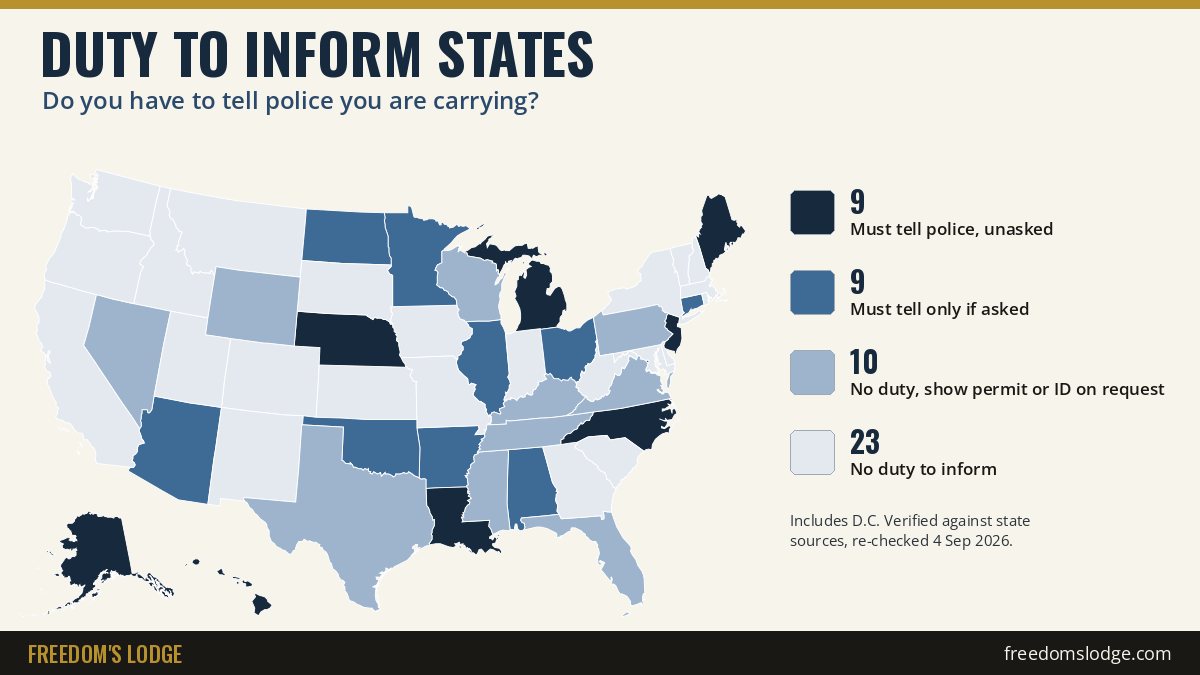
Duty to Inform States: Do You Have to Tell Police?
Duty to inform states: 9 jurisdictions make you tell police you are armed without being asked, 9 more only if asked, and 33 impose no duty.
Last updated: October 5, 2026 · Originally published October 4, 2026

Picture it: blue lights in the mirror, a pistol on your hip, and one question running through your head. Do I have to say something? As someone who professionally carries a firearm for a living and likes to travel, I can tell you the answer changes every time you cross a state line. Some states want you to speak up the second an officer walks up. Some only want the truth if they ask. Most do not require you to say a word.
The list below comes straight from the Freedom’s Lodge concealed carry reciprocity map, where every state’s rule was checked against its own statute or official source and the duty to inform wording was re-verified on 4 September 2026. Click any state for the full page with the citation.
Duty to Inform at a Glance
- Must tell unasked: 9 jurisdictions (8 states plus D.C.).
- Must tell only if asked: 9 states.
- No duty to volunteer: 33 states, but 10 of those still make you hand over your permit or ID when an officer asks.
- Watch the fine print: Maine’s duty applies only if you carry without a permit, and Michigan’s only to license holders.
What Does Duty to Inform Mean?
A duty to inform is a state law that makes you tell a police officer you are carrying a gun when the officer stops or contacts you. In the strict version you have to say it first, before anyone asks. In the softer version you only have to answer truthfully if the officer asks you. And in a lot of states there is no duty at all, although you may still have to show your permit or ID on request.
These are three different obligations, and most charts online mash them together. That is how people end up thinking Texas is a duty to inform state (it is not, for someone carrying without a license) or that Indiana has one (it does not). Let’s go through them one group at a time.


Which Duty to Inform States Make You Tell Police Without Being Asked?
These 9 jurisdictions expect you to speak first. The details matter, so read the note next to each one.
- Alaska: tell them immediately. It binds everyone carrying concealed, and “contacted” means stopped, detained, questioned or addressed for an official purpose, which is broader than a traffic stop.
- District of Columbia: tell them.
- Hawaii: disclose immediately when stopped (HRS §134-9).
- Louisiana: you must notify officers.
- Maine: tell them, but only if you are carrying without a permit (25 M.R.S. 2003-A). A permit holder does not have to speak first, only display the permit on demand.
- Michigan: license holders must disclose immediately on contact.
- Nebraska: tell them immediately, and the duty runs to emergency services personnel as well as police (28-1202.04(2)). It binds permit holders and permitless carriers alike.
- New Jersey: disclose and display when stopped (N.J.A.C. 13:54-2.2).
- North Carolina: disclose “when approached or addressed by the officer,” not only at a stop, and display your permit and ID on request. It binds permit holders.
Which States Make You Tell Only If Asked?
In these 9 states you do not have to bring it up, but you do have to answer truthfully when the officer asks.
- Alabama: only if asked, and you must answer truthfully.
- Arizona: only if asked.
- Arkansas: when asked for ID, for licensees.
- Connecticut: only if asked, and rarely. You present the permit only where the officer has reasonable suspicion of a crime and has actually seen the pistol.
- Illinois: only if asked during a stop.
- Minnesota: only if asked, and display the permit on demand.
- North Dakota: a permitless carrier must say so only “if the officer inquires” (62.1-04-04(2)), and a license holder hands the license over on request.
- Ohio: you must disclose when asked during a stop.
- Oklahoma: you must disclose when asked (21 O.S. 1290.26).
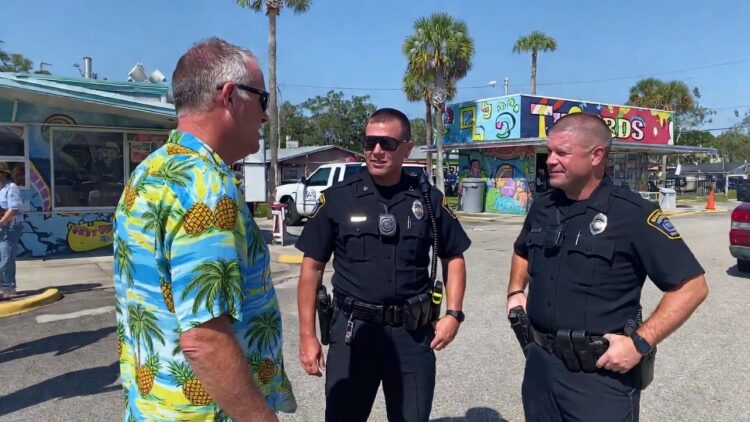
No Duty to Speak, But Show Your Permit or ID When Asked
These 10 states do not make you volunteer anything, but they do expect you to produce paperwork if an officer asks for it.
- Florida: no duty to volunteer; show ID on demand.
- Kentucky: display the license on request.
- Mississippi: display the license on demand.
- Nevada: present the permit if requested.
- Pennsylvania: produce the license on demand.
- Tennessee: display the permit on demand.
- Texas: a license holder asked for identification must hand over the license too (Gov’t Code 411.205), and the trigger is any demand for ID, not just a traffic stop. Someone carrying without a license has no duty at all.
- Virginia: display the permit and ID on demand.
- Wisconsin: display the license on request.
- Wyoming: carry your permit and ID and produce them on request.
States With No Duty to Inform
In these 23 states there is no duty to volunteer that you are armed: California (no statewide duty, though a license may impose one), Colorado, Delaware, Georgia, Idaho, Indiana, Iowa, Kansas, Maryland, Massachusetts, Missouri, Montana, New Hampshire, New Mexico, New York, Oregon, Rhode Island, South Carolina, South Dakota, Utah, Vermont, Washington and West Virginia.
Two of those deserve a note. Indiana’s weapons chapter contains no duty to inform and no duty to display at all. Maryland’s Public Safety 5-308 requires only that you carry the permit while armed and says nothing about producing it on demand.
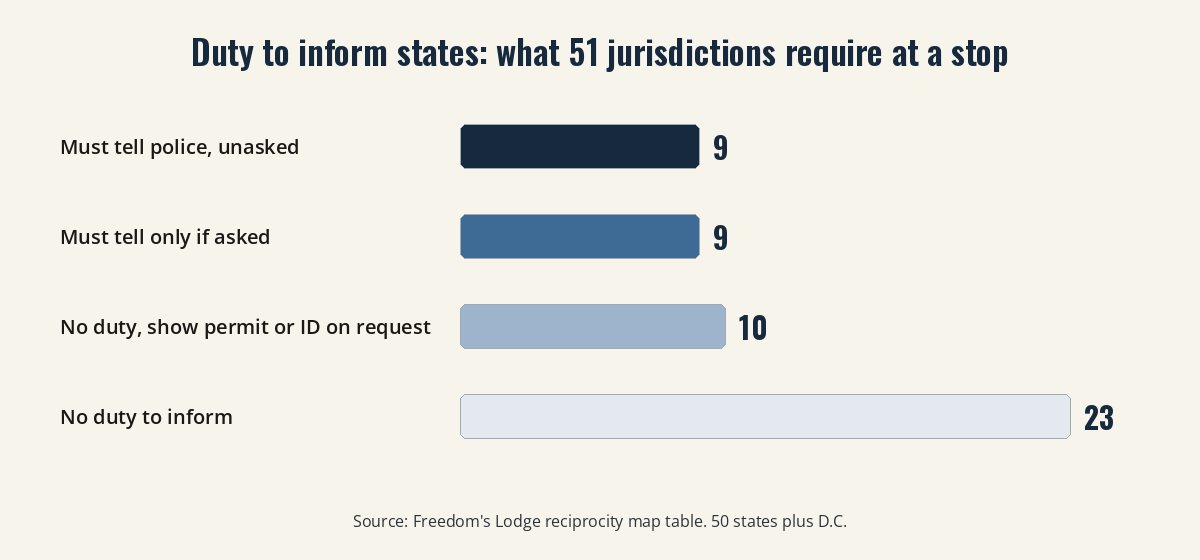
| Rule | Jurisdictions | What you do at a stop |
|---|---|---|
| Must tell unasked | 9 | Say it first, before anything else |
| Must tell if asked | 9 | Answer truthfully when asked |
| No duty, show permit or ID on request | 10 | Hand over what is requested |
| No duty | 23 | Nothing required by statute |
Counts from the Freedom’s Lodge reciprocity map table, verified against official state sources on 14 August 2026, with duty to inform re-verified 4 September 2026. Includes the District of Columbia.
What Should You Say During a Traffic Stop?
Here is my advice, and remember that the law in your state sets the floor, not the ceiling. Pull over somewhere safe, turn off the engine, turn on the dome light at night, and keep both hands on the wheel where the officer can see them. If you are in a must-tell state, say it calmly before anything else: “Officer, I want to let you know I have a permit and I am carrying. My pistol is on my right hip.” Then do exactly what you are told, and do not reach for anything, including your wallet, until the officer says so.
Remember that “I am armed” said while your hand moves toward your waistband is the worst sentence in the English language. Words first, hands still, movements slow and announced. The officer does not know you, and the goal is for everybody to go home.
In an only-if-asked or no-duty state, it is your call. Telling the officer anyway takes the surprise out of the stop, and that is worth something. What you do not do, ever, is lie when asked.
What Happens If You Do Not Inform?
The penalty depends on the state and it is set in the statute on each state’s page. Some states treat it as a minor violation, and some can put your permit at risk. Since the rules differ, the safe move is to know the rule of every state you are driving through before you leave the driveway, which is exactly what our Can I Carry There? trip checker is for.
Frequently Asked Questions
Is Florida a duty to inform state?
No. Florida has no duty to volunteer that you are carrying, but you must show ID on demand.
Is Texas a duty to inform state?
Not in the strict sense. A Texas license holder asked for identification must hand over the handgun license along with it under Gov’t Code 411.205. Someone carrying without a license has no duty at all.
Do I have to tell police I have a gun in my car?
Only where the state’s duty covers it. In the 9 must-tell jurisdictions you speak first, and in the 9 only-if-asked states you answer truthfully. Check the state page for how that state treats a gun in the vehicle.
Does duty to inform apply to open carry?
That comes down to how each statute is written, and several states tie the duty to concealed carry or to a license. Alaska’s, for example, binds everyone carrying concealed. Read the state page before you assume either way.
Know the rule before the blue lights, not after. If you want the whole trip checked in one place, start with our concealed carry by state guide, and if you are shopping for insurance to go with your permit, the CCW insurance guide lays out the options. Still sorting out how you carry? Popular EDC has a good rundown of appendix carry holsters. Have safe and legal travels.
Sources: Freedom’s Lodge concealed carry reciprocity map and its CC BY dataset (each state row cites the state’s own statute or agency); Alaska, Hawaii (HRS §134-9), Maine (25 M.R.S. 2003-A), Nebraska (28-1202.04), New Jersey (N.J.A.C. 13:54-2.2), North Dakota (62.1-04-04), Oklahoma (21 O.S. 1290.26), Texas (Gov’t Code 411.205), Maryland (Public Safety 5-308) as cited in the map table.

Reader Favorites
- Virginia’s Gun-Hating Governor vs. Virginia
- Los Angeles Gun-Grabbers Confused, Terrified by Bill of Rights
- Why Do Anti-Gunners Love Red Flag Laws So Much?
- Gun Companies Fight to End COVID-19; Gun Grabbers Fight to End THEM
- Sunshine State Showdown: “No Guns Under 21” Law Challenge Moves Forward
- Guns at Coronavirus Quarantine Protests: Listen For the Loudest Scream
Gun-owner reference desk
Plain-English references worth bookmarking — NFA rules, carry law, and the gear terms behind every review.
| 2026 at a glance | |
|---|---|
| NFA tax stamp | $0 |
| Permitless carry | 29 states |
| Suppressors legal | 42 states |
50+ NFA, carry and gun-law terms in plain English, updated for 2026.
Open the glossary → Network| Term | Category |
|---|---|
| Striker-fired | Action |
| MOA | Optics |
| Twist rate | Ballistics |
30 gun, ammo and optics terms, from Guns & Gadgets Daily.
View full chart →