Brandishing a Firearm: What Counts, State by State
Brandishing a firearm means showing a gun in a threatening or alarming way, and most state laws punish the manner and intent, not a gun being seen.
Last updated: October 5, 2026 · Originally published October 4, 2026
Brandishing a firearm is one of the fastest ways a law-abiding gun owner turns into a defendant, and most of the people it happens to never fired a shot. As someone who carries a firearm professionally, I can tell you the question that comes up every time a shirt rides up at the grocery store: did I just commit a crime? Usually no. But the line between carrying a gun and brandishing one is real, it is written into statute, and it is not in the same place in every state.
Brandishing at a Glance
- Federal definition: showing a gun, or making it known, “in order to intimidate” someone (18 U.S.C. 924(c)(4)).
- What most state laws look for: an angry, threatening or alarming manner, or pointing the gun at someone.
- Self-defense: California, Florida and Virginia write a self-defense exception straight into the statute.
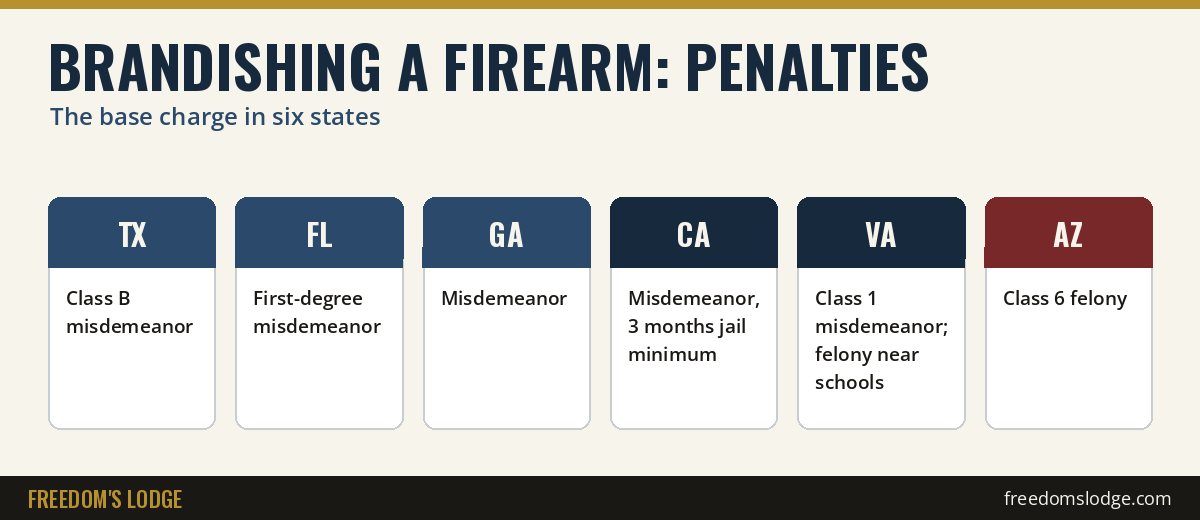
- Penalties run from a Class B misdemeanor in Texas to a felony in Arizona.
What Counts as Brandishing a Firearm?
The federal definition is the cleanest place to start. Under 18 U.S.C. 924(c)(4), to brandish means to “display all or part of the firearm, or otherwise make the presence of the firearm known to another person, in order to intimidate that person, regardless of whether the firearm is directly visible to that person.” Notice two things. You do not have to point it, and you do not even have to show it. Saying “I’ve got a gun” to scare someone can count. And the key words are “in order to intimidate.” The intent is the crime.
That federal definition matters mostly in federal cases. The charges most people actually face come from state law, and each state words it a little differently. Here is how six of them put it, straight from the statute books.
| State and statute | What is illegal | Penalty |
|---|---|---|
| California, Penal Code 417(a)(2) | Drawing or exhibiting a firearm “in a rude, angry, or threatening manner,” except in self-defense | Misdemeanor, at least 3 months in county jail; 3 months to 1 year and up to $1,000 for a concealable gun in a public place |
| Texas, Penal Code 42.01(a)(8) | Displaying a firearm “in a public place in a manner calculated to alarm” | Class B misdemeanor |
| Florida, Stat. 790.10 | Exhibiting a weapon “in a rude, careless, angry, or threatening manner, not in necessary self-defense” | First-degree misdemeanor |
| Virginia, Code 18.2-282 | Pointing, holding or brandishing a firearm so as to “reasonably induce fear in the mind of another” | Class 1 misdemeanor; Class 6 felony at or within 1,000 feet of a school |
| Georgia, Code 16-11-102 | Intentionally and without legal justification pointing or aiming a gun at another, loaded or not | Misdemeanor |
| Arizona, ARS 13-2904(A)(6) | Recklessly handling, displaying or discharging a deadly weapon, with intent to disturb the peace or knowing you will | Class 6 felony |
Statute text read from each state’s official code site or a published code mirror. Penalties are the base offense; other charges can be added on top.
Is Printing or an Accidental Flash Brandishing?
Look back at that table. Every one of those six laws needs something more than a gun being seen. California wants “rude, angry, or threatening.” Texas wants “a manner calculated to alarm.” Florida wants rude, careless, angry or threatening. Virginia wants conduct that would “reasonably induce fear.” Georgia wants you to point it. Arizona wants intent to disturb the peace, or knowledge that you will.
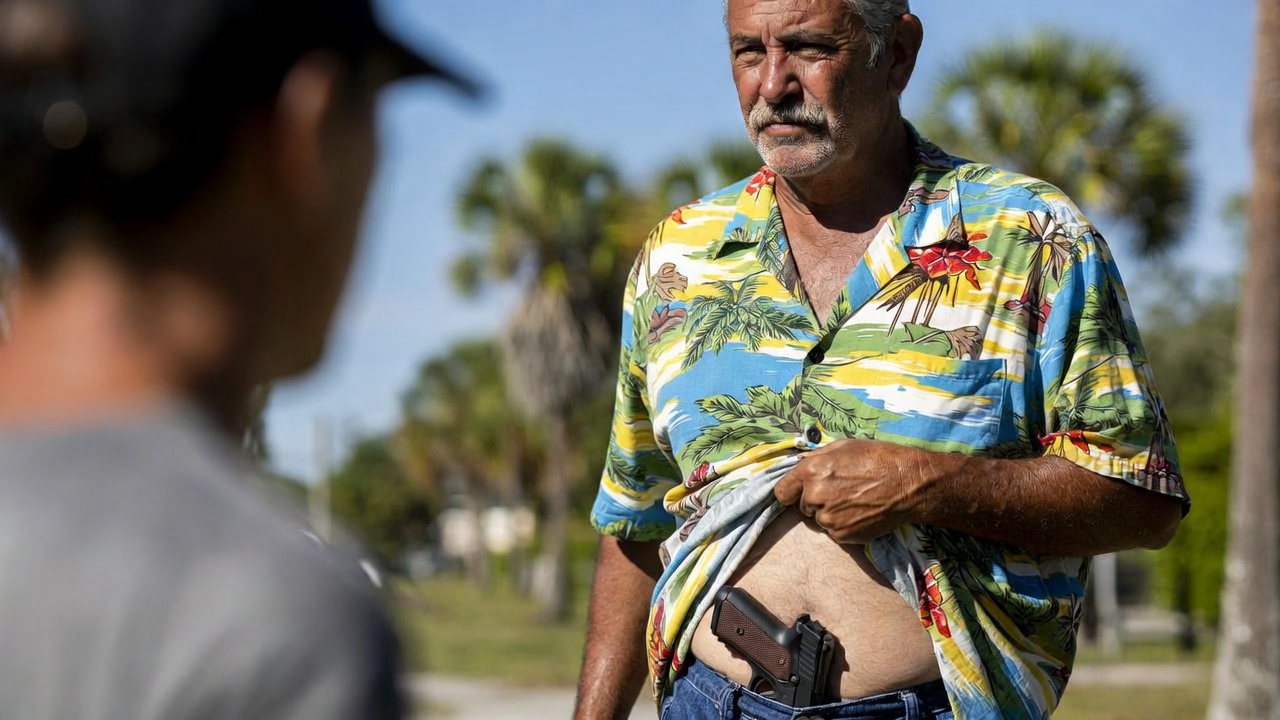
So here is the thing: your cover garment riding up while you reach for a gallon of milk is not, on the face of those statutes, brandishing. Neither is the outline of a pistol under a T-shirt. What turns it into a problem is what you do next. Adjust your shirt and go about your day. Do not make a show of it, do not tap it, and do not rest your hand on it while you argue with somebody about a parking spot.
Notice I said “on the face of those statutes.” Florida’s word “careless” is broader than the others, and a prosecutor and a jury decide what “calculated to alarm” means after the fact. A permit class and a carry holster that actually covers the gun are cheaper than a lawyer.

Can You Show a Gun in Self-Defense?
Sometimes, and this is where people get into trouble in both directions. California’s 417 applies “except in self-defense.” Florida’s 790.10 excludes “necessary self-defense.” Virginia’s 18.2-282 “shall not apply to any person engaged in excusable or justifiable self-defense.”
Florida goes further than most and says it out loud in 776.012(2): a person “is justified in using or threatening to use deadly force” when they reasonably believe it is necessary to prevent imminent death or great bodily harm, or the imminent commission of a forcible felony. In plain English, in Florida, pulling a gun to stop an attack that would justify shooting is treated the same as shooting.
The flip side matters just as much. Showing a gun to win an argument, to scare off someone who is only yelling, or to move a trespasser off your land is the kind of conduct these laws reach. If you would not be justified in firing, you are probably not justified in pointing. For the trespasser question in particular, read can you shoot someone for trespassing, and for where you have a duty to back away first, our stand your ground states guide has all 50.
Brandishing vs. Assault: What Is the Difference?
Brandishing is usually the lowest rung on the ladder, and the charge can climb from there. Georgia’s courts have drawn that exact line: the pointing misdemeanor in 16-11-102 applies where the victim is not placed in reasonable apprehension of immediate violent injury, and when they are, the charge becomes aggravated assault.
And remember that any criminal charge can follow you into your next permit application, so check how your own state treats it on our concealed carry by state guide.
A three-way tie: a third of you rate your state top tier, a third call it pretty restrictive, and a third would move.
Frequently Asked Questions
Is brandishing a felony?
In most of the states above it starts as a misdemeanor. Arizona’s version in 13-2904(A)(6) is a Class 6 felony, and Virginia’s becomes one at or near a school.
Is it brandishing if the gun is still in the holster?
It can be. The federal definition covers making a gun’s presence known “regardless of whether the firearm is directly visible,” so lifting your shirt or announcing that you are armed in order to intimidate someone can count.
Can you get charged for open carry?
Not for lawful open carry by itself in a state that allows it. The charges above need a threatening or alarming manner, pointing, or reckless handling. Our open carry map shows which states allow it.
What should you do if someone brandishes a gun at you?
Get distance or cover, get out if you can, and call 911 as soon as it is safe. Drawing your own gun in response is a self-defense question, and your state’s use-of-force law decides it.
Carry it, conceal it, and leave it alone unless your life depends on it. That is the whole rule, and it has kept a lot of good people out of a courtroom.
Sources: 18 U.S.C. 924(c)(4); California Penal Code 417; Texas Penal Code 42.01; Florida Statutes 790.10 and 776.012; Code of Virginia 18.2-282; Official Code of Georgia 16-11-102 and its annotations; Arizona Revised Statutes 13-2904.
Reader Favorites
- Virginia’s Gun-Hating Governor vs. Virginia
- Los Angeles Gun-Grabbers Confused, Terrified by Bill of Rights
- Why Do Anti-Gunners Love Red Flag Laws So Much?
- Gun Companies Fight to End COVID-19; Gun Grabbers Fight to End THEM
- Sunshine State Showdown: “No Guns Under 21” Law Challenge Moves Forward
- Guns at Coronavirus Quarantine Protests: Listen For the Loudest Scream
Gun-owner reference desk
Plain-English references worth bookmarking — NFA rules, carry law, and the gear terms behind every review.
| 2026 at a glance | |
|---|---|
| NFA tax stamp | $0 |
| Permitless carry | 29 states |
| Suppressors legal | 42 states |
50+ NFA, carry and gun-law terms in plain English, updated for 2026.
Open the glossary → Network| Term | Category |
|---|---|
| Striker-fired | Action |
| MOA | Optics |
| Twist rate | Ballistics |
30 gun, ammo and optics terms, from Guns & Gadgets Daily.
View full chart →