Second Amendment Rights Section Launches at DOJ
Second Amendment Rights Section Launches at DOJ: A Historic Shift for Gun Owners in 2025
By John Patriot | December 4, 2025
Last updated: April 25, 2026 · Originally published December 4, 2025
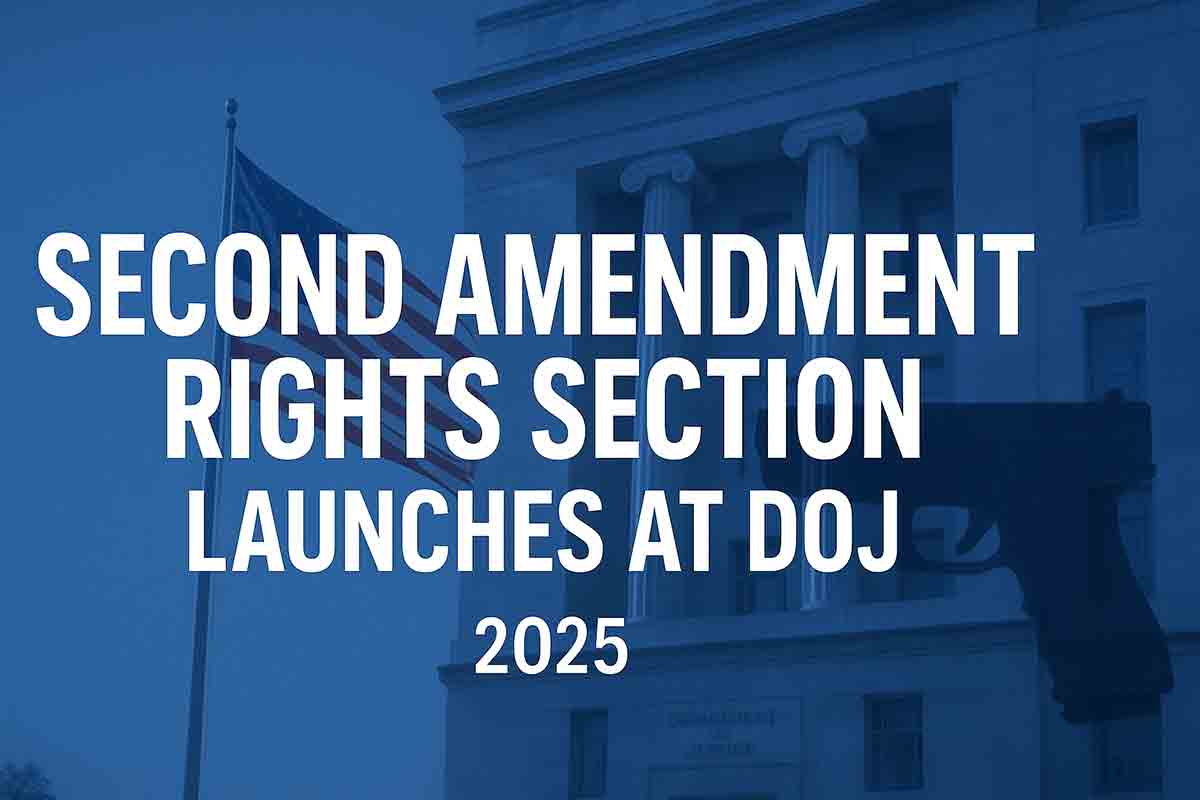
The Second Amendment Rights Section officially launched today at the U.S. Department of Justice, marking one of the most significant federal enforcement shifts for gun owners in modern American history. For the first time ever, the Second Amendment is being treated as a core civil right inside the DOJ’s powerful Civil Rights Division—placing federal muscle directly behind constitutional gun rights enforcement.
This move signals a sharp reversal from the enforcement priorities of the last decade and introduces a new era where state and local gun control laws will face aggressive federal scrutiny, legal challenge, and potential dismantling.
How the Second Amendment Rights Section Came to Be
The foundation for today’s announcement was laid by President Donald Trump’s February 2025 executive order, Protecting Second Amendment Rights. That order directed the Department of Justice to review, revise, and eliminate any federal policy that burdened law-abiding gun owners.
Attorney General Pam Bondi moved quickly. Within weeks, the DOJ began rolling back ATF enforcement policies that had dominated the Biden years—particularly the “zero-tolerance” inspection regime that shuttered hundreds of Federal Firearms Licensees over paperwork errors.
Bondi’s record as a defender of gun rights stretches back years. Her involvement in high-profile Second Amendment litigation and resistance to federal firearm registries became national news during the battle over alleged data-collection abuses tied to ATF oversight. That history is covered in detail here:
Pam Bondi Blocks ATF Overreach in Gun Registry Battle.
By late 2025, that temporary task force was formally elevated into a permanent enforcement unit: the Second Amendment Rights Section, now housed directly inside the DOJ’s Civil Rights Division and led by Assistant Attorney General Harmeet Dhillon.
What the Second Amendment Rights Section Is Designed to Do
The operational mission of the Second Amendment Rights Section is clear: identify infringements at every level of government and challenge them through federal enforcement power.
- State-level “may-issue” carry permitting schemes
- Excessive permit delays that amount to de facto bans
- Assault weapon and high-capacity magazine bans
- Red-flag laws lacking full due process protections
- 18–20-year-old firearm purchase prohibitions
- Ammunition background check systems
- Overbroad “sensitive places” restrictions
California remains one of the central enforcement targets. The state’s aggressive efforts to restrict handgun sales through roster manipulation recently blocked popular Glock models entirely—an action now under renewed constitutional scrutiny:
California’s Glock Block and the Escalating Handgun Battle.
The NFA, ATF Power, and Why This Office Changes Everything
Perhaps the most legally explosive implication involves the National Firearms Act (NFA) and the long-standing authority of the Bureau of Alcohol, Tobacco, Firearms and Explosives.
Multiple legal challenges now argue that the NFA’s foundational structure exceeds constitutional limits entirely. One of the most closely watched cases is currently working its way through the courts:
Jensen v. ATF and the Claim That the NFA Is Unconstitutional.
With the Second Amendment Rights Section now embedded inside the Civil Rights Division, DOJ legal positions in these cases could flip entirely. Instead of defending ATF authority by default, the federal government could soon be arguing that long-standing firearms regulations violate the Constitution.
Real-World Impact for Gun Owners Across America
This is not theoretical. The Second Amendment Rights Section shifts power directly into the hands of ordinary citizens:
- Urban residents facing extreme carry permit delays gain federal enforcement backing.
- Young adults blocked from firearm ownership regain standing.
- FFLs targeted for political enforcement regain regulatory stability.
- Non-violent offenders blocked from firearm restoration regain constitutional review.
It also dramatically reshapes the legal battlefield surrounding due process. In recent years, politicians increasingly framed gun owners as security threats rather than constitutional citizens. One of the most controversial public statements came from Senator Chris Van Hollen, who argued that due process standards applied more appropriately to criminal suspects than to gun owners themselves. That position triggered national backlash:
Van Hollen’s Due Process Controversy Explained.
The Second Amendment Rights Section now places federal enforcement squarely on the side of due process for firearms owners.
Could “Loser Pays” Tort Reform End the Anti-Gun Lawsuit Industry?
One of the most overlooked aspects of this shift involves civil litigation economics. Anti-gun states and municipalities have relied heavily on taxpayer-funded lawsuits to attack manufacturers, distributors, and dealers—even when those cases are repeatedly dismissed.
There is growing legal pressure for nationwide “loser pays” tort reform, which would require losing parties to cover defense costs. If enacted, it could collapse the financial foundation of the modern anti-gun lawsuit industry:
Would Loser Pays Tort Reform Stop Anti-Gun Lawsuits?.
The DOJ’s new enforcement direction opens the door for federal backing of that policy shift.
The “Hunter’s Pardon” and the Two-Class Gun System
Another emerging symbol of legal hypocrisy in gun enforcement has been the so-called “Hunter’s Pardon,” where politically connected actors receive firearm legal forgiveness denied to average citizens.
This selective application of firearms law has fueled public outrage:
Hunter’s Pardon Proves Gun Laws Are for the Little People.
The Second Amendment Rights Section introduces federal oversight that could force consistent constitutional standards rather than politically selective enforcement.
Why Housing 2A Enforcement Inside Civil Rights Is So Powerful
The Civil Rights Division carries extraordinary authority. It investigates voting violations, religious discrimination, police misconduct, and free-speech suppression. By placing the Second Amendment within that same enforcement framework, the federal government now acknowledges that the right to keep and bear arms is not secondary—but equal.
“The Second Amendment is not a second-class right.” — Attorney General Pam Bondi
This institutional upgrade gives gun rights the same federal protection historically reserved for speech, voting, and equal protection.
Reactions From Gun Owners, Media, and Political Opposition
Major Second Amendment organizations—including the NRA-ILA, Gun Owners of America, Firearms Policy Coalition, and the National Shooting Sports Foundation—praised the move as historic.
Meanwhile, gun-control advocacy groups like Brady United and Everytown for Gun Safety immediately condemned the decision. Several media outlets framed the development as a “federal gun lobby takeover.” That response was widely criticized as an overt attempt to delegitimize constitutional enforcement.
The Supreme Court, Bruen, and the Collapse of State Gun Bans
The timing of this launch coincides with a Supreme Court docket already stacked with Second Amendment cases. Since the New York State Rifle & Pistol Association v. Bruen ruling reshaped the constitutional test for gun laws, dozens of state-level restrictions have fallen in lower courts.
With the DOJ now positioned to actively enforce that standard instead of resist it, legal analysts expect a rapid acceleration in the collapse of state bans.
What Comes Next for the Second Amendment in 2026 and Beyond
Looking forward, analysts expect movement in several major areas:
- National concealed-carry reciprocity
- Suppressed firearms deregulation
- Short-barreled firearms reclassification
- ATF structural reform or jurisdictional limits
- State preemption enforcement through federal court
While legislative timelines remain uncertain, the enforcement shift alone reshapes the legal battlefield nationwide.
Reader Favorites
- Hot Take: Viridian V-Series Long-Range Illuminators
- Officer Justifiably Shoots Good Guy: Lessons For Armed Citizens
- Be Your Own AR-15 Armorer With This Kit
- Mossberg Celebrates Century With New CCW Pistol
- CCW Central: Check Out Concealed Carry Expo this May in Pittsburgh
- Free Self-Defense Videos From Viridian Weapon Tech
Gun-owner reference desk
Plain-English references worth bookmarking — NFA rules, carry law, and the gear terms behind every review.
| 2026 at a glance | |
|---|---|
| NFA tax stamp | $0 |
| Permitless carry | 29 states |
| Suppressors legal | 42 states |
50+ NFA, carry and gun-law terms in plain English, updated for 2026.
Open the glossary → Network| Term | Category |
|---|---|
| Striker-fired | Action |
| MOA | Optics |
| Twist rate | Ballistics |
30 gun, ammo and optics terms, from Guns & Gadgets Daily.
View full chart →




Pam Bondi should defund the ATF and any other commie organization. She also needs to rock knuckle-head Loser Lee Tennessee Governor over his commie crap. He broke his oath of office after he was unchallenged for office. Bondi should demand his resignation!! He’s a turn-coat liar. Hang your head in shame, “mommas boy” 2027 can’t get here fast enough!!