ATF New Era of Reform: 34 Rules Rescinded May 2026
On May 6, 2026 the ATF published 34 rule changes, the largest deregulatory package in its 53-year history, covering braces, licensing and forms.
As an FFL and 07/02 manufacturer of NFA items, I have spent twenty years filling out the paperwork the ATF just promised to shrink, so I read the whole ATF new era of reform package before I let myself get excited. Thirty-four rule changes span pistol braces, bump stocks, FFL dealer licensing, Form 4473, electronic recordkeeping, and the NFA registration procedures that govern suppressors, machine guns, and short-barreled rifles. New ATF Director Robert Cekada called it the most significant modernization of ATF regulations in history. The Federal Register tells a more complicated story (it always does). Three rules are final. One takes effect immediately. The rest carried a 30-day public comment window that has since closed for most of them.
Updated September 8, 2026. The links to every Federal Register document, ATF docket page, and the regulations.gov comment portal are in this piece.
What Is the ATF New Era of Reform?
Basically it is one deregulatory initiative with a landing page, housed at atf.gov/rules-and-regulations/atf-launches-new-era-reform. The agency sorts the 34 changes into three buckets: Repeal (rules being rescinded), Clarify (rules being rewritten so a normal person can read them), and Modernize (forms, recordkeeping, and registration procedures).
Cekada announced the package at an April 29 press conference, minutes after the Senate confirmed him as ATF director. Acting Attorney General Todd Blanche, NRA representatives, and NSSF representatives flanked the podium. The Federal Register documents began publishing May 5; most carry a May 6, 2026 publication date. President Trump’s 2025 executive order directing the Justice Department to review ATF policies for Second Amendment violations is the underlying authority Cekada cited.
That is the political surface. The legal surface, the part that decides whether a hunter, a collector, or a Form 4 applicant sees any real change, is in the four documents already in the Federal Register and the public-comment window that closed for most of them by early June, though the brace rescission (11P) and the Youth Handgun Safety Act notice removal (28P) are both still pending as of September 2026.


The Four Rules Already in the Federal Register
Per the ATF Repeal Group page, four rules are now actionable. The agency labels them by docket: 11P, 27P, 2024-01F, and 28P.
- 2024-01F (Federal Register 2026-08926, 91 FR 24348) — Revising Machine Gun Definition in Response to Supreme Court Decision. This is a final rule, effective on publication. It strips two sentences from the three regulatory definitions of “machine gun” that previously folded bump stocks into the definition. It is ATF lining the Code of Federal Regulations up with the Supreme Court’s 2024 decision in Garland v. Cargill. No comment window. Already binding.
- 27P (Federal Register 2026-08919, 91 FR 24424) — Revising Regs Defining “Engaged in the Business” as a Dealer in Firearms. The ATF lists this as an Interim Final Rule, meaning it took effect on publication; its comment period has since closed, and it remains binding as an interim final rule. It rescinds the Biden-era expansion of when a private seller has to obtain an FFL, while keeping the statutory definition Congress put in the 2022 Bipartisan Safer Communities Act.
- 11P (Federal Register 2026-08930, 91 FR 24453) — Removing Factoring Criteria for Firearms with Attached “Stabilizing Braces.” This is a Notice of Proposed Rulemaking (NPRM). Not yet effective. Public comment open. The proposal formally removes the 2023 brace-factoring criteria from 27 CFR 478.11 and 479.11, the same criteria multiple federal courts have already enjoined or vacated.
- 28P (RIN 1140-AA87) — Removing Youth Handgun Safety Act Notice. NPRM. Would rescind 27 CFR 478.103, the rule requiring FFLs to post the 1998 ATF I 5300.1 sign and hand each handgun purchaser the ATF I 5300.2 notice (yes, the sign by the register that nobody reads).
The other 30 changes in the “34” total are clustered in the Clarify and Modernize tranches. Per the ATF’s own list of work-in-progress items, that includes the simplified ATF Form 20 (transport notice), a rewritten Form 4473, an open letter changing the Brady Chart, electronic signatures on NFA forms, and a regulatory review aimed at finding outdated CFR language. Not all are in the Federal Register yet.
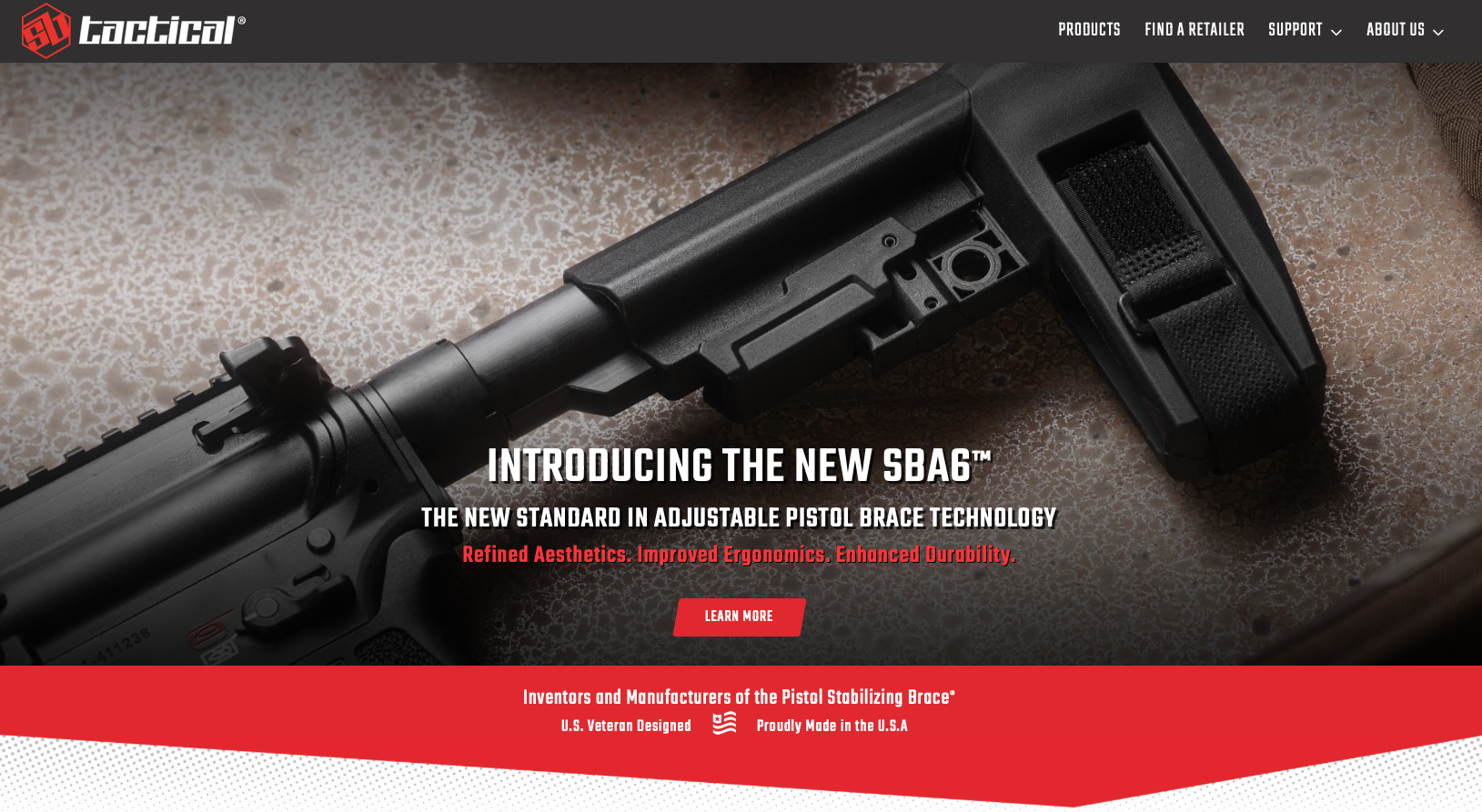
Stabilizing Braces
The brace fight has been a moving target since the ATF’s January 2023 rule reclassified brace-equipped pistols as short-barreled rifles. Multiple federal courts, the Fifth Circuit in Mock v. Garland, the District Court for the Northern District of Texas, and others, found the rule violated the Administrative Procedure Act. The rule has been stayed, vacated, or enjoined across most of the country since 2024. The Trump Justice Department stopped defending it. What was missing was the formal rescission.
11P is that rescission. The Federal Register text removes the 2023 brace-factoring language from 27 CFR 478.11 and 479.11 and restores the regulatory definitions to their pre-2023 form, lined up with the underlying statutory definitions of “rifle” and “short-barreled rifle” in 18 USC 921(a).
Now, for owners the practical change is small in the short term, because the rule has been unenforceable for over a year. The legal change is the architecture: a future administration cannot simply reinstate the 2023 factoring criteria with a policy memo. Reissuing the rule would take its own notice-and-comment rulemaking and would now face the post-Bruen constitutional analysis that helped kill the original. We covered the upstream policy logic in our piece on the $0 NFA tax and brace changes.

Bump Stocks and Garland v. Cargill
2024-01F is the cleanest of the four. The Supreme Court in Garland v. Cargill (2024) held that a bump-stock-equipped semiautomatic rifle does not satisfy the statutory definition of “machine gun” under 26 USC 5845(b). The 2018 Trump-era ATF rule that had classified bump stocks as machine guns survived that decision exactly long enough for the new administration to remove it from the CFR.
The final rule strikes two sentences from each of the three regulatory definitions of “machine gun” that previously roped in bump stocks. It does nothing more. It does not legalize machine guns, it does not change the National Firearms Act, and it does not affect any post-1986 transferable machine-gun registration. It simply removes regulatory language a federal court already invalidated.
“Engaged in the Business”: What Goes, What Stays
27P is the rule the gun-reform groups went on the record opposing. The Biden-era 2024 rule expanded the definition of “engaged in the business” of dealing in firearms by specifying that certain activities, advertising, accepting credit-card processing, displaying inventory, repeated sales, might trigger the requirement to obtain an FFL and run a background check on each buyer.
The ATF interim final rule rescinds those specifying provisions while keeping the statutory definition of “engaged in the business” that Congress wrote into the 2022 Bipartisan Safer Communities Act (BSCA). In other words, the statute that says a person who “predominantly earns a profit” from firearm sales must obtain an FFL is unchanged. What the rule rescinds is the agency’s 2024 list of triggering activities.
Gun-control organizations argue this reopens the “gun show loophole.” The ATF response, in the Federal Register text itself, is that the 2024 specifying provisions went past the statutory language Congress wrote and have not produced the FFL application increases, civil forfeitures, or enforcement metrics the agency projected. The rule’s 30-day public comment window opened May 6, 2026, and has since closed; it remains binding as an interim final rule while ATF reviews the comments.
Form 4473 and Electronic Recordkeeping
The bulk of the “34” lives in the Modernize tranche. The headline items:
- Form 4473 rewrite. The transaction record FFLs collect from every buyer is slated for restructuring with auto-population, electronic signatures, digital attachment, and consolidated demographic fields.
- Electronic dealer records. The ATF proposes letting FFLs keep Acquisition and Disposition records electronically instead of on paper, and cutting the indefinite retention requirement to either 20 or 30 years, comment-dependent.
- Form 20 simplification. The interstate-transport authorization for NFA items moves toward a notice-based system instead of a pre-authorization application.
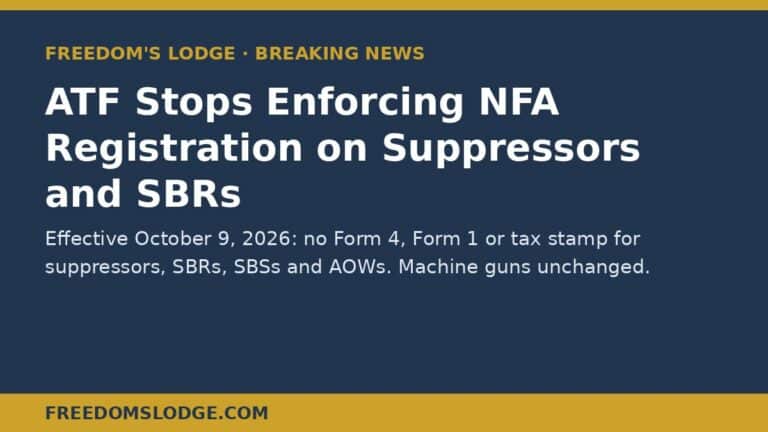
- Electronic signatures on NFA forms. The ATF has signaled a ruling allowing electronic signatures on Form 1, Form 4, and Form 5, the three forms every suppressor, SBR, and SBS buyer runs into.
- Brady Chart open letter. An imminent open letter is expected to revise the chart FFLs use to determine prohibited-person status on the 4473.
For NFA buyers, the ones who watched the $0 tax stamp take effect January 1, 2026, the electronic-signature change is the practical lever. Put that together with the eliminated tax and the maturing eForms platform, and the entire Form 4 path sits within reach of being a fully digital transaction. That is the “modernization” that actually changes a customer’s timeline, and I will believe the wait times when I see them on my own forms.
What Suppressor and Machine-Gun Buyers Should Know
The package proposes simplifying the registration process for NFA-regulated weapons by eliminating the requirement that applicants send copies of their NFA applications to local chief law enforcement officers (CLEOs). The CLEO-notification rule has been a long-standing source of friction; some jurisdictions effectively use it as a soft veto by simply refusing to acknowledge receipt. Removing the notification requirement, if the proposal survives comment, would streamline Form 1 and Form 4 processing further.
Remember, none of this is binding yet. The Modernize items are in various stages of pre-publication. The agency has said it intends to publish them in tranches through summer 2026.
How to File a Comment
The two final rules, 2024-01F (bump stocks) and 27P (engaged in the business), are already in effect. 27P’s comment period has closed; it remains binding as an interim final rule. The two NPRMs, 11P (braces) and 28P (Youth Handgun Safety Act notice), had their 30-day comment periods close in early June and are still pending final rules as of September 2026.
The comment portal is regulations.gov. Find each docket by Federal Register document number (2026-08930 for the brace rule, 1140-AA87 for the Youth Handgun Safety Act notice). Do public comments actually matter? Yes, they do. Agency rulemakers must address substantive comments in the rule’s preamble. Identical form letters get summarized as a single entry. A specific, sourced, on-topic comment from an affected owner moves the needle, so take my advice and write your own.
What Is NOT in the Package
What the “New Era of Reform” does not touch is as important as what it does. The package does not address:
- The Hughes Amendment, the 1986 cap on transferable machine guns that has driven the post-1986 collector market to seven-figure prices for legal full-autos.
- Suppressor ownership at the statutory level. Suppressors remain Title II NFA items, still requiring a Form 4. The package addresses registration procedure, not classification.
- Interstate transport of long guns under state laws. FOPA-style federal preemption of state restrictions remains a legislative question, not an ATF question. The pending Brown v. ATF and the live Jensen v. ATF litigation are working that angle through the courts. Our breakdown of Jensen v. ATF covers what the post-NFA legal architecture looks like.
- Import classifications under 18 USC 925(d)(3) for so-called “non-sporting” firearms. The package adjusts non-lethal training ammunition and dual-use barrels but leaves the broader sporting-purpose framework intact.
- The 2024 ATF “ghost gun” rule on privately made firearms. That rule is the subject of separate ongoing litigation and is not included in the 34.
So here’s the thing if you track all three branches at once: the executive branch (ATF) is consolidating the post-Bruen, post-Cargill, post-Jensen legal architecture into the regulations the agency actually enforces. The legislative branch (Congress) is the only mechanism for the deeper structural questions, the Hughes Amendment, suppressor declassification, and national CCW reciprocity. The judicial branch is still deciding whether the underlying NFA registration scheme survives at all.

Frequently Asked Questions
When does the ATF new era of reform take effect?
Two pieces took effect May 6, 2026, and remain in force as of September 2026: the bump stock final rule (2024-01F) and the “engaged in the business” interim final rule (27P). The brace proposal (11P) and the Youth Handgun Safety Act notice rescission (28P) had their 30-day comment periods close in early June and are still awaiting final rules. The other 30 items rolled out in tranches through summer 2026.
Is the stabilizing brace rule officially dead?
Dead in practice, not yet dead on paper. Courts have had the 2023 brace-factoring rule enjoined, stayed, or vacated across most of the country since 2024, so nobody has been able to enforce it. The May 6 NPRM (11P) is the formal removal from 27 CFR 478.11 and 479.11, which happens once the comment period closes and the ATF publishes a final rule. Nothing changes for the brace-equipped pistol in your safe either way, because the statute defining a short-barreled rifle never moved.
Does this change anything for suppressor owners?
Not what a suppressor is, only how you get one. Suppressors stay Title II NFA items. Electronic signatures on Form 4, the eForms platform, and the proposed end of CLEO notification all shorten the walk from purchase to pickup, and with the $0 NFA tax that took effect January 1, 2026, a first-time buyer has a thinner stack of paperwork than at any point since 1934.
Can I comment on the ATF new era of reform proposed rules?
Yes, and you should. File at regulations.gov by Federal Register document number: 2026-08930 for the brace NPRM, RIN 1140-AA87 for the Youth Handgun Safety Act NPRM. Write something specific and sourced in your own words; a form letter gets counted once no matter how many people send it. The window is 30 days from each rule’s publication date.
Who is Robert Cekada?
A career ATF official the Senate confirmed as ATF Director on April 29, 2026. He took over from Army Secretary Daniel Driscoll, who had been running the ATF as acting head on top of his Army job. President Trump nominated Cekada in November 2025.
What to Watch Next
The comment window closed for 11P and 28P in early June. As of September 2026, ATF has not yet published final rules on either — both remain proposed. The Modernize tranche, Form 4473, electronic NFA signatures, the CLEO-notification removal, is the one that decides whether a 2026 Form 4 applicant sees the same wait times their 2024 predecessor did or measurably less. Meanwhile, Brown v. ATF and Jensen v. ATF keep working the bigger constitutional question through the courts: whether the NFA registration scheme survives the post-Bruen historical-tradition test at all.
The ATF new era of reform is the administrative leg of 2A reform taking its largest step in a generation. The legislative and judicial legs are next, and I would take the bet they are slower. In the meantime, go file a comment, then tell me which of these rules matters most to your next purchase on X at @therealxdman and we will dig up the open dockets that affect your zip.
Last updated September 8, 2026. Primary sources: ATF.gov “New Era of Reform” (atf.gov/rules-and-regulations/atf-launches-new-era-reform), Federal Register documents 2026-08930, 2026-08919, 2026-08926, and RIN 1140-AA87. Reporting verified against The Trace (April 30, 2026, Chip Brownlee), Walker & Taylor Law (May 9, 2026), and the ATF April 29 press conference transcript.


Reader Favorites
- Hot Take: Viridian V-Series Long-Range Illuminators
- Officer Justifiably Shoots Good Guy: Lessons For Armed Citizens
- Be Your Own AR-15 Armorer With This Kit
- Smells Like Infringement: Gun Banners in the News
- Smells Like Infringement: Gun Banners in the News (As Usual)
- Smells Like Infringement: 5 Ways H.R. 8 Could Make You a Felon
Gun-owner reference desk
Plain-English references worth bookmarking — NFA rules, carry law, and the gear terms behind every review.
| 2026 at a glance | |
|---|---|
| NFA tax stamp | $0 |
| Permitless carry | 29 states |
| Suppressors legal | 42 states |
50+ NFA, carry and gun-law terms in plain English, updated for 2026.
Open the glossary → Network| Term | Category |
|---|---|
| Striker-fired | Action |
| MOA | Optics |
| Twist rate | Ballistics |
30 gun, ammo and optics terms, from Guns & Gadgets Daily.
View full chart →