Sell My Gun: What It’s Worth and How to Sell It Legally
Sell my gun searches end in two rules: price it by condition and real sales, and send any out-of-state sale through a licensed dealer.
Last updated: November 19, 2026 · Originally published October 31, 2026
If you type “sell my gun” into a search bar, the legal answer is shorter than the list of places that want your pistol. Federal law draws one hard line: a private seller cannot hand, sell or ship a gun straight to a buyer who lives in another state, so that sale goes through a licensed dealer (for a handgun, a dealer in the buyer’s state). Inside one state, federal law allows a private sale, but some states still require a dealer background check. Check yours before you list.

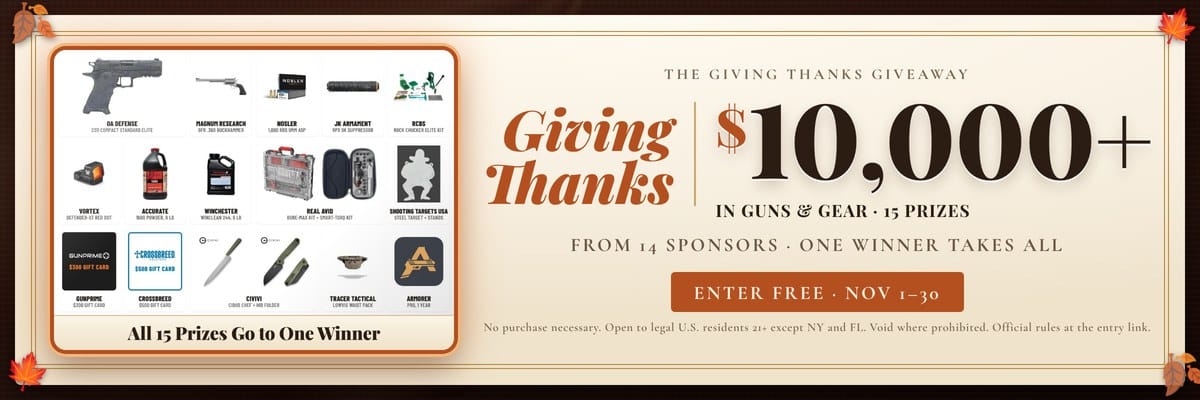
Enter the Giving Thanks giveaway here: fill in your name, email and date of birth below.
Giving Thanks $10,000+ Guns & Gear Giveaway
Selling a gun is a question of price and paperwork, in that order. People sell to clear a safe, settle an estate or pay for the next gun, and the routes split three ways: a store or consignment counter that handles the paperwork for you, an online marketplace that ships to the buyer’s dealer, or a private sale you run yourself. Each one trades money for convenience. The right route is the one that gets a fair price for your gun’s real condition without putting your name on an illegal transfer.
Selling a Gun at a Glance
- Out-of-state buyer: the gun goes through a licensed dealer, and a handgun through one in the buyer’s state (18 U.S.C. § 922(a)(5) and (b)(3)).
- Same-state buyer: federally allowed; some states, such as Colorado, require a dealer check.
- Never sell to: a prohibited person, or a handgun to anyone under 18.
- Handguns and the mail: a private seller cannot mail a handgun through the Postal Service.
- GunsAmerica fees: free to list; 6% after the sale on the free plan ($20 minimum), 3% on the $49.99-a-month plan.

Where Can I Sell My Gun?
Having worked behind the counter for over 20 years, I get asked this more than almost any other question by people holding a gun they no longer want. My answer is always “it depends,” and then I pick: if you want it gone this afternoon, sell it to a store; if you want the most money, list it where the most buyers will see it and let a dealer on the buyer’s end handle the transfer.
| Way to sell | How the gun changes hands | Federal paperwork | What it costs you |
|---|---|---|---|
| Sell or trade to a gun store | You carry it in; the dealer makes an offer and buys it | Logged in the dealer’s records; no check on you | The gap between the offer and the store’s resale price |
| Consign at a dealer | The dealer holds it, sells it and pays you after | Logged in the dealer’s records; to take it back unsold, you fill out a Form 4473 and pass a background check | The shop’s consignment cut |
| Online marketplace (GunsAmerica) | You list it, the buyer pays, you ship it to the buyer’s licensed dealer | The buyer does the Form 4473 and background check at his dealer | 6% after the sale on the free plan ($20 minimum); shipping |
| Private sale, same state | You meet the buyer, check the gun and the money, and hand it over | None federally; some states, such as Colorado, require a dealer check | Nothing, or a dealer’s transfer charge where required |
| Buyer in another state | Only through a licensed dealer; a handgun must go through one in the buyer’s state | 18 U.S.C. § 922(a)(5) and (b)(3), 27 C.F.R. § 478.30; exceptions for a bequest or inheritance and a temporary sporting loan | Shipping, plus whatever the platform charges |
| Firearms auction house | The house takes the guns, catalogs them and sells to bidders | Arranged by the auction house, under the same federal rules | The house’s commission; GunsAmerica’s guide suggests this for large estates |
Federal rules come from 18 U.S.C. § 922, the dealer record rule in 18 U.S.C. § 923(g) and ATF’s answer on consignment firearms; the Colorado rule is Colo. Rev. Stat. § 18-12-112; GunsAmerica’s fee is from its seller page. Each shop sets its own offers and consignment cut.
What Is My Gun Worth?
Price is where most sellers go wrong, and always in the same direction (nobody thinks Grandpa’s shotgun is worth LESS than the internet says). Three things set what a used gun brings: the exact make and model, its condition, and how many buyers want that model when you list it.
Condition has a common language. The NRA Museum’s guide to evaluating firearms condition lays out the NRA Modern Gun Condition Standards in six grades, from New (“Not previously sold at retail”) through Perfect, Excellent, Very Good and Good down to Fair (“In safe working condition but well worn”). The same guide says “Differences in condition can easily halve or double the value of a collectible gun.” So grade your gun fairly, and photograph the wear instead of hiding it.
For a quick number, GunsAmerica’s “My Gun Worth” tool takes one clear photo of the whole gun (close-ups of the markings help, it says) and returns a free instant estimate, which the page says is powered by “market data, real-time listings, and expert input.” Treat it as a starting line, then check what the same model in the same grade has sold for.
Do You Need a License to Sell a Gun?
No, not to sell your own guns. Federal law requires a dealer’s license for a person “engaged in the business,” which 18 U.S.C. § 921(a)(21)(C) defines as dealing “as a regular course of trade or business to predominantly earn a profit through the repetitive purchase and resale of firearms.” The same definition leaves out a person “who makes occasional sales, exchanges, or purchases of firearms for the enhancement of a personal collection or for a hobby, or who sells all or part of his personal collection of firearms.”
Selling off a safe full of guns you have owned and shot is a collection; buying guns at the Saturday show to relist them on Monday starts to look like a business, and willfully dealing without a license carries up to five years in federal prison under 18 U.S.C. § 924(a)(1)(D).
Can You Sell a Gun to Anybody?
No, and this is the part that lands sellers in court. Under 18 U.S.C. § 922, three federal limits follow every private seller:
- Prohibited buyers. Section 922(d) makes it a crime to sell any gun to someone you know or have “reasonable cause to believe” is prohibited (a felon, for example). A knowing violation carries up to 15 years under § 924(a)(8).
- Handguns and minors. Section 922(x) bars selling a handgun or handgun-only ammunition to anyone you know or have reasonable cause to believe is under 18.
- Out-of-state buyers. Section 922(a)(5) bars a private seller from transferring any gun to someone he knows or has reasonable cause to believe lives in another state. ATF’s rule, 27 C.F.R. § 478.30, says the same and carves out the same two exceptions: a bequest or inheritance, and a temporary loan for lawful sporting use.
Remember, the background check is the dealer’s job under § 922(t), so a stranger who balks at a dealer is a stranger you should not sell to. If the guns came from an estate, read our guide to what to do with inherited guns before you sell any of them.
State Private-Sale Rules
Federal law is the floor, not the ceiling. Colorado is a clear example: under Colo. Rev. Stat. § 18-12-112 (Justia copy), a private seller “shall arrange for a licensed gun dealer” to run the background check before the transfer. GunsAmerica’s local-sales help page agrees: “In some states, a private sale may still require an FFL transfer or background check.” Our state-by-state guide to private gun sales gives every state’s rule, its family exceptions and the statute behind it, so look up your row before you meet a buyer.
How Do I Sell My Gun Online?
GunsAmerica says it was founded in 1997 and was “the first dedicated online firearms marketplace in the United States,” and private sellers, dealers and collectors all list there, per its about page. A sale runs like this, per GunsAmerica’s first-time seller guide:
- Verify who you are. Before your first listing you pass a free identity check with a passport, driver’s license or state ID card plus a selfie. GunsAmerica says it “usually takes less than 5 minutes.”
- List it. Posting a classified ad is free; the free plan allows 3 photos, the paid plans 15.
- Get paid. Once the buyer’s payment clears, you ship.
- Ship the gun to the buyer’s dealer. “If the item sold is a firearm you must ship it to an FFL so proper paperwork and background check can be completed.” Accessories can ship straight to the buyer.
Payment can run through GunTab, which GunsAmerica calls an escrow-based payment platform built for firearms. Per GunsAmerica’s GunTab page, the buyer gets “exactly 3 calendar days” after delivery to inspect, the seller is paid “no more than 3 days after delivery,” and GunTab’s 2.9% service fee is “typically paid by the seller.”
What GunsAmerica Charges Sellers
The numbers below are from GunsAmerica’s seller page.
| Plan | Monthly price | Fee after a gun sells | Example: $800 gun |
|---|---|---|---|
| Basic Seller | $0.00 | 6% ($20 minimum) | $48 |
| Trusted Seller | $49.99 | 3% ($10 minimum) | $24, plus the monthly price |
| Platinum Access | $995.95 | No after-sale fee | $0, plus the monthly price |
| Local Listing | No plan needed | $5 to list, no after-sale commission | $5 |
The $800 column is our own arithmetic on GunsAmerica’s posted rates, not a GunsAmerica figure. GunTab’s 2.9% payment fee, when used, is separate. Fees change, so check the seller page before you list.

One $800 rifle costs $48 on the free plan; the Trusted Seller plan saves $24 on that sale but charges $49.99 for the month, so it pays only when you sell several guns a month. A Local Listing is the cheapest, but GunsAmerica’s help page says it “does not process or guarantee transactions for Local Listings,” that you “pay the seller directly,” and that it is “up to both parties to conduct the sale safely and legally.” That is a private sale with a $5 ad, and every rule above still applies.
Shipping a Gun to a Buyer
Ship the gun to the dealer the buyer named, never to the buyer’s house. Before you tape the box, look the dealer up on ATF’s FFL eZ Check, which ATF says lets “an FFL or other user” verify that a federal firearms license is valid. (ATF issued a rule letting dealers use that lookup in place of a certified license copy for transfers, then withdrew it on July 6, 2026 before it took effect; our breakdown of the ATF eZ Check rule has the background.)
Then pick the carrier. GunsAmerica tells sellers “It is the sellers responsibility to know which carriers accept firearms,” and the Postal Service draws its own lines. Under 18 U.S.C. § 1715, handguns are “nonmailable” except in trade shipments between manufacturers and dealers and for a few officials, and knowingly mailing one carries up to two years. USPS Publication 52, section 432 says “unloaded rifles and shotguns are mailable,” that a non-licensed owner may mail them “to FFL dealers, manufacturers, or importers in any state,” and that no outside marking may show what is inside. So a handgun goes by a commercial carrier that accepts it.
The proposed ATF rule that would let a dealer sell to an in-state buyer remotely and ship the gun is a dealer rule and would not change what a private seller may do; I covered it in our guide to the ATF ship-to-home rule.
What Happens If You Get It Wrong
A private seller who willfully ships or hands a gun straight to an out-of-state buyer violates § 922(a)(5), and § 924(a)(1)(D) sets the penalty at up to five years in prison, a fine, or both. Sell to someone you have reasonable cause to believe is prohibited and § 924(a)(8) raises that to 15 years. Your listing, your messages and your tracking number are the paper trail, so if a buyer asks you to skip the dealer “just this once,” the conversation is over.
GunsAmerica Digest
GunsAmerica Digest is the editorial side of the marketplace, which GunsAmerica bills as “expert gear reviews and daily industry news”: gun and gear reviews, gun news and the Hunt365 hunting section. Read the review of your model before you price it (it often tells you which version buyers hunt for).
A buyer likes a cleaning and round-count record, and our look at the Armorer gun maintenance app covers one way to keep it.
GunsAmerica and the Giving Thanks Giveaway
GunsAmerica is the promotion partner for Brand Avalanche Media’s Giving Thanks $10,000+ Guns & Gear Giveaway. It is one giveaway with 15 prizes and one winner who takes all 15, worth $10,000+ in total, led by an OA Defense 2311 Compact Standard Elite pistol package and a Magnum Research BFR revolver in .360 Buckhammer. Entry is free from November 1 through 11:59 p.m. Central on November 30, 2026, and open to legal U.S. residents 21 and older, except in New York and Florida. No purchase necessary. Firearm prizes ship to the winner’s local FFL. Read the full prize list and the rules in the Giving Thanks giveaway details.
Private sale won: 43% of you who voted have sold a gun to someone you know, a third have never sold one, and 5% sold to a gun store.
Frequently Asked Questions
Is GunsAmerica legit?
Yes. GunsAmerica has run since 1997, requires every seller to pass an ID and selfie check, ships guns only to licensed dealers, and offers GunTab payment with a three-day inspection window. It does not process or guarantee Local Listing sales.
How do I find out what my gun is worth?
Grade its condition on the NRA Modern Gun Condition Standards, then compare sold prices for the same model and grade. GunsAmerica’s My Gun Worth page gives a free estimate from one photo.
Can I ship a gun to a buyer myself?
Only to a licensed dealer when the buyer lives in another state. A private seller may not mail a handgun; unloaded rifles and shotguns may be mailed to a licensed dealer in any state.
Do I need a license to sell my gun?
No, not to sell part or all of a personal collection or to make occasional sales. A dealer’s license is required for anyone who buys and resells guns as a regular business to predominantly earn a profit.
Can I sell my gun to a friend in another state?
Not directly. Federal law sends that sale, or a gift, through a licensed dealer, who runs the background check; a handgun has to go through a dealer in your friend’s state.
Price it by its true condition, sell it through a dealer whenever the buyer lives across a state line, and walk away from anyone who wants to skip that step. Your gun should leave your safe with your name clean and your money in the bank.
Sources: U.S. Code, “18 U.S.C. § 922”; Cornell LII, “18 U.S.C. § 921”; U.S. Code, “18 U.S.C. § 923”; U.S. Code, “18 U.S.C. § 924”; Cornell LII, “18 U.S.C. § 1715”; eCFR, “27 C.F.R. § 478.30”; ATF, “Firearms Questions and Answers” (consignment firearms); ATF, “FFL eZ Check”; USPS, “Publication 52, 432 Mailability”; Justia, “Colo. Rev. Stat. § 18-12-112”; NRA Museum, “Evaluating Firearms Condition”; GunsAmerica, “Sell Your Gun Online”; GunsAmerica, “About Us”; GunsAmerica, “How Much Is My Gun Worth?”; GunsAmerica Help, “Buying Local Listings”; GunsAmerica Digest, “Selling Estate Guns and Large Gun Collections”.
Informed Owner Want more detail? Read Florida SBR Law: AG Says No NFA Paperwork Needed
Reader Favorites
- Virginia’s Gun-Hating Governor vs. Virginia
- Los Angeles Gun-Grabbers Confused, Terrified by Bill of Rights
- Guns at Coronavirus Quarantine Protests: Listen For the Loudest Scream
- Supreme Court Second Amendment Cases: Careful What You Wish For
- Has COVID-19 Secured the Second Amendment’s Future?
- Defending the Defensive Blade: New Knife Rights App
Gun-owner reference desk
Plain-English references worth bookmarking — NFA rules, carry law, and the gear terms behind every review.
| 2026 at a glance | |
|---|---|
| NFA tax stamp | $0 |
| Permitless carry | 29 states |
| Suppressors legal | 42 states |
50+ NFA, carry and gun-law terms in plain English, updated for 2026.
Open the glossary → Network| Term | Category |
|---|---|
| Striker-fired | Action |
| MOA | Optics |
| Twist rate | Ballistics |
30 gun, ammo and optics terms, from Guns & Gadgets Daily.
View full chart →