NFA Suppressor Facts in 2026: What Changed, What Remains, What Matters
The One Big Beautiful Bill Act eliminated the $200 suppressor tax stamp, but it did not remove the rest of the NFA process around ownership.
Last updated: October 10, 2026 · Originally published June 26, 2026
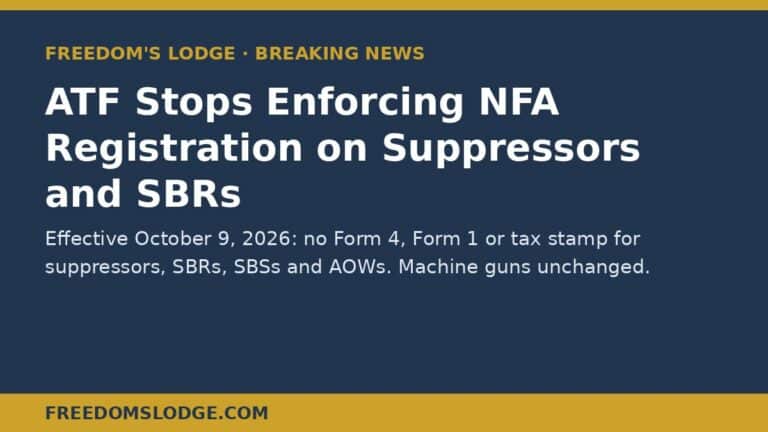
Update, October 10, 2026: On October 9, ATF stopped requiring a Form 4, Form 1, federal registration or a tax stamp for suppressors, SBRs, SBSs and AOWs, for everyone nationwide. State law still applies. What ATF’s October 9 guidance changes.
Suppressor ownership in 2026 is significantly different from 2025 — but not in every way that social media commentary suggests. The One Big Beautiful Bill Act eliminated the $200 NFA tax stamp. What it did not do is equally important to understand. This guide provides a clear, accurate summary of the current NFA suppressor framework for anyone considering their first purchase in 2026. This NFA suppressor facts 2026 changes guide covers what actually changed.

NFA suppressor facts — What the One Big Beautiful Bill Act Changed
The $200 Tax Stamp Is Gone
When you consider the NFA suppressor facts 2026 changes, the National Firearms Act of 1934 imposed a $200 transfer tax on suppressors (and other NFA items) as a de facto prohibition measure — $200 in 1934 was equivalent to approximately $4,400 in today’s dollars. The One Big Beautiful Bill Act (H.R. 1), signed July 4, 2025 and effective January 1, 2026, eliminated this tax. The cost of the NFA Form 4 tax stamp is now $0. The $200 that previously had to accompany every Form 4 application is no longer required. For a buyer purchasing a $999 suppressor, the total cost in 2026 is $999 — not $1,199.
Electronic Form 4 Approval Times
Separately from the tax stamp elimination, the ATF’s continued improvement of the eForm system has shortened Form 4 approval times significantly from the historical norm of 6 to 12 months. Electronic Form 4 approvals currently process in approximately 30 to 90 days for most applicants — a timeline improvement that makes suppressor ownership planning more practical than the previous open-ended wait. (See also: BANISH 30 Gold: The American Rifleman’s Quick-Detach Suppressor.)

What Has Not Changed
The NFA Registration Requirement
Suppressors remain Title II NFA items under the National Firearms Act. Every suppressor transfer must be accompanied by an approved ATF Form 4. You cannot purchase a suppressor without completing the Form 4 process. And you cannot transfer a suppressor to another person without completing a new Form 4 for that transfer. The NFA registration follows the suppressor, not the buyer.
ATF Background Check
The NFA suppressor facts 2026 changes the Form 4 background check process continues to apply. This is a more thorough background check than the NICS check used for standard firearms purchases — it includes a review of state and federal criminal history, mental health adjudications, and other disqualifying factors. The typical buyer who can legally purchase a standard firearm can also legally purchase a suppressor; the background check is more involved but not meaningfully more restrictive for law-abiding citizens.

State Law Compliance
State suppressor laws remain in effect. The 9 states that prohibit suppressor ownership have not changed as a result of the One Big Beautiful Bill Act. The federal tax elimination does not preempt state prohibition. Residents of California, Delaware, Hawaii, Illinois, Massachusetts, Minnesota, New Jersey, New York, and Rhode Island cannot legally possess suppressors regardless of the federal tax status.
Common Misconceptions About 2026 Suppressor Law
| Misconception | Reality |
| Suppressors are now unregulated | Still NFA-regulated; Form 4 still required |
| You can carry a suppressor anywhere | State law still applies; 9 states prohibit |
| No background check required anymore | ATF background check still required |
| You can sell a suppressor like a standard firearm | NFA transfer process still required |
| The $0 stamp means immediate possession | Form 4 approval time is still 30–90 days |
The Practical Bottom Line
In 2026, buying a suppressor costs $200 less than it did in 2025. The process is otherwise the same. For buyers who were waiting for the tax to be eliminated, 2026 is the year to act. For buyers who are new to NFA items, Silencer Central provides a free NFA Gun Trust, electronic Form 4 filing, fingerprints by mail, and direct delivery — the most complete managed NFA process available. See the complete first suppressor buying guide for the step-by-step process.
Day 70 of 100 Days of Silence
Day 70 — 30 days to go — features the BANISH 30-V2. Both giveaways close at 10:30 PM CT. See the 100 Days of Silence page, the winners page, and the Official Rules. For the complete BANISH lineup, see the BANISH Suppressor Comparison Guide.
Related 100 Days of Silence Articles
- BANISH 30 Gold: The American Rifleman’s Quick-Detach Suppressor
- BUCK 30 by BANISH: American Heritage Meets Suppressor Technology
- Why Every .22 Rifle Needs a Suppressor: A Second Amendment Perspective
About Silencer Central
Silencer Central was founded in 2005 by Brandon Maddox in Sioux Falls, South Dakota. What started as a basement operation at gun shows has grown into America’s largest direct-to-consumer suppressor dealer, licensed in all 42 states where suppressors are legal and with more than 100,000 ATF eForm approvals completed.
Maddox serves on the boards of the Congressional Sportsmen’s Foundation and the National Shooting Sports Foundation. He received the NRA’s 2024 Golden Bullseye Pioneer Award — the publication’s highest individual recognition for lasting contributions to American shooting sports. He is the only suppressor industry representative on the ATF advisory board.
Silencer Central carries a 4.0 out of 5.0 rating on Trustpilot from more than 27,000 verified buyer reviews and holds an A+ rating with Better Business Bureau Honor Roll status. Their process includes a free state-specific NFA gun trust, all paperwork managed electronically, fingerprint kit mailed to the buyer, and direct-to-door delivery once approved. As of January 1, 2026, the $200 federal transfer fee has been eliminated under the One Big Beautiful Bill Act, and ATF eForm 4 processing averages approximately 11 days.
Who Should Buy the generic
The American shooter exercising a consti. The American shooter exercising a constitutional right and supporting the suppressor industry. The generic fits this use case because of its weight, sound reduction, and construction.
The heritage firearm owner. The heritage firearm owner who wants suppression on classic American-made rifles and pistols. The generic fits this use case because of its weight, sound reduction, and construction.
The Second Amendment advocate. The Second Amendment advocate who sees the $0 transfer fee as a step toward full deregulation. The generic fits this use case because of its weight, sound reduction, and construction.
The veteran or first responder building . The veteran or first responder building a hearing-safe setup after years of occupational exposure. The generic fits this use case because of its weight, sound reduction, and construction.
Frequently Asked Questions
Is the generic hearing safe?
At a muzzle reading of approximately 134 dB, the generic brings most host firearms below the 140 dB threshold for impulse noise. Hearing safety depends on caliber, barrel length, and ammunition. Subsonic loads produce lower readings. Always verify with your specific host and ammunition combination.
How long does ATF approval take for the generic?
As of 2026, ATF eForm 4 processing averages approximately 11 days. The $200 federal transfer fee was eliminated on January 1, 2026 under the One Big Beautiful Bill Act. Silencer Central handles all paperwork electronically and notifies buyers when approval arrives.
Can I use the generic on more than one firearm?
Yes. The generic uses a direct thread system. With appropriate thread adapters, it can move between compatible host firearms. Silencer Central carries all necessary adapters for common thread pitches.
Read More About suppressors Across Our Network
- How Suppressors Work: The Science Behind BANISH Sound Reduction — PopularSuppressors.com
- 100 Days of Silence: The Finale — 100 Days, 200 Giveaways, 200 Suppressors Won — PopularSuppressors.com
- 100 Days of Silence: Halfway Through — The Best Suppressors of Days 1–50 — CurrentHomesteading.com
- Day 99: One Day Before the 100 Days of Silence Finale — CurrentHomesteading.com
Official Resources and Further Reading
- Find Your Silencer — Silencer Central
- How to Buy a Suppressor — Silencer Central
- Why Silencer Central
- ATF NFA Firearms Overview


Reader Favorites
- Virginia’s Gun-Hating Governor vs. Virginia
- Los Angeles Gun-Grabbers Confused, Terrified by Bill of Rights
- Guns at Coronavirus Quarantine Protests: Listen For the Loudest Scream
- Supreme Court Second Amendment Cases: Careful What You Wish For
- Has COVID-19 Secured the Second Amendment’s Future?
- Defending the Defensive Blade: New Knife Rights App
Gun-owner reference desk
Plain-English references worth bookmarking — NFA rules, carry law, and the gear terms behind every review.
| 2026 at a glance | |
|---|---|
| NFA tax stamp | $0 |
| Permitless carry | 29 states |
| Suppressors legal | 42 states |
50+ NFA, carry and gun-law terms in plain English, updated for 2026.
Open the glossary → Network| Term | Category |
|---|---|
| Striker-fired | Action |
| MOA | Optics |
| Twist rate | Ballistics |
30 gun, ammo and optics terms, from Guns & Gadgets Daily.
View full chart →