How to Survive an Active Shooter: A Practical 2026 Guide
Knowing how to survive an active shooter is no longer a niche skill — it is basic preparedness for anyone who spends time in public. The federal Run-Hide-Fight model gives you a simple decision framework, and the August 2026 Twin Falls In-N-Out shooting shows how quickly ordinary people have to make life-or-death choices.
Last updated: August 7, 2026 · Originally published August 6, 2026
Updated August 2026 · By James Nicholas
This guide covers how to survive an active shooter step by step, what the data says about armed citizens, and how to build the awareness that keeps you ahead of a threat.
On This Page
Key Takeaways
- Run first: If there is a safe escape path, leave everything and get out.
- Hide smart: If you can’t escape, lock and barricade, silence your phone, stay out of sight.
- Fight as a last resort: If your life is in immediate danger, commit fully to stopping the attacker.
- Armed citizens matter: Independent analysis finds civilians stop a large share of active-shooter attacks, especially outside gun-free zones.
- Awareness wins: The earlier you notice a threat, the more options you keep.


How to Survive an Active Shooter: Run, Hide, Fight
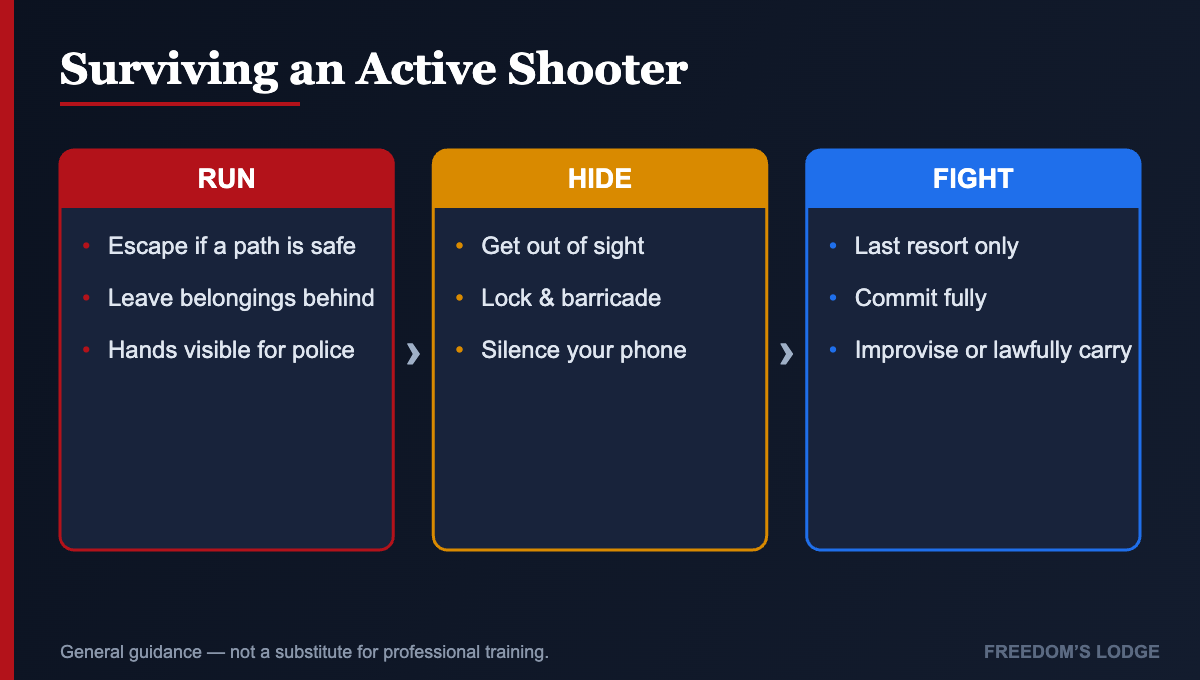
The Department of Homeland Security and FBI teach a three-part response, in order of preference: Run, Hide, Fight. It is not a rigid script but a priority list. Your goal is distance and cover first, concealment second, and direct confrontation only when there is no other choice.
Run: Get Out
If there is an accessible escape route, take it. Leave belongings behind, help others if you can, and keep your hands visible when you reach police. Do not let indecision or the urge to record video cost you seconds. Movement away from the threat is almost always your best survival tool.
Hide: Deny Access
When you cannot run, get out of the shooter’s line of sight and put a locked, barricaded door between you and the threat. Silence your phone, turn off the ringer and vibrate, spread out from others, and stay quiet. Look for improvised weapons in case Fight becomes necessary.
Fight: Commit Fully
If the attacker reaches you and your life is in immediate danger, fighting back is a legitimate option. Improvise weapons, act aggressively, and commit completely — hesitation helps the attacker. For lawfully armed citizens, this is where training and a reliable carry gun can change the outcome, as it did in Twin Falls.
The Armed Citizen Factor
How often do armed citizens actually stop these attacks? It depends on who is counting. The FBI’s active-shooter reports for 2014–2024 credited armed civilians with stopping about 3.7% of incidents (14 of 374). A 2025 Crime Prevention Research Center analysis, using the FBI’s own definition, identified 561 incidents and found armed citizens intervened in 202 of them — roughly 36%. When gun-free zones are excluded and civilians were actually allowed to be armed, that figure rose to about 52.5%, and in 2024 alone reached 62.5%.
Excluding gun-free zones, armed citizens stopped an estimated 52.5% of active-shooter attacks — and 62.5% in 2024.— Crime Prevention Research Center analysis
Researchers attribute the gap to cases the FBI missed or misclassified. The bureau’s own figures understate reality, and the direction is unmistakable: where law-abiding people can carry, they stop a large share of attacks. Twin Falls is one more data point in that column. The lesson is the one gun owners have always known: the fastest way to stop a bad guy with a gun is a good guy who already has one. Choosing a gun you will carry every day — see our best concealed carry handgun picks — is the first step to being able to respond.
Situational Awareness Comes First
Every survival option improves when you notice the threat early. Practice a relaxed, alert baseline in public: know where the exits are, watch for people who seem out of place or agitated, and trust the instinct that something is wrong. Keep your head up and your phone down in transitional spaces like parking lots and entrances, where many attacks begin. Our everyday concealed carry tips go deeper on building that habit.
What to Do When Police Arrive
Responding officers are focused on stopping the threat, not helping the wounded yet. Keep your hands empty and visible, follow commands instantly, and avoid pointing or grabbing. If you are a lawfully armed citizen, be prepared to holster or set down your firearm and clearly identify yourself as police direct.
Frequently Asked Questions
What is the first thing to do in an active shooter situation?
Run if you can. If a safe escape route exists, leave everything behind and get away from the threat. Escaping is the top priority in how to survive an active shooter.
Does Run-Hide-Fight really work?
It is the framework taught by the FBI and DHS because it gives a clear priority order under stress: escape first, conceal and barricade second, and fight only as a last resort.
How often do armed citizens stop active shooters?
Estimates vary. The FBI counted about 3.7% for 2014–2024, while a Crime Prevention Research Center analysis put it near 36% overall and over 52% outside gun-free zones.
Should I fight back against an active shooter?
Only as a last resort when your life is in immediate danger. If you must fight, commit fully and use any improvised or lawfully carried weapon available.
▶ Watch: Active Shooter Response with Rob Pincus — Personal Defense Network, via YouTube
▶ Watch: Inside The Ranch TX: Tactical Training Facility — The Ranch TX, via YouTube
More Second Amendment Coverage from Freedom’s Lodge
- In-N-Out Shooting: How Two Armed Citizens Stopped the Twin Falls Gunman
- Best Concealed Carry Handguns for 2026
- CCW Insurance: Legal Protection for Armed Citizens
- Everyday Concealed Carry Tips

About the Author — James Nicholas
James Nicholas is a firearms and Second Amendment writer for Freedom’s Lodge, covering concealed carry, gun rights, and self-defense for law-abiding Americans. He curates and compares gear, law, and news from manufacturer data, official sources, and the consensus of experienced shooters.

Reader Favorites
Gun-owner reference desk
Plain-English references worth bookmarking — NFA rules, carry law, and the gear terms behind every review.
| 2026 at a glance | |
|---|---|
| NFA tax stamp | $0 |
| Permitless carry | 29 states |
| Suppressors legal | 42 states |
50+ NFA, carry and gun-law terms in plain English, updated for 2026.
Open the glossary → Network| Term | Category |
|---|---|
| Striker-fired | Action |
| MOA | Optics |
| Twist rate | Ballistics |
30 gun, ammo and optics terms, from Guns & Gadgets Daily.
View full chart →