Robert Cekada, ATF Director: Career, Confirmation, and 2A Posture
Robert Cekada, sworn in as ATF director on April 30, 2026, is the first career agent to lead the bureau in its 53-year history.
Robert Cekada ATF director took office with the bureau already mid-overhaul. Within 24 hours of his confirmation, Cekada announced the largest deregulatory package in ATF’s 53-year existence — the 34-rule “new era of reform” now working its way through the Federal Register. This is who he is, what he said on the record, and what gun owners should reasonably expect from his tenure.
Updated September 3, 2026. Re-checked against the Federal Register. The 34-rule package did not trickle out over the summer as this piece originally said — 27 proposed rules published on May 6 and May 8, 2026, together with a half-dozen final rules that took effect immediately. Comment windows have since closed and final rules are now issuing; the first, on restoring federal gun rights, published August 20, 2026 (91 FR 54054) and takes effect September 21.

Who is Robert Cekada, ATF director, in plain biography
Robert Cekada is a New York-born, Florida-raised career law enforcement officer who joined the Bureau of Alcohol, Tobacco, Firearms and Explosives as a special agent in 2005, rose through the chain of command for two decades, and was sworn in as the agency’s 11th director on April 30, 2026. According to the introduction Senator Jerry Moran (R-KS) read into the confirmation-hearing record, Cekada’s parents fled communism — a biographical detail that surfaces frequently in his own public statements about why he chose law enforcement.
Per his official ATF bio at atf.gov/about/leadership/director and the prior Deputy Director biography preserved on the agency site, his career path is:
- 1992-2000 — New York City Police Department officer. Started as a cadet. Assigned to Housing Bureau, Citywide Anti-Gang Enforcement Unit, and Street Crime Unit. Promoted to detective in 1999. Transferred to Organized Crime Control Bureau, Gang Division, focused on gun violence attributable to gang activity.
- 2001-2005 — City of Plantation Police Department (Broward County, FL). Patrol Division and Special Weapons and Tactics (SWAT) Team.
- 2005-2011 — ATF Special Agent, Baltimore Field Division, Hyattsville II Field Office. Regional Area Gang Enforcement Task Force.
- 2011-2013 — Tampa Field Division.
- 2013-2015 — ATF Headquarters, Frontline Branch project officer in the Firearms Operations Division.
- Resident Agent in Charge — High Intensity Drug Trafficking Area (HIDTA) Task Force North, Miami Field Division.
- Assistant Special Agent in Charge — Philadelphia Field Division.
- Special Agent in Charge — Baltimore Field Division, then Miami Field Division.
- January 2022 – September 2022 — Deputy Assistant Director Central, Field Operations. Operational and regulatory oversight of 19 central-region states.
- September 2022 – April 2025 — Executive Assistant Director for Operations. Oversaw Office of Regulatory Operations, Office of Field Operations, and Office of Intelligence Operations.
- April 2025 – April 2026 — Deputy Director (the #2 position at ATF).
- April 30, 2026 — Sworn in as Director.
He also serves on the National Crime Gun Intelligence Governing Board and the International Association of Chiefs of Police (IACP) Firearms Committee.
The Robert Cekada ATF director confirmation timeline
President Trump nominated Cekada in November 2025. The Senate Judiciary Committee held his confirmation hearing on February 4-5, 2026, chaired by Senator Chuck Grassley (R-IA), with Senator Moran formally introducing him. NSSF sent a letter to Grassley and ranking member Dick Durbin (D-IL) expressing “strong and unqualified support” for confirmation. The committee favorably reported the nomination. Senate floor action on cloture and confirmation took place across April 22, April 27, and April 29, 2026, per the Congressional Record. Cekada was sworn in April 30, 2026.
The full Senate vote was a simple majority. Cekada faced little organized opposition; Senator Durbin’s questioning at the hearing was limited to a single question about ATF agents being detailed to ICE, which Cekada answered directly. NSSF’s letter to the committee noted Cekada’s 30+ years in law enforcement, including over 20 years at ATF.
What Robert Cekada, ATF director, said on the record
The clearest window into the new director’s posture is the confirmation-hearing transcript and his April 29 press conference unveiling the 34-rule package.
On ATF’s core mission, from his opening statement to the Senate Judiciary Committee: “I’ve spent nearly thirty-four years in local and federal law enforcement with a singular mission — keeping the American people safe. ATF’s core mission is public safety: targeting violent criminals and disrupting firearms trafficking networks, armed gangs and cartels.”
On Second Amendment posture: “ATF’s mission is not to burden lawful gun owners or undermine the Second Amendment. The right to keep and bear arms is a Constitutional guarantee and I am committed to protecting and preserving it.”
On regulatory modernization, in his hearing exchange with Chairman Grassley: “The top priorities for the ATF will remain violent crime, illegal use of firearms, explosives and the illegal use of arson. We will modernize critical systems, forms and licensing systems, which are over 25 years old and unnecessarily burden people, and we will follow President Trump’s Second Amendment order to review all of ATF’s rules to make sure we don’t infringe upon Americans unnecessarily.”
On agency culture, also at the hearing: “Senator, I can assure you that under my watch the ATF has been 1,000-percent successful in going after people who have committed violent crimes. We’re not here to burden the American citizen who has a complete right to exercise their Second Amendment right to bear arms, and we will not do that in the future if I am so confirmed.”
For gun owners: these are the most pro-rights public statements made by an ATF director nominee in the agency’s history. Whether the administrative record matches the rhetoric is what the next 18 months tell.

What Robert Cekada, ATF director, has already done
Within 24 hours of his confirmation, on April 29, 2026, Cekada announced the “new era of reform” package — 34 rule changes targeting bump stocks, pistol braces, the “engaged in the business” dealer rule, Form 4473, electronic recordkeeping, NFA registration procedures, and import classifications. The package hit the Federal Register almost at once: 27 proposed rules across May 6 and May 8, 2026, plus a half-dozen final rules that took effect without a comment period. Our full breakdown is at the ATF new era of reform piece.
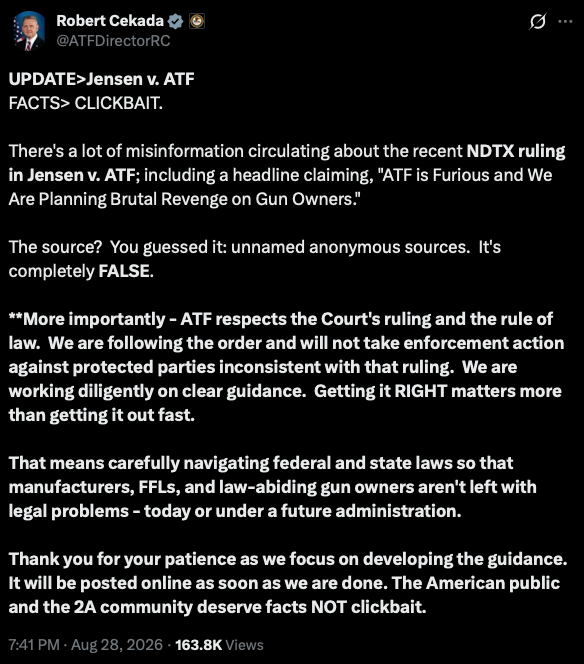
The structural moves Cekada announced before the rule package were also worth noting. Per the ATF.gov reform page, since taking over operations he has:
- Ended the Enhanced Regulatory Enforcement Policy that had targeted FFLs.
- Published a new Administrative Action Policy emphasizing firearm traceability and public safety while deemphasizing “immaterial paperwork errors.”
- Encouraged FFLs whose licenses were revoked or surrendered under the prior policy to reapply.
- Removed revoked FFL inspection reports from ATF’s public website.
- Instituted a NICS alert policy restricting use of alerts to federal firearms trafficking violations.
- Established a Senior Industry Partnership Advisor/Liaison within the Office of the Director (industryliaison@atf.gov).
- Established a classifications board requiring all new firearm classifications to be reviewed and approved by the Office of the Director before publication.
- Reversed the ban on importation of non-lethal training ammunition.
- Reversed the ban on importation of dual-use barrels.
For FFLs, the Administrative Action Policy change is the most material structural move. For NFA buyers, the classifications board change is the most material. Both are operational shifts that don’t require notice-and-comment rulemaking.
The Cekada-era ATF distinction: career agent, not political appointee
Cekada is the first ATF director in recent memory who held the Deputy Director position before promotion. The previous Senate-confirmed director, Steven Dettelbach, was a former U.S. Attorney with no ATF agent experience. Acting Director Daniel Driscoll was concurrently serving as Army Secretary. Cekada has worked the agency for over 20 years and made cases at every level — the line he repeatedly used in the hearing was “I’ve done this job from a ground level police officer to a task force officer with the Attorney General. I’m not telling people to go out and make the cases. I’ve made the cases myself.”
What this means for gun owners: agency-internal credibility, deep institutional knowledge of which rules are working and which aren’t, and a working relationship with the ATF agents who will be implementing whatever rules survive the comment period.
Frequently asked questions
When was Robert Cekada sworn in as ATF director?
April 30, 2026. The Senate confirmed him on April 29, 2026 by simple majority vote after a Senate Judiciary Committee hearing held February 4-5, 2026, chaired by Senator Chuck Grassley.
What was Robert Cekada’s role before becoming ATF director?
He served as ATF Deputy Director from April 2025 to April 2026 — the #2 position in the agency.
How long has Robert Cekada worked at ATF?
Cekada joined ATF as a special agent in 2005. As of his April 30, 2026 swearing-in as director, he has 21 years at the bureau and 34 years in total law enforcement (including eight years at NYPD and four years at City of Plantation Police Department in Florida).
What did Robert Cekada announce on his first day as ATF director?
On April 29, 2026 — minutes after his Senate confirmation — Cekada announced the “new era of reform” package, 34 rule changes targeting bump stocks, pistol braces, FFL dealer licensing, Form 4473, electronic recordkeeping, NFA registration, and import rules.
Who endorsed Robert Cekada for ATF director?
NSSF sent a letter expressing “strong and unqualified support” for confirmation. The NRA, GOA, and other gun-rights organizations also publicly supported his nomination.
Is Robert Cekada a sworn law enforcement officer as ATF director?
Yes. Cekada specifically noted at his confirmation hearing that “unlike some prior ATF directors, I will still be a sworn law enforcement officer.”
What to watch over the next 18 months
The administrative test of the Cekada-era ATF is whether the 34-rule package’s final rules — the ones now emerging from comment windows that closed over the summer — track the regulatory text in the NPRMs. The political test is whether the agency posture announced at the April 29 press conference holds up under the next inevitable mass-shooting news cycle. The institutional test is whether the Cekada-era classifications board actually prevents the kind of classification chaos that produced the brace rule in the first place.
For gun owners: the Cekada-era ATF is the most consequential personnel change at the agency in a decade. The new director is a career agent who knows the building. That is either the best news 2A advocates have gotten in a generation or a faster way to professionalize the regulatory state. The next 18 months tell.
What ATF-rule story do you most want tracked across this director’s tenure? Reply on X to @therealxdman.
Last updated September 3, 2026. Primary sources: Federal Register (91 FR 24348–24485, May 6, 2026; 91 FR 25112–25243, May 8, 2026; 91 FR 54054, August 20, 2026); ATF.gov director biography, preserved ATF.gov Deputy Director biography (April 14, 2025), AmmoLand confirmation-hearing coverage by Lee Williams (Feb 6, 2026), NSSF letter to Senate Judiciary Committee (Feb 5, 2026, Larry Keane), Congressional Record entries CRI-2026-CEKADA-ROBERT.
Reader Favorites
- Hot Take: Viridian V-Series Long-Range Illuminators
- Officer Justifiably Shoots Good Guy: Lessons For Armed Citizens
- Be Your Own AR-15 Armorer With This Kit
- Mossberg Celebrates Century With New CCW Pistol
- CCW Central: Check Out Concealed Carry Expo this May in Pittsburgh
- Free Self-Defense Videos From Viridian Weapon Tech
Gun-owner reference desk
Plain-English references worth bookmarking — NFA rules, carry law, and the gear terms behind every review.
| 2026 at a glance | |
|---|---|
| NFA tax stamp | $0 |
| Permitless carry | 29 states |
| Suppressors legal | 42 states |
50+ NFA, carry and gun-law terms in plain English, updated for 2026.
Open the glossary → Network| Term | Category |
|---|---|
| Striker-fired | Action |
| MOA | Optics |
| Twist rate | Ballistics |
30 gun, ammo and optics terms, from Guns & Gadgets Daily.
View full chart →