Trump NFA Pardons Four Gun Owners Walk Free. The NFA Doesn’t.
President Trump pardoned four men convicted under the National Firearms Act. The law itself did not change — the NFA still stands.
Last updated: October 9, 2026 · Originally published September 5, 2026
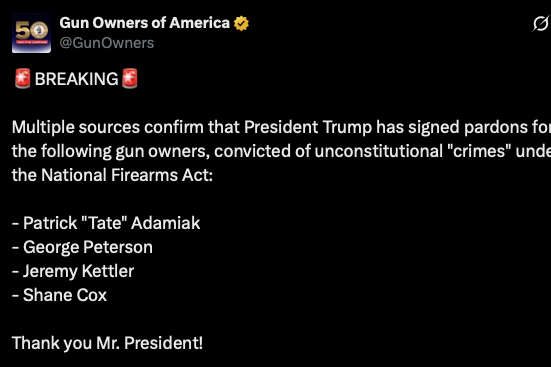
Gun Owners of America dropped the news Friday that President Trump signed pardons for four men convicted of National Firearms Act violations that 2A advocates have long called regulatory overreach, not real crime.

The four: Patrick “Tate” Adamiak, George Peterson, Jeremy Kettler, and Shane Cox. All were convicted of possessing, making, or transferring items the NFA treats as extra-special (machine guns, suppressors, short-barreled rifles, “destructive devices”). None of the cases involved violence, straw purchases for criminals, or anyone getting shot. They involved collectors, a small home-based dealer, a surplus-store owner who believed his state’s law, and a combat veteran who wanted to protect his hearing.
The NFA is the 1934 law that added a $200 tax stamp and a federal registry to certain firearms and accessories. In practice, the ATF has spent decades stretching definitions, using confidential informants with their own problems, and treating unfinished parts or replica collectibles as if they were ready-to-rock machine guns. These four cases show how that approach works when the target is a regular guy instead of an actual trafficker.

Patrick “Tate” Adamiak: Navy Sailor, Parts Seller, 20-Year Sentence for Toys and Flats
Tate Adamiak was an active-duty Navy E-6 Master-at-Arms who had been accepted to BUD/S, the pipeline to become a SEAL. He also ran a side business selling gun parts and military collectibles on GunBroker and his own site. He has said he never sold a completed firearm that required an FFL.
In April 2022, ATF agents raided his Virginia Beach home after a paid confidential informant (who was facing his own felony charges) claimed Adamiak had an Mk-19 grenade launcher. What they found were cut-up demilled parts kits, inert RPG-7 launchers with holes drilled in the receivers and internals removed, a cheap Denix non-firing STEN replica, pre-ban open-bolt semi-autos, unfinished MAC “flats” (sheet-metal pieces), and similar items. ALL of those exact products are still sold commercially today with no paperwork.
The government’s expert added barrels, live bolts, and other parts That were never in Tate’s possession until some of the items would fire a single round, then classified them as machine guns or destructive devices. A jury convicted Adamiak in 2023. The judge stacked the counts and handed down 20 years. Even the current ATF director later called that sentence excessive for a non-violent possession case with no evidence the items were used for anything but collecting.
Adamiak spent more than four years inside. His family, lawyers, journalists, and groups like SAF and GOA kept the case in the spotlight. On Friday he walked out. “The feeling of freedom is surreal,” he said. “Thank you to President Donald J. Trump for granting me a full and unconditional pardon and giving me my life back.”

George Peterson: Licensed Dealer, Family Raid, Two Years for a Homemade Can in the Safe
George Peterson ran PDW Gun Solutions LLC out of his Waggaman, Louisiana, home. He was a licensed FFL. In June 2022 a large tactical team with rifles pointed at him and his kids, then 12, 16, and 18, hit the house and attached shop after months of ATF investigation into sales reporting and undercover buys.
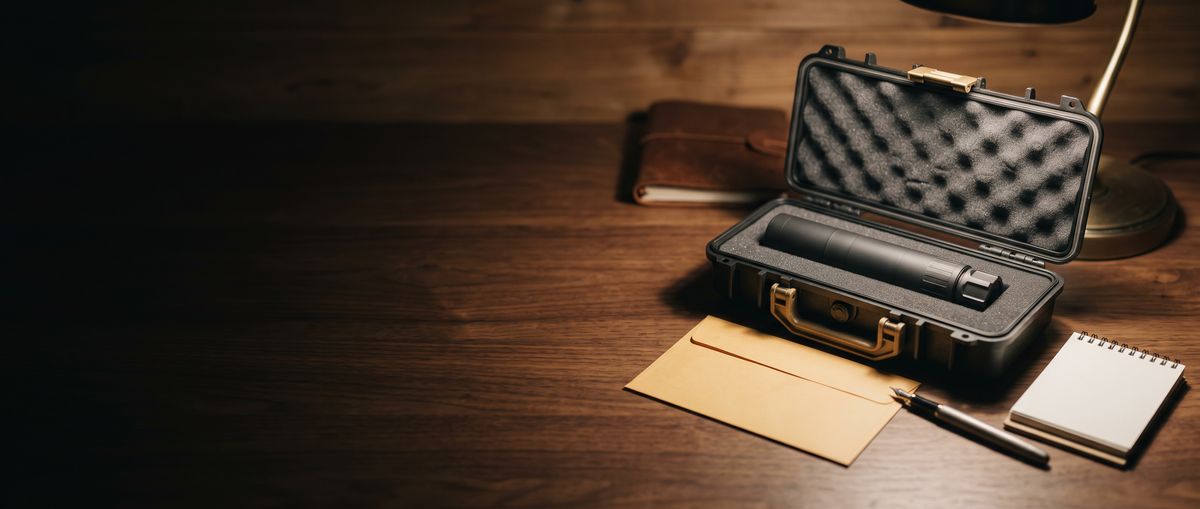
Most of the original probable-cause claims evaporated. What they charged him with was a homemade, unserialized suppressor (a milled solvent-trap kit) found in a bedroom closet safe. He had used it on a .22 for varmints and snakes around the property. It was not registered in the NFA book. That was the whole case.
Peterson took a conditional guilty plea so he could appeal. He got 24 months plus three years of supervised release. His lawyers argued the NFA’s tax-and-registration scheme for suppressors fails the Bruen test. The Fifth Circuit disagreed, calling suppressors “accessories,” not “arms.” The Supreme Court declined to take the case. Peterson became the test case everyone watched.
In a statement to GOA after the pardon he said: “My case was the proverbial ‘tip of the spear’ in taking down the unconstitutional NFA. Our fight for liberty is far from over.” The two-year sentence is over.
Shane Cox: Kansas Surplus Store Owner Who Posted the State Law on the Wall
Shane Cox ran Tough Guys, an army-surplus shop in Chanute, Kansas. After Kansas passed the 2013 Second Amendment Protection Act, claiming firearms, accessories, and ammo made and kept inside the state were exempt from federal rules. Cox started making and selling homemade silencers. He posted a copy of the state law in the store and stamped “Made in Kansas” on the products. He also had a short-barreled rifle. He believed the state statute protected him.
ATF learned about the sales (Facebook posts helped) and investigated. A jury convicted him in 2016 on eight counts of making, transferring, and dealing in unregistered NFA items. He was not sent to prison; the judge gave him two years of probation after noting the men had relied on the Kansas law. The felony convictions still cost him his gun rights. The 10th Circuit and Supreme Court left the convictions standing. Kansas lawmakers later passed a resolution asking President Trump to pardon both men.
Jeremy Kettler: Combat Veteran Who Bought Hearing Protection From Cox
Jeremy Kettler is a disabled Army veteran who served in Iraq and Afghanistan. He grew up in rural Kansas, the oldest of ten kids. After coming home with damaged hearing, he bought one of Cox’s homemade silencers to keep from making it worse. He posted about it on Facebook. That post helped ATF find him.
He was convicted of possessing an unregistered silencer and received one year of probation. Like Cox, he thought Kansas law covered the transaction. The federal courts said state law does not override the NFA. The felony still barred him from owning guns. The pardon wipes that away.
A Step Forward, Not the Finish Line
These pardons are a good day. Four men who never hurt anyone get their lives and their rights back. The president used the pardon power the way it was meant to be used: to correct a raw deal when the courts and the bureaucracy would not. It sends a message that treating a collector, a small dealer, or a veteran like a cartel boss over paperwork and parts is no longer the default setting.
That matters for the Second Amendment. These cases were never about “keeping guns out of the wrong hands.” They were about stretching a 90-year-old tax statute until ordinary people became felons. When the government can turn a toy replica, an unfinished flat, a homemade suppressor in a bedroom safe, or a can bought under a state law into a 20-year sentence, the right to keep and bear arms starts looking like a privilege the ATF can revoke on a technicality. Pardoning these four chips away at that idea. It tells future prosecutors that victimless NFA cases will not automatically be treated like terrorism.
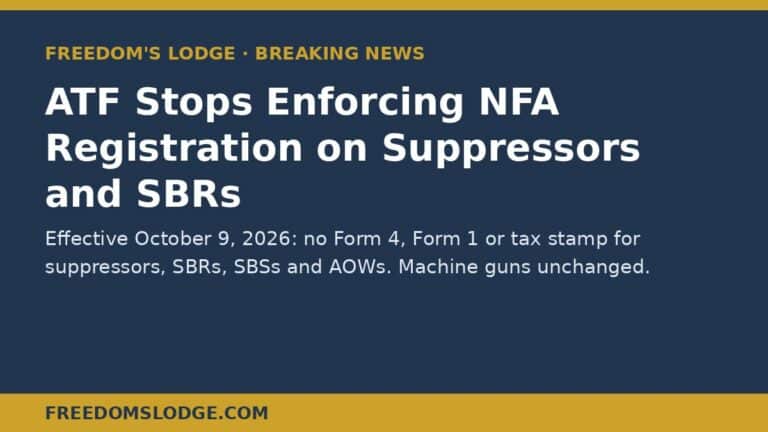
It also puts a spotlight on the unfinished business. The NFA is still on the books. Registration requirements remain even after the tax stamp was reduced to zero in some recent legislation. Courts have been inconsistent with one circuit saying suppressors are not even “arms,” and others dancing around Bruen and Heller. State laws like Kansas’s SAPA still lose when they collide with federal power. Thousands of other gun owners sit in the same gray zone these four used to occupy. The ATF’s habit of adding parts in the lab and then calling the original item illegal did not disappear overnight.
George Peterson said it best after his pardon: the fight for liberty is far from over. These four men are free. The 1934 law that put them there is not. That is the next job.
This is most important thing you will read, and you NEED to pass on
If you like seeing cases like these get the attention they deserve, consider supporting the people who actually break the news and do the work. They are a no-compromise Second Amendment lobby that has been around since the mid-1970s. They lobby Congress and state legislatures, file lawsuits and amicus briefs in cases that reach the Supreme Court, fight ATF rulemaking, grade candidates on their actual voting records, and mobilize members when a bill or a prosecution threatens gun owners. They do not endorse “gun control lite.” They treat the Second Amendment as a freedom issue, not a bargaining chip. A donation to GOA helps keep that pressure on. Visit gunowners.org if you want to help.
And while you are thinking about it, look at the calendar. Midterm elections are coming in November. Every House seat, a third of the Senate, and thousands of state and local races will be on the ballot. Those races decide who writes the next gun bill, who funds or defunds the ATF, who sits on the courts, and who sets the tone for the next round of NFA or “assault weapon” fights. If you value the Second Amendment, treat those races like they matter. Vote like your life and your freedom depend on it. Because they do.


Reader Favorites
- Hot Take: Viridian V-Series Long-Range Illuminators
- Officer Justifiably Shoots Good Guy: Lessons For Armed Citizens
- Honored American Veterans Afield & NSSF Raise Funds For Disabled Vets
- Be Your Own AR-15 Armorer With This Kit
- Smells Like Infringement: Gun Banners in the News
- Smells Like Infringement: Gun Banners in the News (As Usual)
Gun-owner reference desk
Plain-English references worth bookmarking — NFA rules, carry law, and the gear terms behind every review.
| 2026 at a glance | |
|---|---|
| NFA tax stamp | $0 |
| Permitless carry | 29 states |
| Suppressors legal | 42 states |
50+ NFA, carry and gun-law terms in plain English, updated for 2026.
Open the glossary → Network| Term | Category |
|---|---|
| Striker-fired | Action |
| MOA | Optics |
| Twist rate | Ballistics |
30 gun, ammo and optics terms, from Guns & Gadgets Daily.
View full chart →