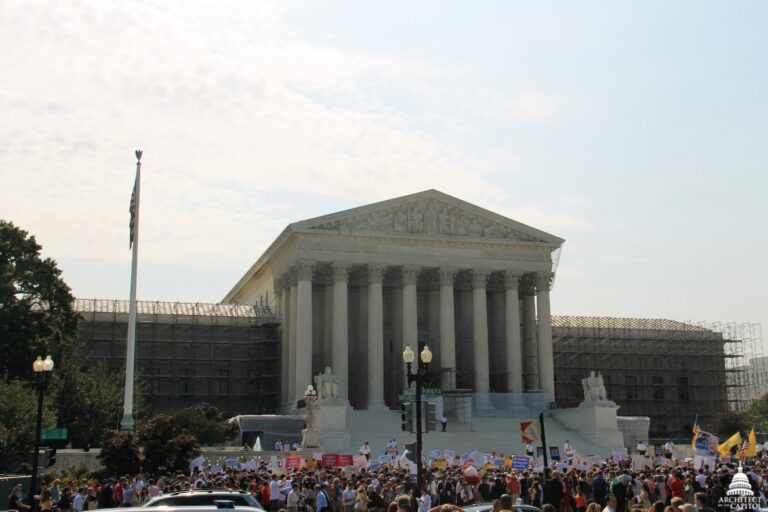
Second Amendment News This Week: Rights Restored, Rules Fall
The Second Amendment news this week was written almost entirely in the executive branch and the district courts: the Justice Department reopened a gun-rights restoration process that had been dead for more than three decades, a federal judge put the Biden-era “frame or receiver” rule on the wrong side of both the Second and Fifth Amendments, the three biggest gun-rights groups in the country joined forces against New York’s Glock ban, the magazine cases stacked up for the Supreme Court’s September conference, and California shipped three gun bills to the governor’s desk. Here are the five stories that matter most to gun owners, what each one actually did, and what happens next.
Last updated: September 3, 2026 · Originally published August 27, 2026
The week at a glance
| Date | What happened | Why it matters |
|---|---|---|
| Aug. 20 | DOJ’s firearm rights restoration rule hits the Federal Register | First working § 925(c) path in more than 30 years |
| Aug. 24 | NRA-ILA analysis lands on the Aug. 17 Defense Distributed ruling | Frame-or-receiver rule held to violate the Second and Fifth Amendments |
| This week | NRA, SAF and FPC press Firing Pin, LLC v. James | New York’s “convertible pistol” ban sweeps in most Glocks |
| Aug. 26 | Magazine cases still held, expected at the Sept. 28 long conference | Duncan, Gator’s and NAGR all await a cert decision |
| Aug. 26 | California sends SB 948, SB 1220 and AB 1743 to the governor | Four-hour live-fire mandate, new prohibiting misdemeanor, wider data sharing |


A real path back: the DOJ reopens federal gun rights restoration
On August 20, the Justice Department’s final rule creating a functioning federal firearm rights restoration process was published in the Federal Register, three days after Attorney General Todd Blanche announced it as one of his first acts in office. The rule takes effect September 21, 2026, and creates a new 28 C.F.R. Part 107 governing applications.
The statute at the center of this has been on the books the entire time. Under 18 U.S.C. § 925(c), a person who has lost the right to possess firearms can apply to the Attorney General for relief from that federal disability. Congress never repealed it — starting in the early 1990s it simply stripped the funding ATF needed to process the applications, leaving the statute technically alive and practically useless for more than three decades.
The new rule restores the machinery. It is not an amnesty, and DOJ is blunt about that. Relief is neither automatic nor guaranteed: each applicant has to satisfy the Attorney General that the circumstances behind the prohibition, along with the applicant’s record, reputation and subsequent conduct, show the person is not likely to act in a way dangerous to public safety and that relief would not be contrary to the public interest. The rule builds in presumptive disqualification periods — at least 10 years after a violent offender finishes a sentence, five years for other felony convictions — and strong presumptions against relief. Absent extraordinary circumstances, violent felons, registered sex offenders, illegal aliens and others DOJ considers an ongoing danger stay presumptively ineligible. The rollout is staged rather than an open door on day one: the Justice Department’s program page says the application window opens November 4, 2026, and that it will take the first 5,000 applications.
Two limits matter before anyone gets their hopes up. Relief under this rule removes federal firearms disabilities only — if your state independently prohibits you, that prohibition survives untouched. And this is an individualized, discretionary process, not a category-wide fix, so the early application waves will tell us far more than the rule text does. The Justice Department has set up a Federal Firearm Rights Restoration Program page with eligibility information and instructions. U.S. Pardon Attorney Edward Martin described the program as “a pathway for restoration for the 30 million Americans who have lost their Second Amendment rights.” That is Martin’s figure for how many people carry a disability of some kind, not a forecast of how many will qualify — but it captures why this is the most consequential item of the week for individual gun owners.
Update, September 3, 2026. The Justice Department has begun publishing the grants. A Federal Register notice on August 27, 2026 (91 FR 55362) names nine people granted relief from federal firearms disabilities under § 925(c) — eight on May 18, 2026 and one on August 5, 2026, all signed by then-Acting Attorney General Todd Blanche. Two details are worth reading carefully. First, § 925(c) obliges the Attorney General to publish every grant in the Federal Register, so these notices are the running public record of how often relief is actually granted. Second, the notice says the department reviewed materials each person had submitted seeking either a pardon or relief from Federal firearms disabilities — these nine came through the existing route, not through the new process. The Part 107 rule still takes effect September 21, and the application window described above still opens November 4, 2026.
The frame-or-receiver rule now has a constitutional problem, not just a statutory one
Chief Judge Reed O’Connor’s opinion in Defense Distributed v. Blanche, out of the Northern District of Texas, landed on August 17 and got its full reading this week. The court held that portions of the ATF’s 2022 “frame or receiver” rule — specifically parts of 27 C.F.R. §§ 478.11 and 478.12(c) — are unconstitutional on two independent grounds: the Second Amendment and the Fifth Amendment’s due process guarantee.
That distinction is the whole story. When the Supreme Court decided Bondi v. VanDerStok in March 2025, it answered a narrow statutory question — whether ATF had room under the Gun Control Act to reach certain unfinished frames and parts kits — and said yes, 7–2. It did not decide whether ATF’s exercise of that authority passed constitutional muster. This ruling is the court finally reaching that second question, and answering no.
On the Second Amendment, O’Connor wrote that the rule “does not merely lack supporting analogues. It contradicts the actual historical tradition of personal gunsmithing.” Self-manufacture of firearms in America, the opinion says, was common and indeed foundational to establishing the Nation. On vagueness, the court found that deciding when a piece of metal or plastic “may readily be completed, assembled, restored, or otherwise converted” is left to ATF’s subjective judgment and gives ordinary people no fair notice of when a component becomes a regulated firearm. For the historical record the opinion cites a 2023 law review article by Joseph Greenlee, “The American Tradition of Self-Made Arms”; Greenlee is NRA-ILA’s Director of Litigation.
The relief is party-specific rather than a nationwide vacatur, which is the honest caveat here — the rule is not erased for everyone. But a federal court is now on record that the rule violates two constitutional provisions, which is a roadmap other plaintiffs can follow. We covered the ruling itself in our full report on the frame and receiver decision. The open question this week is whether DOJ appeals to the Fifth Circuit; as of August 27 there was no public confirmation either way, and the administration’s recent pattern has been to let gun-rights wins stand rather than defend the rules on appeal.
Can New York ban most Glocks? Three groups just said no

The NRA, the Second Amendment Foundation and the Firearms Policy Coalition — plus a licensed dealer and individual gun owners — are pressing Firing Pin, LLC v. James, No. 1:26-cv-01718, in the Western District of New York. The suit challenges New York’s 2026 ban on so-called “convertible pistols,” and the problem is the definition, not the label.
The statute keys on a cruciform trigger bar. That is not an exotic feature found on a handful of oddball guns; it is standard architecture on Glock and Glock-pattern pistols, which are among the most commonly owned defensive handguns in the country. Written that way, a law aimed rhetorically at conversion devices reaches an enormous share of ordinary, lawfully owned handguns.
Plaintiffs argue the straightforward Heller–McDonald–Bruen line: states cannot ban firearms in common use for lawful purposes, and Glock-pattern pistols are about as common-use as a handgun gets. They are seeking declaratory and injunctive relief ahead of May 31, 2027, the date on which a dealer or gunsmith who sells or transfers a convertible pistol commits a class D felony. Other pieces of the law are already live: since August 25, 2026, a convertible pistol fitted with a converter has been a machine gun under New York law. No injunction has issued yet, so the statute stays on its current timeline.
What makes this bigger than one state is the pattern. Parallel challenges to Glock-style bans are already pending in Maryland and California, and we covered the Maryland fight in our report on the SB 334 injunction motion. Three states, three statutes with similar mechanics, and now the three largest gun-rights litigators working the same theory in coordination. If any one of them draws a favorable ruling, the others inherit the reasoning.
The magazine cases are stacked up for September 28
The Supreme Court is on summer recess, but the docket is doing work in the background. Three magazine cases were held over from last term rather than granted or denied, and all three are expected to be taken up at the September 28 long conference: Duncan v. Bonta, No. 25-198, on California’s 10-round limit; Gator’s Custom Guns v. Washington, No. 25-153, on Washington’s ban on manufacturing and selling magazines over 10 rounds; and NAGR v. Lamont, No. 25-421, on Connecticut’s combined rifle-and-magazine ban.
The reason to care is the split underneath them, which got worse this summer, not better. On July 9 the Seventh Circuit upheld Illinois’ Protect Illinois Communities Act in Barnett v. Raoul. Eight days later, the Third Circuit sitting en banc struck down New Jersey’s rifle and magazine bans in Cheeseman v. Davenport, the Firearms Policy Coalition case decided together with two others under Association of New Jersey Rifle and Pistol Clubs v. Attorney General New Jersey — a decision we covered in our breakdown of the New Jersey ruling. Two federal appeals courts, two opposite answers, weeks apart.
New Jersey got a stay from the Third Circuit on August 4, so its ban stays enforceable while the state prepares a Supreme Court petition due by October 15, with a possible 60-day extension. That keeps the Third Circuit’s pro-gun-rights reasoning on the books as binding circuit law even though it is not currently in effect, and it likely adds a fourth vehicle to the magazine cluster the justices will look at in late September.
Sitting above all of it: Viramontes v. Cook County, No. 25-238, and Grant v. Higgins, No. 25-566, consolidated for a single hour of argument on whether the Second and Fourteenth Amendments guarantee the right to possess AR-15-platform and similar semiautomatic rifles. Cert was granted June 30. Merits briefing runs into late October, and neither case appears on the Court’s published October or November argument calendars, so a hearing before December is unlikely. No argument date has been set. We laid out the stakes in our full breakdown of the assault weapons ban cases, and in our last Second Amendment news roundup.
California sends three gun bills to the governor’s desk

August 31 is the California Legislature’s deadline for each house to pass bills, and the final week produced final passage for three firearm bills now headed to Governor Newsom.
SB 948 is the big one. It expands the state’s Firearm Safety Certificate requirement into a minimum four-hour training course beginning in 2029, with live-fire exercises and state-prescribed classroom instruction. Today an FSC is a 30-question written test plus a safe-handling demonstration with an unloaded firearm. Under SB 948, a first-time buyer in California would need to schedule, travel to, pay for and complete a half-day course with a range component before they can lawfully buy a firearm — a real cost and scheduling barrier that falls hardest on people with the least money and the least flexible work schedules.
SB 1220 adds a new firearm-prohibiting misdemeanor to California’s list, covering possessing, selling or transferring a firearm whose identifying marks or serial number have been altered or removed. Conduct of that kind is already a misdemeanor under existing law; what SB 1220 changes is that a conviction now triggers a 10-year firearm prohibition on top of it.
AB 1743 widens access to the data California already keeps on gun owners, expanding the state’s firearm data-sharing framework around the Automated Firearms System and related databases. The obvious objection is not theoretical: in 2022 the California Department of Justice exposed personal information belonging to firearm owners and concealed carry permit holders — roughly 192,000 CCW applicants alone, by the Attorney General’s own accounting.
Several other measures were live going into the final week, including AB 2047, which would restrict the sale or transfer of 3-D printers unless they carry “firearm blueprint detection algorithms,” and AB 1974, a “voluntary” storage measure that expands state involvement in the custody and return of lawfully owned guns. The governor now has until the end of September to sign or veto what reached his desk.
Also this week: the crime numbers and the NFA aftermath
The FBI’s 2025 crime data. The Bureau’s Reported Crimes in the Nation release put detailed tables behind the headline number, and the headline is remarkable: 2024 to 2025 was the largest year-to-year decline in violent crime rates since FBI estimations began in 1936. Violent crime overall fell 9.3 percent. Murder and nonnegligent manslaughter fell an estimated 18.1 percent, robbery 18.5 percent, rape 7.6 percent and aggravated assault 7.2 percent. The 2025 murder rate of 4.1 per 100,000 ties 1955 and 1956 for the lowest on record. The drop happened during a stretch in which permitless carry spread and federal gun regulation loosened — a correlation, not proof of causation, but one that sits awkwardly with predictions made in the other direction.
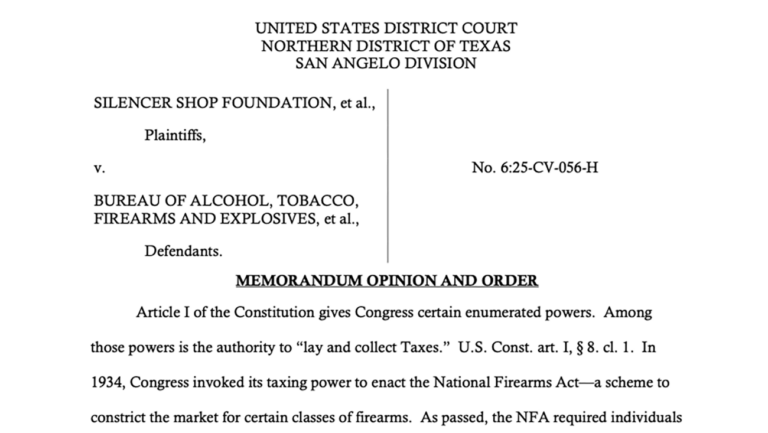
The NFA ruling settles in. Judge Wesley Hendrix’s August 5 decision in the Northern District of Texas, in the consolidated Silencer Shop Foundation v. BATFE and Jensen v. ATF, held that NFA registration and approval requirements for suppressors, short-barreled rifles and short-barreled shotguns exceed Congress’s authority now that the taxes are gone, and DOJ declined to seek a stay. Two important limits are getting lost in the celebration: the relief runs to the parties in that case — it does reach the organizational plaintiffs’ members and customers, but nobody else — and state law still applies wherever you live. ATF has said it will keep processing forms under existing policy, and parallel NFA challenges are pending in Missouri and Kentucky. If you are thinking about acting on this, read our guide to SBR rules after the 2026 NFA changes first, and talk to a lawyer about how the ruling applies to you specifically.
Second Amendment news this week: frequently asked questions
What did the DOJ’s new firearm rights restoration rule do?
It revived 18 U.S.C. § 925(c), the statute allowing a person subject to a federal firearms prohibition to apply for relief. The process had been unusable for more than 30 years after Congress defunded it. The final rule, published in the Federal Register on August 20, 2026 and effective September 21, 2026, creates 28 C.F.R. Part 107 and sets out an application process with waiting periods, presumptions against relief for violent felons and other high-risk categories, and an individualized public-safety determination by the Attorney General.
Is the ATF frame or receiver rule still in effect?
Yes, for most people. The Northern District of Texas held portions of the rule unconstitutional under the Second and Fifth Amendments in Defense Distributed v. Blanche, but the relief is party-specific rather than a nationwide vacatur. The rule remains on the books for everyone else unless a higher court or a broader ruling changes that. The Supreme Court’s 2025 decision in Bondi v. VanDerStok addressed only ATF’s statutory authority, not the constitutional questions.
Does New York’s convertible pistol ban really cover Glocks?
By its definition, yes — plaintiffs in Firing Pin, LLC v. James argue the law’s cruciform-trigger-bar definition sweeps in most Glock and Glock-pattern semiautomatic handguns. The NRA, Second Amendment Foundation and Firearms Policy Coalition filed suit in the Western District of New York seeking to block it before May 31, 2027, the date that makes a dealer sale or transfer of a convertible pistol a class D felony. Other parts of the law took effect August 25, 2026. No injunction has been issued, so the statute is still on its current timeline.
When will the Supreme Court hear the AR-15 ban cases?
Viramontes v. Cook County and Grant v. Higgins were consolidated for one hour of argument on whether the Second and Fourteenth Amendments guarantee the right to possess AR-15-platform and similar semiautomatic rifles. Cert was granted June 30, 2026. Respondents’ briefs are due October 21, 2026 and neither case appears on the October or November argument calendars, so the earliest realistic sitting is December 2026. No date has been set. A decision would be likely by the end of the term in mid-2027.
Do I still have to register a suppressor under the NFA in 2026?
The $200 NFA making and transfer tax was zeroed out for suppressors, short-barreled rifles, short-barreled shotguns and any other weapons effective January 1, 2026, so there is no stamp cost on those. Machine guns and destructive devices still carry the $200 tax. Registration is a separate question. A federal court in Texas struck down the registration and approval requirements for suppressors and short-barreled firearms in August 2026 and DOJ declined to seek a stay, but that relief runs to the parties in that case, ATF continues to process forms under existing policy, and state restrictions are unaffected. Talk to a lawyer before assuming the requirement no longer applies to you.
Five stories, and only one of them came from Congress or the Supreme Court. The action this week was in an executive branch rewriting its own rules, a district judge answering the constitutional question the Supreme Court left open, and a state legislature racing a deadline. That is where the Second Amendment is actually being decided right now — and it is why the September 28 conference matters so much. We will cover each of these as it moves.
By James Nicholas · August 27, 2026

Reader Favorites
- Supreme Court Takes Up the “Assault Weapons” Ban — What It Means for Your AR-15 and Your Rights
- What To Do With Inherited Guns: A Calm, Legal 2026 Guide
- Second Amendment News This Week: 5 Stories That Matter
- New Jersey’s Assault Weapons Ban Struck Down: What the Third Circuit Ruling Means (2026)
- Second Amendment News: New Jersey’s AR-15 Ban Struck Down (July 2026)
- Virginia Assault Weapons Ban Blocked Statewide: What the Injunction Means
Gun-owner reference desk
Plain-English references worth bookmarking — NFA rules, carry law, and the gear terms behind every review.
| 2026 at a glance | |
|---|---|
| NFA tax stamp | $0 |
| Permitless carry | 29 states |
| Suppressors legal | 42 states |
50+ NFA, carry and gun-law terms in plain English, updated for 2026.
Open the glossary → Network| Term | Category |
|---|---|
| Striker-fired | Action |
| MOA | Optics |
| Twist rate | Ballistics |
30 gun, ammo and optics terms, from Guns & Gadgets Daily.
View full chart →