NFA Registration for Suppressors and SBRs Struck Down: Where It Stands Now
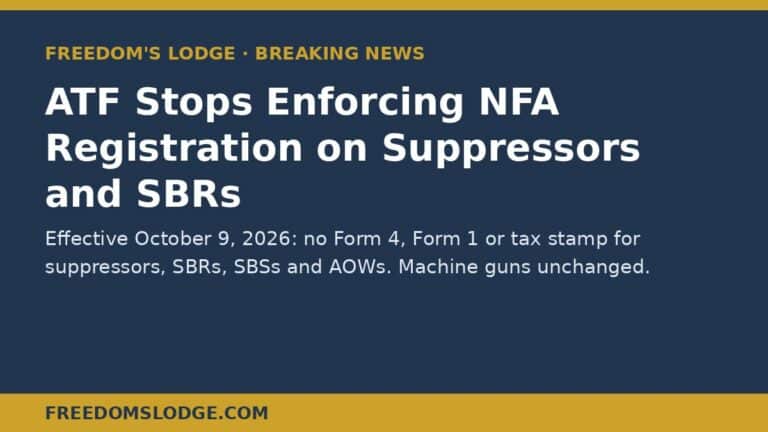
A federal court struck down NFA registration for suppressors and short-barreled rifles; the injunction took effect August 13, 2026, and the Justice Department chose not to appeal.
Last updated: October 9, 2026 · Originally published September 18, 2026
A federal court has struck down the NFA registration scheme for suppressors and short-barreled rifles, and the injunction has been in force since Thursday, August 13, 2026. As an FFL and 07/02 manufacturer of NFA items, I have spent twenty years on the paperwork side of that wall, the applications, fingerprints, photographs, and federal pre-approval that have stood between law-abiding Americans and these arms since 1934. The ruling does not repeal the National Firearms Act. But for a movement that spent 90 years chipping at that wall, this is the biggest structural crack yet, and I am not going to pretend I read it with a straight face.
Here is what the court decided, who the order covers, and where the case stands five weeks on.

What the Ruling Says
On August 5, 2026, U.S. District Judge James Wesley Hendrix granted summary judgment to gun owners in two consolidated cases, Silencer Shop Foundation v. ATF and Jensen v. ATF, out of the Northern District of Texas. He held that the NFA registration requirements for suppressors, short-barreled rifles, short-barreled shotguns, and “any other weapons” are unconstitutional.
The logic is clean. Congress built the NFA in 1934 as a tax. The Supreme Court blessed it that way in Sonzinsky v. United States (1937), treating the registration rules as a support system for collecting revenue. So the registry lived under the taxing power, not the power to regulate arms.
Then the tax went to zero. The One Big Beautiful Bill Act set the making and transfer tax on these items at $0, effective January 1, 2026. As Judge Hendrix saw it, once the tax vanished, the constitutional floor under the registry vanished with it. No tax, no taxing-power hook, no registration.

Why the Zero Tax Changed Everything
Gun owners cheered the zero tax as a win on its own, and it was. But it also set a legal trap for the government, and the trap sprang this month.
The NFA’s controls were always justified as tax-collection machinery. Strip the tax, and courts face a blunt question: what power lets Congress fingerprint and pre-approve a citizen for buying a muffler for a rifle? The plaintiffs argued the answer is none. The court agreed.
As the legal writers at Reason’s Volokh Conspiracy put it, the ruling found that the rug had been pulled out from the constitutional basis of the NFA. That is the whole case in one line.
What Changed on August 13
Judge Hendrix entered a permanent injunction, then paused it for seven days so the government could seek relief. Count seven days from August 5 and you land on August 12. Nobody froze the order, so it went live the next day, August 13, 2026, and it has run without interruption since.
Since that date the ATF has been barred from enforcing the challenged NFA registration provisions against the people and businesses the order covers. For them, the Form 4 wait, the fingerprint cards, and the pre-purchase approval simply stop applying to untaxed NFA arms.
Who the Order Covers, and Who It Does Not
Now, here is where the celebration needs a cold-eyed edit. The order is a real win, but it is not a nationwide switch that flips off registration for every American at once.
The Supreme Court closed the door on universal injunctions in Trump v. CASA (2025). So Judge Hendrix wrote a targeted order instead. It blocks enforcement against the named plaintiffs, the member organizations in the case, and, critically, the customers of the business plaintiffs, both current and future.
Those business plaintiffs include major retailers and makers, so a wide slice of buyers falls under the order’s umbrella. If you belong to a plaintiff group or you buy through a covered dealer, you may be covered on day one. If you do not, the old process may still apply until the ruling spreads through appeals or fresh cases.
Basically, read the order before you assume it covers you. This tracks the reasoning in the Fifth Circuit’s ruling that suppressors are “arms” and in the parallel challenge to suppressor registration.
What the Ruling Does Not Touch
Three limits matter. First, the order does not erase old registry entries. Your existing stamps and records stay where they are. Second, it does not override state law. Third, it leaves machine guns and destructive devices alone, because those categories were not in the case.
State bans are the big one. Suppressors remain off-limits to civilians in California, Delaware, Hawaii, Illinois, Massachusetts, New Jersey, New York, and Rhode Island, and several states keep their own short-barreled-rifle rules. So a buyer in a free state may watch the federal wall fall while a buyer in Trenton sees nothing change. Geography still rules. For the post-tax-stamp picture, see why suppressor ownership just got easier.
The DOJ Will Not Appeal
That was everyone’s assumption, mine included, and it did not happen. Solicitor General D. John Sauer told Senate Judiciary Chairman Chuck Grassley in a letter dated September 24, 2026 that the Justice Department “has determined not to file an appeal,” and the government filed that letter with the court on October 1. The 60-day window closed on October 5 with no notice of appeal and no request for a stay, so the Fifth Circuit never got the case.
That takes the biggest risk off the table. The relief that began on August 13 no longer hangs on one order from an appeals court. What is still open is who the order covers. Nine states that are plaintiffs asked Judge Hendrix to spell that out, and the Justice Department has until October 12, 2026 to answer.
The ATF has moved slower. Its only 2026 open letter on silencers, dated August 28, covers repairs and caliber changes, not registration. Director Robert Cekada told an industry audience on September 24 that suppressors transferred on a Form 4473 would not be treated as violations, and on October 4 he said on X that written guidance would be issued during the week of October 5. Until that guidance is published, nobody inside the government has told buyers or dealers in writing how to behave, which is exactly why the coverage question below matters so much. The NRA-ILA and the Second Amendment Foundation are already pressing to widen the win.
What Gun Owners Should Do Right Now
Stay calm and stay documented. A few practical moves, and please take my advice on the second one:
- Confirm your coverage. Check whether your dealer or your membership puts you inside the order before you skip any federal step.
- Keep your paperwork. Do not toss existing stamps or records. They still prove lawful possession.
- Watch the ATF. Written guidance on how dealers and buyers handle covered transfers is the next thing to land, and it will settle a lot of the guesswork.
- Mind your state. Federal relief does nothing against a state suppressor ban.
The larger Second Amendment fight is moving through the same courts at the same time. Magazines, “assault weapons,” and carry are all in play, as our coverage of the assault-weapons case now before the Supreme Court lays out. New to suppressors? A plain-English buyer’s guide from PopularSuppressors.com walks through the mechanics without the jargon.
Frequently Asked Questions
Q: Does this ruling end NFA registration everywhere?
A: No. Judge Hendrix could not write a nationwide injunction after Trump v. CASA, so the order protects the plaintiffs, their members, and the customers of the business plaintiffs. Everyone else may still be in the old line until appeals or new suits stretch the ruling.
Q: Do I still need a Form 4 to buy a suppressor?
A: My answer is always “it depends,” so here is what it depends on: whether you are inside the order. Buy through a covered dealer or belong to a plaintiff group and the challenged federal steps stop applying to untaxed NFA arms. Otherwise, plan on the normal process until the law settles.
Q: Does the ruling erase my existing tax stamp?
A: No. Old registry entries and stamps stay right where they are. The order stops future enforcement; it does not delete past records, so keep yours.
Q: Can I own a suppressor in a state that bans them?
A: No. This is about federal registration. California, Delaware, Hawaii, Illinois, Massachusetts, New Jersey, New York, and Rhode Island still ban them, and the ruling does not touch that.
Q: Can the DOJ still appeal?
A: No. The 60-day window closed on October 5, 2026 with nothing filed, and the Solicitor General had already told Congress the department would not appeal. The trial court can still clarify who the order covers, and other courts are deciding the same question in separate cases.
For 90 years, the wall around suppressors and short-barreled rifles was built out of tax law. In August a judge pointed out that the wall no longer has a foundation. The government had its chance to fight that in the Fifth Circuit and let the window close on October 5. Now the fight moves to who is covered and what the ATF puts in writing, and every suppressor buyer in America, me included, is watching for it.
Sources and methodology: summarized from the August 5, 2026 judgment in Silencer Shop Foundation v. ATF and Jensen v. ATF (N.D. Tex.), with analysis from NRA-ILA, the Second Amendment Foundation, and Reason’s Volokh Conspiracy. Last verified October 6, 2026 against the N.D. Tex. docket, including the government’s October 1 filing of the Solicitor General’s no-appeal letter, and against ATF’s own published documents.


Reader Favorites
- Hot Take: Viridian V-Series Long-Range Illuminators
- Officer Justifiably Shoots Good Guy: Lessons For Armed Citizens
- Be Your Own AR-15 Armorer With This Kit
- Mossberg Celebrates Century With New CCW Pistol
- CCW Central: Check Out Concealed Carry Expo this May in Pittsburgh
- Free Self-Defense Videos From Viridian Weapon Tech
Gun-owner reference desk
Plain-English references worth bookmarking — NFA rules, carry law, and the gear terms behind every review.
| 2026 at a glance | |
|---|---|
| NFA tax stamp | $0 |
| Permitless carry | 29 states |
| Suppressors legal | 42 states |
50+ NFA, carry and gun-law terms in plain English, updated for 2026.
Open the glossary → Network| Term | Category |
|---|---|
| Striker-fired | Action |
| MOA | Optics |
| Twist rate | Ballistics |
30 gun, ammo and optics terms, from Guns & Gadgets Daily.
View full chart →