Federal Gun Rights Restoration Returns: What DOJ’s Rule Requires
Federal gun rights restoration reopened on August 20, 2026, when the Justice Department published a final rule reviving 18 U.S.C. 925(c).
Last updated: October 9, 2026 · Originally published September 18, 2026
Updated August 27, 2026
Federal gun rights restoration is open again, and I have been turning away the people who need it at my counter for my entire career. On August 20, 2026, the Justice Department published a final rule in the Federal Register that revives 18 U.S.C. § 925(c), the relief-from-disabilities provision Congress defunded in 1992 and left inert for 34 years.
The rule took effect on September 21, 2026. DOJ expects roughly 330,000 applications a year, drawn from a pool the Department puts at “at least 20 million adults in the United States.”

What Federal Gun Rights Restoration Does
It is a formal administrative process that lifts a federal firearm prohibition imposed by 18 U.S.C. § 922(g). It is not a pardon. It is not an expungement. It is a determination by the Attorney General that one specific person no longer belongs on the prohibited list.
The statutory test has not moved since 1968. Relief may be granted when an applicant shows that “the circumstances regarding the disability (or disabilities), and the applicant’s record and reputation, are such that the applicant will not be likely to act in a manner dangerous to public safety, and that the granting of the relief would not be contrary to the public interest.”
The new rule builds the machinery around that sentence. It creates 28 CFR Part 107, a new part of the Code of Federal Regulations covering definitions, application content, review standards, scope of relief, fees, presumptive disqualifications, mental-health applicants, repeat filings, and fraud. Docket No. OAG191, AG Order No. 7109-2026, RIN 1105-AB78.
One clause carries more weight than the rest. Section 107.10(b) says the Attorney General “is not confined to a ‘categorical approach’ that looks only at the elements of the underlying offense.” Facts count. A decades-old paper felony and a violent one do not walk in the door as equals.


Why the Program Sat Dead for 34 Years
The program never disappeared from the statute books. Congress simply stopped paying for it.
Starting with the fiscal 1993 Treasury and Postal Service appropriations act, and in every appropriations cycle since, a rider barred ATF from spending appropriated funds to investigate individual relief applications. The Senate report behind that first rider gave the reason plainly: “ATF agents spend many hours investigating a particular applicant,” and the roughly 40 staff-years burned each year “would be better utilized to crack down on violent crime.”
The right survived. The clerk did not. A second rider, in force since 1994, barred ATF from handing its functions to anyone else.
DOJ’s answer to both is textual. The funding proviso reaches only “the funds appropriated herein” within a specific ATF training and laboratory account, not the Department as a whole. And processing these applications, the Department argues, was never an ATF function to begin with: “The processing of section 925(c) applications is a power given expressly to the Attorney General, not to ATF.”
The Department also drew an inference from the shape of the rider itself. Had Congress concluded that § 925(c) was “an irredeemably dangerous threat to public safety, it could have amended the GCA to remove section 925(c) entirely.” It never did.
Who Runs It Now
Not ATF. In March 2025 the Attorney General issued an interim final rule withdrawing ATF’s delegation. This rule adopts that withdrawal as final.
The program now runs through the Office of the Pardon Attorney. The rule’s contact line names Deputy Pardon Attorney Kira Gillespie, and its cost analysis funds “initial intake by staff within the Office of the Pardon Attorney.” Pardon Attorney Ed Martin announced the relaunch in a video address. Attorney General Todd Blanche signed the rule on August 13, 2026.
ATF keeps a narrow slice of the work. Federal firearms license renewal denials still route through the ATF Director of Industry Operations for the relevant field division, and anyone seeking to become a licensee still applies to ATF.

What the Application Requires
An application runs to 14 categories of material, and none of them are quick. Take my advice and start a folder today.
Every applicant files a statement of each § 922(g) prohibition that applies, a written consent releasing employment, medical, military, and criminal records, and, for individuals, an electronic fingerprint scan or two completed FBI Form FD-1222 fingerprint cards. When the program first opens, DOJ will accept fingerprints submitted through the U.S. Postal Service only.
From there the file grows with the disability:
- Felony conviction: charging instrument, plea agreement, factual basis for the plea, presentence report, judgment, plus a certificate from corrections, probation, or parole fixing the date the sentence and any supervision ended.
- Mental-health adjudication or commitment: the order, the petition, medical records characterizing the diagnosis, any discharge or restoration order, and a current certification from a licensed mental health professional.
- Misdemeanor crime of domestic violence: the charging instrument, the underlying investigative reports, a statement of the victim relationship, the judgment, and every police report involving domestic violence “from the time of original arrest or apprehension to the present.”
- Military service: DD Form 214 for any active or reserve duty since turning 18 or for the last 25 years, whichever is shorter, regardless of what caused the disability.
- Record checks: criminal history from every state where the applicant has lived and every state where he has been arrested, again covering age 18 to the present or 25 years, whichever is shorter.
Then the human element. Three character references sign affidavits under penalty of perjury attesting that they are unrelated by blood or marriage, have known the applicant at least three years, are not themselves prohibited, and that the applicant has committed no crime in five years, does not abuse alcohol or intoxicants, and would not pose a danger to himself or anyone else. The applicant signs a parallel affirmation carrying two additional clauses, one of them disclaiming membership in “a group of three or more persons who acted together in the United States or elsewhere with the aim of committing any crime within the last 10 years.”
Foreign records come in as well. Section 107.10(g)(12) requires foreign criminal, medical, and military records that would have been required had the conduct occurred here, with certified English translations. Foreign convictions do not disable anyone under federal law and create no presumption. DOJ says the material only helps “inform the Attorney General’s overall decision.”
Missing paperwork is survivable. Section 107.10(f) accepts a sworn statement in place of records lost to fire, flood, or the passage of time, provided the applicant lays out the underlying facts, the disposition, and the effort made to recover them.
Who Draws a Presumptive Denial
The rule sorts presumptive disqualifications into four buckets. Every one is rebuttable “absent extraordinary circumstances,” a phrase DOJ deliberately refused to define so as “to avoid unnecessarily cabining the Attorney General’s discretion.”
| Bucket | Trigger | Examples from § 107.50 |
|---|---|---|
| Permanent | Ever convicted | Homicide, rape or sexual assault, human trafficking, kidnapping, domestic or intimate-partner violence, burglary, robbery, arson, carjacking, extortion, terrorism, stalking, witness tampering, or any felony in which a firearm was brandished or discharged |
| 10 years | Conviction or any part of a sentence served in the last decade | Drug-trafficking felonies, threats of violence, explosives offenses, most § 922 offenses, firearms on school property, animal abuse, misdemeanor crime of domestic violence |
| 5 years | Conviction in the last five years | Any other felony; any assault, battery, or stalking offense or threatened act of violence |
| Current status | True today | Awaiting sentencing, serving a sentence, in a diversion or treatment program, fugitive, unlawful alien, subject to a protective order, unlawful drug user, or SORNA registrant on a disqualifying offense |
Two details deserve a second read. The rule carves marijuana out entirely: § 107.1 defines “controlled substance” to exclude it and excludes marijuana-only users from the unlawful-user category, citing the Supreme Court’s ruling in Hemani. And the domestic violence clock restarts on new conduct. An arrest for a violent offense in year nine resets the 10-year period to zero.
Mental-health applicants face an exhaustion requirement. Where a compliant state or federal relief program exists and the applicant qualifies for it, § 107.60(b) makes him use that first. DOJ counts 37 compliant state and territorial programs as of publication.
Now, DOJ declined to add several disqualifiers that commenters pushed for, among them hate crimes, alcohol offenses, suicide risk, and renounced citizenship. Those flow into case-by-case discretion instead of a hard bar.
What It Will Not Do
Section 107.30(a) says it outright: relief “shall not extend to disabilities imposed by State law if the applicant is independently subject to any such State-law prohibition.”
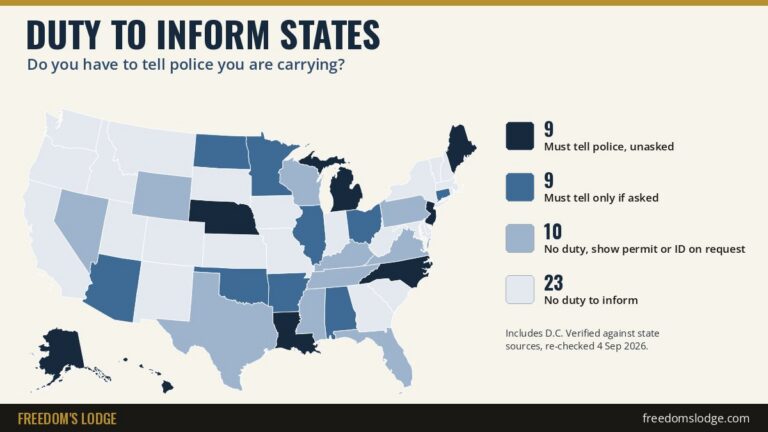
Clear the federal prohibition and a state prohibition still stands on its own legs. The fix for that lives in each state’s restoration or expungement process, and those vary wildly, a reality anyone tracking the constitutional carry map or reciprocity between states already understands. DOJ says it “plans to work with state partners” to encourage recognition of the federal process. That is an intention, not a rule.
It is also not a license. A grant does not entitle anyone to an FFL. And § 107.30(a) adds that a person who picks up a new disability after a grant “shall not be relieved of such disability and must reapply for relief.”
What It Costs and When It Opens
| Line item | Cost |
|---|---|
| Application fee | $30 |
| Fingerprints via U.S. Postal Service | $50 |
| Court documentation | $12.00 |
| State and local record checks | $13.13 |
| DOJ estimated total per applicant | $105.13 |
DOJ raised the fee from the $20 it originally proposed, citing the cost factors in 31 U.S.C. 9701(b). The dollar figure sits in the preamble rather than the codified text: § 107.40 sets only the mechanism and a review cycle of no less than every two years. Section 107.40(e) permits a waiver or reduction for indigency. At 330,000 applications, the fee covers roughly 65 to 70 percent of the Department’s $14,510,100 annual cost. To put that in perspective, $105 to get your rights back is less than a case of 9mm.
The rule itself carries one date: September 21, 2026. The phased rollout (an invited pool on September 25, 2026, then 5,000 public applications beginning November 4, 2026, and 500 more on January 4, 2027) comes from DOJ’s implementation page at justice.gov/ffrr, not from the Federal Register text. Anyone building a plan around those numbers should watch that page instead of the rule.
So there is no promised decision date. Commenters asked for 30-, 60-, and 180-day deadlines; the Department called a deadline “premature and speculative” and warned that turnaround during the initial launch will run longer. It did allow that simple files, one nonviolent § 922(g)(1) conviction with all time requirements satisfied, are “likely to be processed relatively quickly.”
If DOJ Denies Your Application
There is no administrative appeal, by design. The Department pointed to the statute instead: “Any person whose application for relief from disabilities is denied by the Attorney General may file a petition with the United States district court for the district in which he resides for a judicial review of such denial.”
An incomplete file is not a denial. Section 107.20(b) gives 30 days to amend and resubmit; miss that window and the application is treated as abandoned, which carries no penalty later. A denial does carry one. A denial resting on the permanent category bars reapplication indefinitely; any other denial bars it for five years.
Grants are public. Section 107.20(c) requires every grant to be published in the Federal Register “together with the reasons therefor.”
Frequently Asked Questions
Q. When can I apply for federal gun rights restoration? The rule took effect on September 21, 2026, and DOJ began soliciting applications that day, but the doors open in waves: an invited pool on September 25, 2026, 5,000 public slots on November 4, 2026, and 500 more on January 4, 2027. Those wave dates live on justice.gov/ffrr, not in the Federal Register rule, so watch that page.
Q. How much does the application cost? $30 for the fee itself, up from the $20 DOJ first proposed, plus about $50 for fingerprints through the Postal Service, about $12 for court documents, and about $13 for state and local record checks. DOJ’s all-in estimate is near $105, and § 107.40(e) lets the Department waive or cut the fee if you can show indigency.
Q. Does federal gun rights restoration also clear a state prohibition? No, and this is the part that will trip people up. Section 107.30(a) says relief “shall not extend to disabilities imposed by State law if the applicant is independently subject to any such State-law prohibition.” A federal grant lifts the federal bar and nothing else; your state’s own restoration, set-aside, or expungement process handles the rest.
Q. Can I appeal a denial? Not inside the Department. DOJ built no administrative appeal and pointed to the remedy Congress wrote into § 925(c): a denied applicant petitions the U.S. district court where he lives. An incomplete file that sits 30 days is treated as abandoned, not denied, so it does not count against you.
Q. Does marijuana use disqualify an applicant? Not by itself under this rule. Section 107.1 defines “controlled substance” to leave marijuana out and keeps marijuana-only users out of the unlawful-user category, citing the Supreme Court’s decision in Hemani. Other federal restrictions on unlawful users are still on the books, so get advice specific to your state before you file.
Thirty-four years is a long time for a right to sit behind a funding rider. Federal gun rights restoration is a paperwork process now, not a theory. The door opens September 21. Whether it stays open past this administration is the one question the rule cannot answer, and it is the reason every applicant should build a file that survives a second look.
Sources: DOJ final rule, 91 FR 54054 (Aug. 20, 2026), FR Doc. 2026-16981, Docket No. OAG191, AG Order No. 7109-2026, RIN 1105-AB78; Federal Register; NRA-ILA. Quotations are taken verbatim from the published rule and its preamble. Related coverage: our report on the court that struck down the ATF frame-and-receiver rule, and, across the BAM network, Guns & Gadgets Daily on serialization and Popular Suppressors on the Texas NFA ruling.


Reader Favorites
- Hot Take: Viridian V-Series Long-Range Illuminators
- Officer Justifiably Shoots Good Guy: Lessons For Armed Citizens
- Be Your Own AR-15 Armorer With This Kit
- Mossberg Celebrates Century With New CCW Pistol
- CCW Central: Check Out Concealed Carry Expo this May in Pittsburgh
- Free Self-Defense Videos From Viridian Weapon Tech
Gun-owner reference desk
Plain-English references worth bookmarking — NFA rules, carry law, and the gear terms behind every review.
| 2026 at a glance | |
|---|---|
| NFA tax stamp | $0 |
| Permitless carry | 29 states |
| Suppressors legal | 42 states |
50+ NFA, carry and gun-law terms in plain English, updated for 2026.
Open the glossary → Network| Term | Category |
|---|---|
| Striker-fired | Action |
| MOA | Optics |
| Twist rate | Ballistics |
30 gun, ammo and optics terms, from Guns & Gadgets Daily.
View full chart →