SBR Registration on Trial: Coalition Asks Sixth Circuit to Strike NFA Rules
Americans had registered 1,178,348 short-barreled rifles by June 2026, and four major gun-rights groups now ask the Sixth Circuit to strike the rule.
Last updated: October 10, 2026 · Originally published September 18, 2026
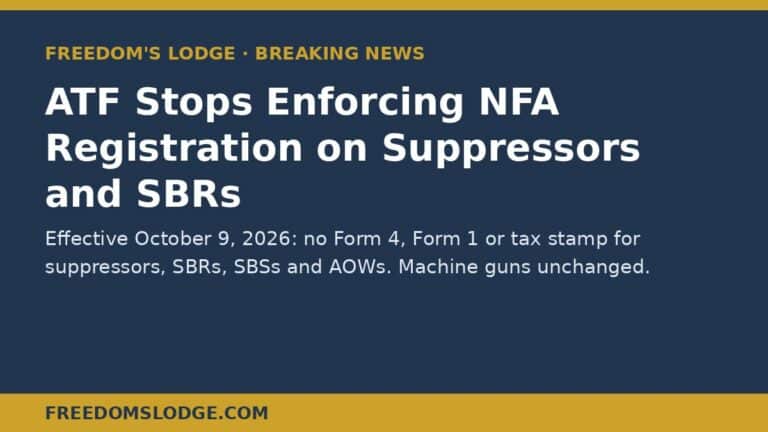
Update, October 10, 2026: On October 9, ATF stopped requiring a Form 4, Form 1, federal registration or a tax stamp for suppressors, SBRs, SBSs and AOWs, for everyone nationwide. State law still applies. What ATF’s October 9 guidance changes.
Updated July 16, 2026 · James Nicholas
As an 07/02 manufacturer, I build short-barreled rifles for a living and file the paperwork on every one of them, so I have a personal stake in this one. Americans have registered 1,178,348 short-barreled rifles with the federal government as of June 8, 2026. On July 13, four of the nation’s largest gun-rights organizations told a federal appeals court that SBR registration itself violates the Second Amendment.
The filing is an amicus brief in United States v. Machamer, now before the U.S. Court of Appeals for the Sixth Circuit. The National Rifle Association wrote it, joined by the Firearms Policy Coalition, the Second Amendment Foundation, and the American Suppressor Association. NRA attorney Joseph G.S. Greenlee represents the coalition. Their argument is direct: short-barreled rifles are protected arms, and the National Firearms Act’s registration scheme fails the Supreme Court’s history-and-tradition test.
What United States v. Machamer Is About
The case began with a January 2024 federal search of Christopher Machamer’s home in North Canton, Ohio. According to the FBI, agents recovered AR-style rifles with barrels of roughly 9.25 inches, unserialized receivers, suppressors, handguns, and machining equipment. Machamer pleaded guilty to five counts and got a sentence of more than five years.
Now, the appeal is narrower than the indictment. The amici address only 26 U.S.C. §§ 5812, 5841, and 5861(d), the NFA’s approval, registration, and possession provisions as applied to short-barreled rifles. They take no position on the separate manufacturing charges.
That focus matters, because a ruling on those three provisions would reach every lawful SBR owner in the country, not one defendant in Ohio.

The Core Claim: Registration Fails Bruen
Under Heller, Bruen, and this term’s Wolford v. Lopez, the threshold question asks whether the government is restricting a bearable arm. If it is, the burden shifts, and the government must prove its law fits the nation’s historical tradition of firearm regulation. The Supreme Court reinforced that framework in its unanimous Hemani ruling this June.
The district court never made the government carry that burden. It held that short-barreled rifles are “unusual or dangerous” and therefore not “Arms” at all. The brief calls that a double error, since courts cannot load historical limitations into the plain-text step to spare the government from defending its law. So SBR registration has never actually faced the historical scrutiny Bruen demands.
Two Words Doing All the Work
The traditional exception covers weapons that are both dangerous and unusual, not one or the other. The district court swapped the conjunction and changed the outcome.
Short-barreled rifles flunk the “unusual” half decisively. The brief reports 1,178,348 of them in the federal registry, lawful to possess in 45 states. Owners use them for home defense, hunting, and recreational shooting. Shorter barrels make them easier to move through a hallway than a standard rifle, and shoulder stocks make them easier to control than a pistol (which is the whole reason I build them). By every measure the Supreme Court has used, they sit in common use.
A Historical Accident, Not a Crime-Fighting Tool
Here is the part most people do not know. Congress never set out to restrict rifle barrels in 1934. The original NFA draft targeted concealable firearms, including handguns. The minimum barrel length entered the bill as a safe harbor after lawmakers worried the concealable-firearm language might sweep in ordinary hunting rifles. Handguns came out of the final bill. The barrel-length line stayed behind with nothing left to protect.
“The NFA’s application to short-barreled rifles was thus a historical accident and not a necessary measure to keep arms away from criminals,” the brief argues, adding that “no one mentioned a short-barreled rifle having any criminal use” during the Senate hearings.

The Government’s Historical Evidence
A livestock census from 1631
Prosecutors cited a 1631 Virginia census that recorded arms alongside corn, cattle, hogs, goats, boats, gardens, and orchards. The brief points out what that census was for: it helped make sure colonists could comply with laws requiring them to possess and carry firearms. A colonial gun mandate is not a federal gun registry, any more than a hog count is.
The government’s other analogues covered selling arms to hostile foreign powers, proof-testing defective barrels, and inspecting gunpowder storage. None of them required peaceful Americans to submit fingerprints, get advance federal permission, and enter a rifle into a national registry under threat of felony imprisonment.
Miller does not carry the weight
United States v. Miller, decided in 1939, was about a short-barreled shotgun, not a rifle. The defendant never showed up and presented no evidence. Heller and Bruen ask about arms in common use today, and constitutional protection is not frozen by whatever evidence was missing from an uncontested record nearly 90 years ago.

What SBR Registration Still Requires in 2026
Congress eliminated the NFA’s $200 making and transfer taxes effective January 1, 2026. SBR registration survived the repeal of the tax that justified it. Here is what federal law still demands of a law-abiding owner.
| Requirement | Status in 2026 |
|---|---|
| $200 making and transfer tax | Eliminated January 1, 2026 |
| ATF approval before making or transfer (Form 1 / Form 4) | Still required |
| Fingerprints and photographs | Still required |
| Entry in the federal NFA registry | Still required |
| Penalty for an unregistered SBR | Up to 10 years, fines, and forfeiture |
That mismatch is the heart of the constitutional problem, and it echoes the argument in Brown v. ATF: a registry built on a tax power should not outlive the tax. FPC President Brandon Combs put the stakes bluntly.
“The Trump DOJ wants courts to treat the Second Amendment like a second-class right instead of a full constitutional guarantee,” Combs said in FPC’s announcement. “Fundamental rights are not privileges to be sold back to Americans through special taxes and bureaucratic permission slips.”
Where the Challenge Goes From Here
The Sixth Circuit will set argument in the coming months. A ruling against the registration provisions would create a circuit-level conflict the Supreme Court could not ignore for long, and the timing makes it louder. The Court just agreed to hear two challenges to “assault weapon” bans in its October 2026 term. The Fifth Circuit has already held that suppressors are protected arms. Basically the NFA’s remaining architecture is being tested from three directions at once.
The barrel-length line looks more arbitrary every year the market builds around it. Pistol-caliber platforms like the Ruger PC Charger differ from a registered SBR by a stock and a stamp of federal permission. One-tenth of an inch of barrel can separate an ordinary rifle from a 10-year felony. The amici are asking the court to say what history says about that line: nothing.
Staying Legal While the Case Is Pending
Remember, nothing in the Machamer appeal changes current law. Registration requirements stay in force, and prosecutors keep enforcing them. If you own a registered SBR, keep your approved Form 1 or Form 4 with the rifle and store a digital copy. If you are building or buying one, file and wait for approval before you assemble or take possession. Please take my advice on that one.
Where can you legally take a registered SBR? Interstate travel with an SBR still requires advance ATF approval on Form 5320.20, and five states prohibit possession outright. Check your destination state’s law before any trip, the same way you would check carry reciprocity before crossing a state line.
The smartest move is also the simplest one: follow the case. Court calendars move slowly, and a Sixth Circuit panel decision is likely months away. We will track the briefing schedule, argument date, and decision here as each one lands.
Frequently Asked Questions
Is it legal to own a short-barreled rifle in 2026? Yes, in 45 states, as long as the ATF approved it and it sits in the NFA registry before you build it or take it home. Skip that step and you are looking at a federal felony and up to 10 years.
Do you still pay $200 for SBR registration? No, that check stopped on January 1, 2026. Everything else stayed: Form 1 or Form 4 approval, fingerprints, photographs, and the registry entry all have to be done before you can lawfully possess the rifle.
What is United States v. Machamer? A Sixth Circuit appeal out of an Ohio prosecution where, on July 13, 2026, the NRA, FPC, SAF, and ASA filed a brief arguing that making people register short-barreled rifles violates the Second Amendment under the history-and-tradition test.
What happens if the Sixth Circuit strikes down SBR registration? It would clash with other circuits that have upheld the NFA, and a circuit split is the classic ticket to the Supreme Court. The registry itself would be on the Court’s doorstep.
Does this case affect suppressors? Not directly, but the reasoning carries over. Suppressors live in the same registration system, the American Suppressor Association signed the brief, and the Fifth Circuit already called suppressors protected arms, so a win here helps every NFA challenge.
The registry holds 1,178,348 rifles and, since January 1, not one dollar of tax revenue. The Sixth Circuit now decides whether history supports the list, or whether the list was the accident all along.
Sources: NRA-ILA legal update, July 13, 2026; AmmoLand News; the coalition’s amicus brief in United States v. Machamer (6th Cir., filed July 13, 2026).


Reader Favorites
- Hot Take: Viridian V-Series Long-Range Illuminators
- Officer Justifiably Shoots Good Guy: Lessons For Armed Citizens
- Be Your Own AR-15 Armorer With This Kit
- Mossberg Celebrates Century With New CCW Pistol
- CCW Central: Check Out Concealed Carry Expo this May in Pittsburgh
- Free Self-Defense Videos From Viridian Weapon Tech
Gun-owner reference desk
Plain-English references worth bookmarking — NFA rules, carry law, and the gear terms behind every review.
| 2026 at a glance | |
|---|---|
| NFA tax stamp | $0 |
| Permitless carry | 29 states |
| Suppressors legal | 42 states |
50+ NFA, carry and gun-law terms in plain English, updated for 2026.
Open the glossary → Network| Term | Category |
|---|---|
| Striker-fired | Action |
| MOA | Optics |
| Twist rate | Ballistics |
30 gun, ammo and optics terms, from Guns & Gadgets Daily.
View full chart →