Can You Shoot Someone for Trespassing? What the Law Says
Can you shoot someone for trespassing? Almost never for trespassing alone. Deadly force needs a threat of death, serious harm, or a forcible felony.
Can you shoot someone for trespassing? It is the question that comes up every fall about the guy cutting across the back forty, and the answer starts the same way every time: not for trespassing alone. I am all for defending what is yours. But the law draws a hard line between protecting your property and protecting your life, and “No Trespassing” signs do not move that line an inch.
Here is where the line actually sits, with the statutes, so you can check me.
Shooting a Trespasser at a Glance
- Trespass alone: not a legal reason for deadly force. Non-deadly force to remove someone is a different question.
- Deadly force: only against a reasonable threat of death or great bodily harm, or to stop a forcible felony.
- Your home is different: all 50 states protect you inside your dwelling, and 26 presume your fear was reasonable when someone unlawfully and forcibly breaks in.
- Texas is the big exception: Penal Code 9.42 allows deadly force to protect property in narrow cases, including theft or criminal mischief at night.
Can You Shoot Someone for Trespassing on Your Land?
No, not for simply being there. A trespasser standing in your pasture, walking your fence line, or ignoring your posted signs has committed a crime against your property, not an attack on your life. Deadly force is for the second thing.
Florida’s statute is a clear example, because it spells both halves out. Under Florida Statute 776.031(1), you may use or threaten force, “except deadly force,” to “prevent or terminate the other’s trespass” on real property other than a dwelling or on your personal property. Under 776.031(2), deadly force is justified “only if” you reasonably believe it is “necessary to prevent the imminent commission of a forcible felony.”
In plain English: you can tell them to leave, you can call the sheriff, and in states like Florida and Texas the statutes allow reasonable non-deadly force to end a trespass. The gun stays in the holster unless the situation turns into something that would justify shooting anywhere else.


What Changes When They Come Into Your Home?
A lot. This is the castle doctrine, and it is stronger than most people think. After reading the statutes in all 50 states for our castle doctrine states guide, here is what we found: not one state makes you retreat from your own dwelling before defending yourself in it. Twenty-six states go further and write a presumption of reasonable fear into the statute when someone unlawfully and forcibly enters.
Florida’s version, 776.013, is typical of that presumption. If a person unlawfully and forcefully enters your dwelling, residence or occupied vehicle and you know it, the law presumes you reasonably feared death or great bodily harm. That presumption does not apply in some situations, including when the person has a right to be there, when you are engaged in criminal activity yourself, or when the person entering is a law enforcement officer performing official duties who identified themselves or who you knew, or should have known, was an officer.
Notice the words “unlawfully and forcibly enters.” A guy on your lawn is not in your house. A guy kicking in your back door is. The presumption covers the second one.
What About Your Yard, Barn or Driveway?
This is the gray zone, and it is where people get hurt legally. Many castle statutes protect a “dwelling” or “residence,” and states define those words differently. An attached garage, a porch, a detached barn, a hunting camp and your truck parked in the driveway may or may not count depending on the state. The only way to know is to read your own state’s statute, which our castle doctrine table links for every state.
Outside the dwelling, you are back to ordinary self-defense rules. Your state’s stand your ground law decides if you have a duty to retreat. Our stand your ground states guide covers all 50.
Does Texas Let You Shoot to Protect Property?
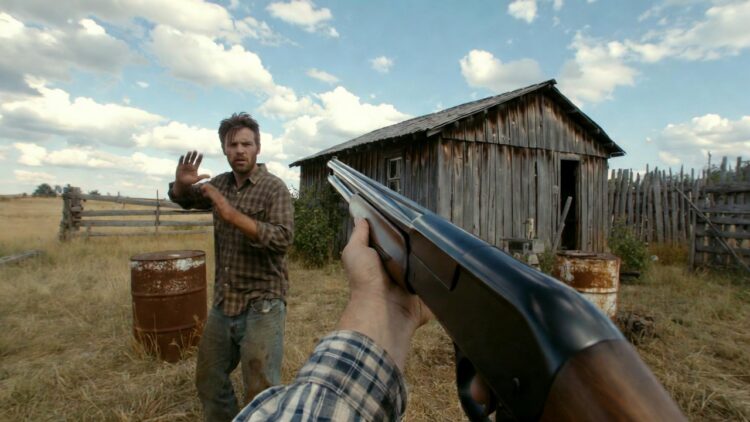
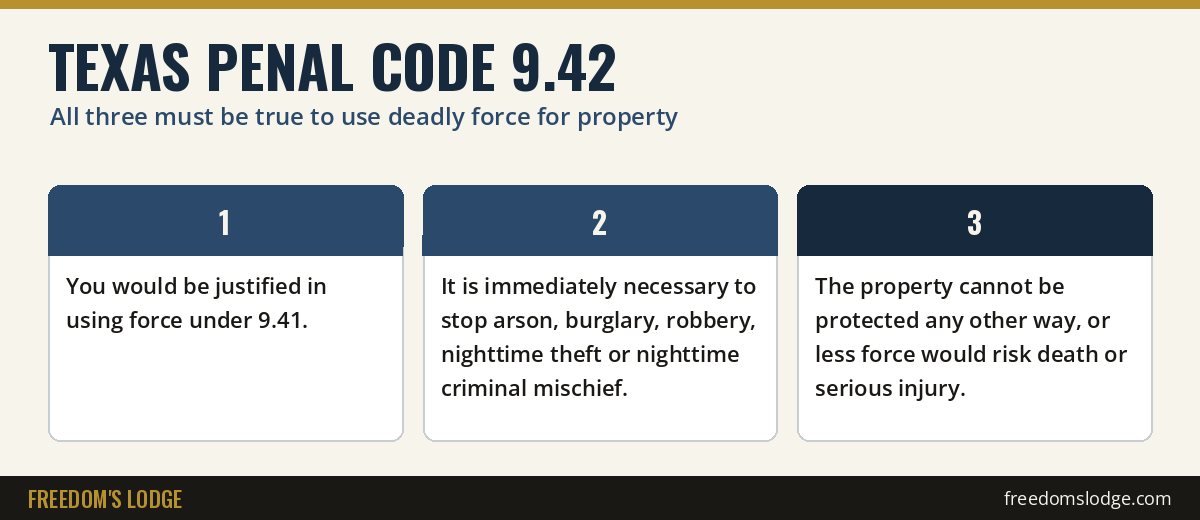
Texas is the state everybody points to, and it is the exception, not the rule. Texas Penal Code 9.41 lets you use force to stop a trespass on your land or interference with your property. Section 9.42 goes further and allows deadly force to protect land or property, but only when all three conditions are met:
- You would be justified in using force under 9.41.
- You reasonably believe deadly force is immediately necessary to prevent arson, burglary, robbery, aggravated robbery, theft during the nighttime or criminal mischief during the nighttime, or to stop someone fleeing right after a burglary, robbery, aggravated robbery or nighttime theft from escaping with the property.
- You reasonably believe the property cannot be protected or recovered any other way, or that using non-deadly force would expose you or someone else to a substantial risk of death or serious bodily injury.
Read that list again. Simple trespass is not on it. A guy walking across your ranch in daylight does not qualify under 9.42, and Texas juries still decide what was “reasonable” after the fact.
| Situation | Florida | Texas |
|---|---|---|
| Someone walking across your land | Non-deadly force only (776.031(1)) | Force to end the trespass (9.41); not a 9.42 crime |
| Someone stealing from your shed at night | Deadly force only to prevent an imminent forcible felony (776.031(2)) | Theft during the nighttime is listed in 9.42, if all three conditions are met |
| Someone forcing their way into your home | Presumption of reasonable fear applies (776.013), with exceptions | See Texas in our castle doctrine table |
| Someone threatening you with a weapon | Ordinary self-defense rules | Ordinary self-defense rules |
Florida Statutes 776.013 and 776.031; Texas Penal Code 9.41 and 9.42. This table is a guide to the statutes, not a prediction of how a case will turn out.
What Can You Legally Do About a Trespasser?
- Tell them to leave, clearly, and from a safe distance.
- Call the sheriff and let them handle it. That is what they are there for.
- Post your land the way your state requires, so the next one has no excuse.
- Get it on camera. A trail camera or doorbell camera is the cheapest witness you will ever hire.
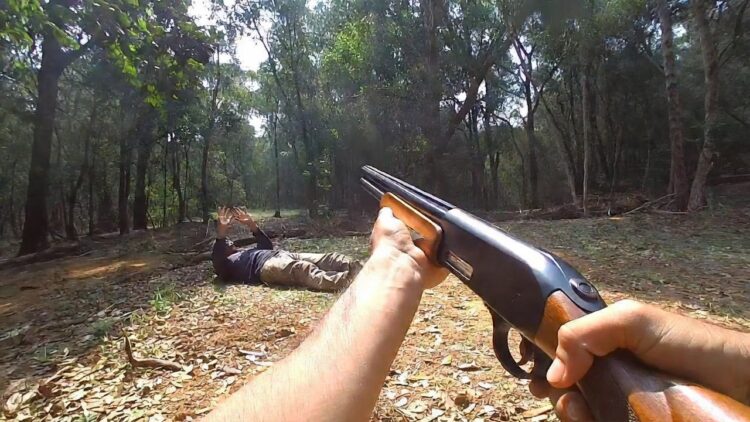
- Keep your gun holstered and your hands off it. Pointing a gun at someone who is only trespassing can be a crime by itself, and our guide to brandishing a firearm shows how six states write it.
Frequently Asked Questions
Can I shoot someone for stealing from my property?
In most states, not to protect property alone. Texas is the notable exception under 9.42, and only in the narrow circumstances listed there. Everywhere, the question becomes if you faced a threat of death, serious harm or a forcible felony.
Does a No Trespassing sign let me use force?
No. A sign makes it easier to prove the person knew they were not welcome. It does not change when deadly force is justified.
What about a trespasser who threatens me?
Then it is no longer a trespass question. It is a self-defense question, and the ordinary rules of your state apply, including any duty to retreat outside the home.
Can I hold a trespasser at gunpoint until police arrive?
That is threatening deadly force, and in Florida, for example, the law treats threatening deadly force the same as using it (776.012). If you would not be justified in firing, do not point. Call the sheriff instead.
Protect your family with everything you have. Protect your stuff with a lock, a camera and a phone call. Know the difference before it matters, and if you hunt other people’s land this fall, Popular Outdoorsman keeps a state hunting season hub that links to every wildlife agency’s rules on access and posting.
Sources: Florida Statutes 776.012, 776.013 and 776.031; Texas Penal Code 9.41 and 9.42; National Conference of State Legislatures, “Self-Defense and Stand Your Ground”; Freedom’s Lodge castle doctrine states table (all 50 statutes, last verified 5 September 2026).


Reader Favorites
- Virginia’s Gun-Hating Governor vs. Virginia
- Los Angeles Gun-Grabbers Confused, Terrified by Bill of Rights
- Why Do Anti-Gunners Love Red Flag Laws So Much?
- Gun Companies Fight to End COVID-19; Gun Grabbers Fight to End THEM
- Sunshine State Showdown: “No Guns Under 21” Law Challenge Moves Forward
- Guns at Coronavirus Quarantine Protests: Listen For the Loudest Scream
Gun-owner reference desk
Plain-English references worth bookmarking — NFA rules, carry law, and the gear terms behind every review.
| 2026 at a glance | |
|---|---|
| NFA tax stamp | $0 |
| Permitless carry | 29 states |
| Suppressors legal | 42 states |
50+ NFA, carry and gun-law terms in plain English, updated for 2026.
Open the glossary → Network| Term | Category |
|---|---|
| Striker-fired | Action |
| MOA | Optics |
| Twist rate | Ballistics |
30 gun, ammo and optics terms, from Guns & Gadgets Daily.
View full chart →