Gun Laws by State: All 50 States and D.C. in One Table
Gun laws by state allow permitless carry in 29 states, set magazine limits in 15 states plus D.C. and ban suppressors in 8 plus D.C.
Originally published: October 21, 2026
Gun laws by state are the rules each state writes on top of federal law about who may carry, what you may own and when you may use force to defend yourself, and they can flip the moment you cross a state line. The four that cause the most trouble are the permit, the magazine, the suppressor and the duty to retreat. Treat the table as a map, not a lawyer, and read the statute before you bet your freedom on a single cell.
Picture it: the pistol that rode legally on your hip in Texas becomes a second-degree crime the moment it is on your hip in New Jersey. (Nobody at the toll booth hands you a pamphlet.) So here is the short answer for every state.
Gun Laws by State at a Glance
- Permitless carry: 29 states, with the youngest legal age at 18 in 16, 19 in Alabama and 21 in 12.
- Magazine limits: 15 states and D.C. have one on the books; Oregon’s is delayed to 2028 and a court has blocked Virginia’s.
- Suppressors: legal to own in 42 states and banned in 8 states plus D.C.
- Stand your ground: 37 of the 50 states put no duty to retreat on you in public, 29 by statute and 8 by court rulings.
- Changed in 2026: West Virginia and Wyoming (by statute) and Florida (by court ruling) lowered their permitless carry age to 18.


Gun Laws by State: Find Your State
Looking up the gun laws in your state? Find your row and click the state name for the full page. Our gun law maps and charts page collects the reciprocity, open carry, stand your ground and magazine maps in one place.
| State | Permitless carry (youngest age) | Magazine limit (rounds) | Suppressors legal to own | Stand your ground |
|---|---|---|---|---|
| Alabama | 19+ | None | Yes | Yes, statute |
| Alaska | 21+ | None | Yes | Yes, statute |
| Arizona | 21+ | None | Yes | Yes, statute |
| Arkansas | 18+ | None | Yes | Yes, statute |
| California | No | 10 | Banned | Yes, court rulings |
| Colorado | No | 15 | Yes | Yes, court rulings |
| Connecticut | No | 10 | Yes | No |
| Delaware | No | 17 (carry-permit holders exempt) | Banned | No |
| District of Columbia | No | 10 | Banned | Limited: no duty, but a jury may weigh retreat |
| Florida | 18+ (court ruling; see note) | None | Yes | Yes, statute |
| Georgia | 21+ | None | Yes | Yes, statute |
| Hawaii | No | 10, pistols only | Banned | No |
| Idaho | 18+ | None | Yes | Yes, statute |
| Illinois | No | 15 handgun, 10 long gun | Banned | Yes, court rulings |
| Indiana | 18+ | None | Yes | Yes, statute |
| Iowa | 18+ | None | Yes | Yes, statute |
| Kansas | 21+ | None | Yes | Yes, statute |
| Kentucky | 21+ | None | Yes | Yes, statute |
| Louisiana | 18+ | None | Yes | Yes, statute |
| Maine | 21+ | None | Yes | No |
| Maryland | No | 10 (sales, not possession) | Yes | No |
| Massachusetts | No | 10 (5 shotgun shells) | Banned | No |
| Michigan | No | None | Yes | Yes, statute |
| Minnesota | No | None | Yes | No |
| Mississippi | 18+ | None | Yes | Yes, statute |
| Missouri | 18+ (see note) | None | Yes | Yes, statute |
| Montana | 18+ | None | Yes | Yes, statute |
| Nebraska | 21+ | None | Yes | No |
| Nevada | No | None | Yes | Yes, statute |
| New Hampshire | 18+ | None | Yes | Yes, statute |
| New Jersey | No | 10 | Banned | No |
| New Mexico | No | None | Yes | Yes, court rulings |
| New York | No | 10 | Banned | No |
| North Carolina | No | None | Yes | Yes, statute |
| North Dakota | 18+ | None | Yes | Yes, statute |
| Ohio | 21+ | None | Yes | Yes, statute |
| Oklahoma | 21+ | None | Yes | Yes, statute |
| Oregon | No | 10 (not before Jan. 1, 2028) | Yes | Yes, court rulings |
| Pennsylvania | No | None | Yes | Limited: attacker shows or uses a weapon |
| Rhode Island | No | 10 | Banned | No |
| South Carolina | 18+ | None | Yes | Yes, statute |
| South Dakota | 18+ | None | Yes | Yes, statute |
| Tennessee | 21+ | None | Yes | Yes, statute |
| Texas | 21+ | None | Yes | Yes, statute |
| Utah | 21+ | None | Yes | Yes, statute |
| Vermont | 18+ | 15 handgun, 10 long gun | Yes | Yes, court rulings |
| Virginia | No | 15 (sales; blocked by a court) | Yes | Yes, court rulings |
| Washington | No | 10 (sales, not possession) | Yes | Yes, court rulings |
| West Virginia | 18+ (2026 law; see note) | None | Yes | Yes, statute |
| Wisconsin | No | None | Yes | Limited: home, vehicle, business |
| Wyoming | 18+ (2026 law; see note) | None | Yes | Yes, statute |
How to read it: a permitless carry age means an adult who may legally own a handgun, and meets the state’s conditions, may carry it concealed from that age with no permit. Stand your ground means no duty to retreat in public, by statute or by court rulings. Each cell was checked against our state page and law map, every magazine limit, suppressor ban and disputed row against the statute, and where they disagree the table follows the statute or the court ruling.
Row notes: Florida, West Virginia and Wyoming changed their ages in 2026; see below. Missouri’s carry statute, RSMo 571.030, names no minimum age outside restricted areas, so its row shows 18, the age federal law sets for handgun possession (18 U.S.C. 922(x)); the 19 on many lists is Missouri’s permit age (RSMo 571.101). D.C.’s criminal code (Title 22) has no stand-your-ground chapter, but its appeals court held in Gillis v. United States (1979) that there is no duty to retreat, though a jury may weigh a failure to retreat; our stand-your-ground map covers the 50 states only. Some states let younger service members carry; see the state page.

Permitless Carry and the Minimum Age
Twenty-nine states let an adult carry a concealed handgun with no permit, which most people call constitutional carry. The youngest legal age is where they split: 18 in 16 states, 19 in Alabama, and 21 in the other 12. Our constitutional carry states page lists each state’s statute, and our concealed carry by state hub covers the permit side.
Three ages moved in 2026. West Virginia’s HB 4106 dropped its permitless age from 21 to 18 on June 12, 2026 (W. Va. Code 61-7-7(c)). Wyoming’s HB 96 lowered the age in W.S. 6-8-104(b)(ii) from 21 to 18 on July 1, 2026, and the permitless clause borrows that age. In Florida a court did it: in Eubanks v. State, decided June 17, 2026, the Fourth District Court of Appeal held the age-21 rule in Fla. Stat. 790.06(2)(b) “facially unconstitutional as it applies to people aged 18 to 20,” though the printed statute still says 21.
Texas trips people the other way: Texas Penal Code 46.02 makes carrying a handgun an offense if you are “younger than 21 years of age” and off your own property and out of your own vehicle, unless you hold a Texas handgun license (Penal Code 46.15). My advice: get the permit anyway, even in a permitless state, because the permit is the thing that travels.

Will Your Permit Work in Another State?
As someone who carries a firearm professionally, I can tell you the answer changes every time you cross a state line. Our concealed carry reciprocity map shows 22 states honoring every valid out-of-state permit (Florida and Michigan, resident permits only), 15 honoring a published list and 11 jurisdictions honoring none: California, Connecticut, D.C., Hawaii, Illinois, Maryland, Massachusetts, New Jersey, New York, Oregon and Rhode Island. Virginia leaves the first group on July 1, 2027, when a 2026 change to Va. Code 18.2-308.014 limits it to permits from states with substantially similar rules.
North Carolina and Michigan honor out-of-state permits and neither has permitless carry, so a visitor who skipped the permit has NOTHING to show there. Before a road trip, run your route through our Can I Carry There? trip planner, state by state.
Magazine Limits
Fifteen states and D.C. have a magazine limit on the books, the same sixteen jurisdictions on our magazine capacity limits by state page. Most stop at 10 rounds; Colorado and Virginia stop at 15, Delaware at 17, and Illinois and Vermont allow 15 in a handgun and 10 in a long gun.
The verb matters as much as the number. Maryland, Virginia and Washington ban selling or transferring the big magazines but not owning one, while New York, New Jersey and Connecticut make possession a crime. (A couple of these states treat a 17-round magazine like it might go off on its own.)
Two limits come with an asterisk. Oregon’s, from Ballot Measure 114, has been tied up in court, and a 2026 law, HB 4145, applies its magazine rules only to conduct on or after January 1, 2028. Virginia’s 15-round sales ban took effect July 1, 2026, and it went straight into court: the Attorney General says a Lancaster County judge issued a temporary injunction against the State Police in June, and on August 21 his office announced a stay order in the same case. In a second suit, Santolla v. Katz, a Washington County judge blocked the magazine ban and the new assault firearm ban statewide from July 21, 2026, as Hanover County’s status page confirms. That order is temporary, so check our Virginia gun laws page and the State Police before you buy or sell a big magazine there.
New Jersey is the opposite case: the full Third Circuit Court of Appeals ruled against its limit on July 17, 2026 (ANJRPC v. Attorney General), but our magazine page reports that the court put the ruling on hold, so the limit is still enforced. (Welcome to appellate procedure.)
Are Suppressors Legal in Your State?
Civilians can own a suppressor in 42 states. Eight states and D.C. ban them in their criminal codes: California (Penal Code 33410), Delaware (11 Del. C. 1444), Hawaii (HRS 134-8), Illinois (720 ILCS 5/24-1), Massachusetts (G.L. c. 269, sec. 10A), New Jersey (N.J.S.A. 2C:39-3), New York (Penal Law 265.02), Rhode Island (R.I. Gen. Laws 11-47-20) and D.C. (D.C. Code 22-4514). (Hearing protection that threads onto a muzzle is a felony in Illinois. Your ears did not get a vote.)
Owning one and hunting with one are different questions. Our state-by-state suppressor guide covers ownership, and Popular Suppressors keeps a state-by-state rundown of suppressor ownership and hunting rules that lists Connecticut as the one state where you may own one but not hunt with it.
Stand Your Ground or Retreat?
Thirty-seven of the 50 states put no duty to retreat on you in public: 29 by statute and 8 through court rulings. Under Fla. Stat. 776.012(2), a person justified in using deadly force “does not have a duty to retreat and has the right to stand his or her ground” if not engaged in criminal activity and somewhere he or she has a right to be.
Eleven states keep a duty to retreat in public, and two sit in between. Pennsylvania drops it only when the attacker displays or uses a firearm or other deadly weapon (18 Pa.C.S. 505(b)(2.3)), and Wisconsin bars a court from weighing retreat only when the attacker is forcing, or has forced, his way into your home, vehicle or business (Wis. Stat. 939.48(1m)(ar)). Our stand your ground laws by state map breaks it down, and our castle doctrine states page covers the home.
Stand your ground is a defense, not a hall pass. Even Florida’s immunity law, Fla. Stat. 776.032, lets officers arrest if they find probable cause that the force was unlawful, and at a pretrial hearing the prosecution must overcome the immunity by clear and convincing evidence.
Open Carry Is a Separate Question
Our open carry map counts 37 jurisdictions where an adult may carry a handgun openly with no permit, eight more than the 29 with permitless concealed carry. (Florida is on that list because a 2025 appeals court ruling held its open carry ban unconstitutional, but in Eubanks another Florida appeals court wrote that the ban “remains presently valid and potentially enforceable” in its district.)
Here is the one that catches people: Washington lets you open carry on foot without a license, but RCW 9.41.050(2)(a) says a person “shall not carry or place a loaded pistol in any vehicle” without a concealed pistol license. Our map flags the same pattern in Michigan and Pennsylvania. So walking to the truck is legal, and driving away is not. (Lawmakers, everybody.)

Do You Have to Tell the Officer?
In 9 jurisdictions you must tell an officer you are armed without being asked, in 9 more only if the officer asks, and the other 33 put no duty on you to volunteer it, though 10 of those make you show a permit or ID on request. Our duty to inform states page lists every state’s rule.
The penalties are real. A Michigan license holder who does not immediately disclose the pistol at a stop faces a $500 civil fine and a six-month license suspension the first time (MCL 28.425f). In Nebraska, failing to inform is a Class III misdemeanor the first time and a Class IV felony by the third (Neb. Rev. Stat. 28-1202.04). My advice everywhere: hands on the wheel, say it calmly when the law requires it, and reach for nothing until the officer tells you to.

Driving Through Other States
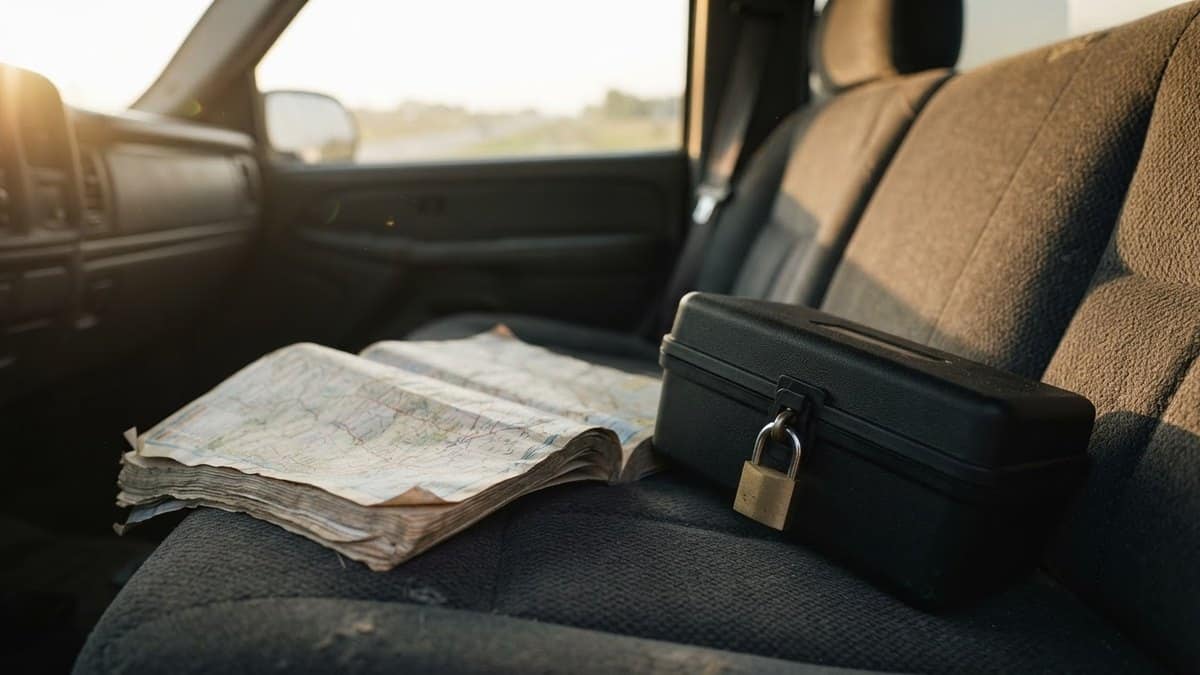
Federal law adds one narrow safe-passage rule, 18 U.S.C. 926A. It covers a firearm moving between two places where you may lawfully possess and carry it, but only unloaded, with neither gun nor ammunition readily or directly accessible from the passenger compartment, and in a vehicle with no trunk, in “a locked container other than the glove compartment or console.”
It does not let you carry a loaded pistol through a state that ignores your permit, and guessing wrong is expensive. In New York, which honors no out-of-state permit, a loaded firearm outside your home or business is criminal possession of a weapon in the second degree, “a class C felony” (Penal Law 265.03). In New Jersey, a handgun without a New Jersey permit to carry is “a crime of the second degree” (N.J.S.A. 2C:39-5).
This is not Smokey and the Bandit, and the cargo is not beer. Heading into a national park? Our national park carry guide covers how the state’s law follows you in, and why the visitor center is different.
Paper won: 60% of you who voted keep a paper log in the safe, and nobody picked an app.
Frequently Asked Questions
Which states have permitless carry?
Twenty-nine states: Alabama, Alaska, Arizona, Arkansas, Florida, Georgia, Idaho, Indiana, Iowa, Kansas, Kentucky, Louisiana, Maine, Mississippi, Missouri, Montana, Nebraska, New Hampshire, North Dakota, Ohio, Oklahoma, South Carolina, South Dakota, Tennessee, Texas, Utah, Vermont, West Virginia and Wyoming. The other 21 states and D.C. require a permit.
Which states limit magazine capacity?
Sixteen jurisdictions: California, Colorado, Connecticut, Delaware, Hawaii, Illinois, Maryland, Massachusetts, New Jersey, New York, Oregon, Rhode Island, Vermont, Virginia, Washington and the District of Columbia. Oregon’s cannot apply before January 1, 2028, and a court has blocked Virginia’s, so 14 are enforced.
Which states ban suppressors?
Eight states plus D.C.: California, Delaware, Hawaii, Illinois, Massachusetts, New Jersey, New York, Rhode Island and the District of Columbia. Possession is a felony in California and a Class 3 felony in Illinois.
What state has the strictest gun laws?
Six states tie on this table’s four measures: Delaware, Hawaii, Massachusetts, New Jersey, New York and Rhode Island each require a carry permit, limit magazines, ban suppressors and impose a duty to retreat in public. California, Connecticut, Illinois and Maryland match three of the four.
Do gun laws change when you cross a state line?
Yes. Your permit, magazines and duty to retreat follow the state you stand in, and in Colorado, Missouri and Oregon state law lets cities restrict open carry, so a city limit can matter too.
Know your row before you load the truck, not after the blue lights come on. And remember who writes every cell in that table: your legislature and the judges who rule on its laws. Vote like your freedom depends on it, because it does.
Sources: Freedom’s Lodge, “Constitutional Carry States”; Freedom’s Lodge, “Magazine Capacity Limits by State”; Justia, “Eubanks v. State” (Florida carry age); Wyoming Legislature, “HB 96”; West Virginia Legislature, “HB 4106”; Cornell LII, “18 U.S.C. 926A”; and each statute linked where it is cited.
Informed Owner Want more detail? Read Most Gun Friendly States, Scored on the Law
Reader Favorites
- Virginia’s Gun-Hating Governor vs. Virginia
- Los Angeles Gun-Grabbers Confused, Terrified by Bill of Rights
- Why Do Anti-Gunners Love Red Flag Laws So Much?
- Gun Companies Fight to End COVID-19; Gun Grabbers Fight to End THEM
- Sunshine State Showdown: “No Guns Under 21” Law Challenge Moves Forward
- Guns at Coronavirus Quarantine Protests: Listen For the Loudest Scream
Gun-owner reference desk
Plain-English references worth bookmarking — NFA rules, carry law, and the gear terms behind every review.
| 2026 at a glance | |
|---|---|
| NFA tax stamp | $0 |
| Permitless carry | 29 states |
| Suppressors legal | 42 states |
50+ NFA, carry and gun-law terms in plain English, updated for 2026.
Open the glossary → Network| Term | Category |
|---|---|
| Striker-fired | Action |
| MOA | Optics |
| Twist rate | Ballistics |
30 gun, ammo and optics terms, from Guns & Gadgets Daily.
View full chart →