Supreme Court Unanimously Backs Gun Rights in Landmark Hemani Decision
The Supreme Court held 9-0 in Hemani that federal prosecutors cannot automatically strip gun rights from people who use marijuana.
Last updated: September 18, 2026 · Originally published June 18, 2026
Nine to nothing. I have been in this business twenty years and I cannot remember the last time the Supreme Court agreed on anything with a gun in it, but today it did. In United States v. Hemani, the Court held that federal prosecutors cannot automatically strip gun ownership from people who use marijuana. The decision lands as the country is re-arguing where the line between public safety and constitutional liberty ought to run, and it is the latest sign that courts will no longer nod along to categorical drug-use disarmament rules without proof of actual danger.

The Case: Ali Hemani’s Fight
The facts are simple. In 2022, FBI agents searched the Texas home of Ali Danial Hemani, a dual U.S.-Pakistani citizen, and found a Glock 19 9mm pistol, 60 grams of marijuana, and 4.7 grams of cocaine. Hemani admitted to using marijuana about every other day. He was not accused of being intoxicated at the time he possessed the firearm, and he was not charged with any other crime. Federal prosecutors charged him anyway under 18 U.S.C. § 922(g)(3), a 1968 law that makes it a federal crime for any “unlawful user of or addicted to any controlled substance” to possess a gun.
Hemani’s lawyers went after the prosecution on constitutional grounds: the government was violating his Second Amendment rights by presuming he was dangerous based on nothing but his marijuana use, with zero evidence he posed a threat to anybody.
How the Court Applied Bruen
Justice Neil Gorsuch, writing for the unanimous majority, applied the framework the Supreme Court set up in its 2022 landmark decision New York State Rifle and Pistol Association v. Bruen. That case held that gun restrictions must be “consistent with the Nation’s historical tradition of firearm regulation” to survive. Basically, under Bruen a court asks two questions. First, does the Second Amendment’s plain text cover the conduct? Second, if yes, can the government show a historical tradition that supports restricting it?
The Trump administration argued that colonial-era laws banning “habitual drunkards” from firearms gave historical cover for modern marijuana bans. Gorsuch did not buy it. The historical precedents, he wrote, targeted active intoxication, people actually impaired at the moment of firearm use, not the mere status of being a regular user of a substance. Marijuana use “today is like alcohol use at the founding,” Alito noted in his concurrence, adding that “from a practical standpoint, law enforcement widely tolerates” it.
So the government failed to carry its burden. It could not show that disarming every regular marijuana user lines up with historical tradition in purpose or in operation.
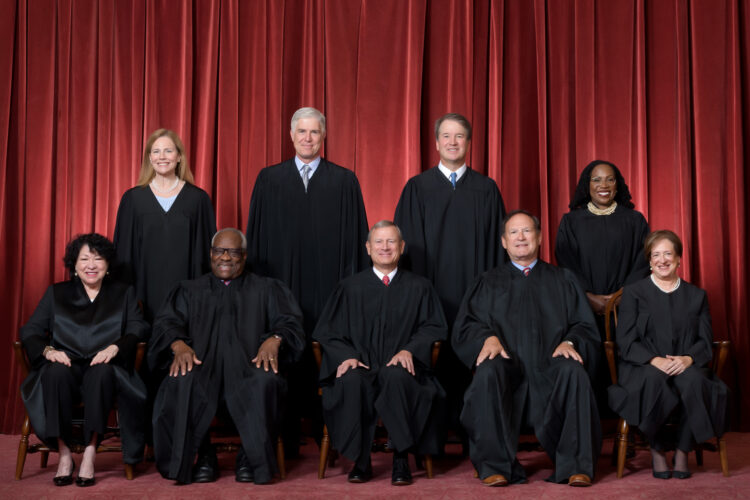
Unanimity Hides a Real Disagreement
Now, the vote was 9-0, but the concurring opinions show real fault lines about how strictly courts should apply the historical tradition test from here on.
Justice Alito’s concurrence (joined by Justice Elena Kagan) took the narrow road. Alito argued that the government’s historical analogy was “too far afield to justify” prosecution, writing: “We need not say more to decide this case.” That leaves room for Congress to write more tailored restrictions, maybe aimed only at people who show acute impairment or abuse patterns, without knocking out the broader statute.
Justice Jackson’s concurrence (joined by Justice Sotomayor) kept up her skepticism of the Bruen test itself, repeating her concern that the Court “veered off course” when it adopted the historical tradition framework in 2022. Jackson signaled she would prefer a different constitutional analysis altogether, though she joined the result here.
Justice Thomas, the architect of Bruen, wrote separately to defend the historical tradition test as the correct constitutional method.
Remember those fractures. If Congress moves to narrow § 922(g), the courts are already split on how hard to police any new restrictions.
What Hemani Means for Gun Rights
The decision does not strike down the entire statute. The government may still prosecute drug users who actually pose a demonstrable danger, a felon with an active meth addiction and a history of violence, for instance. What Hemani requires is showing that connection, not assuming it.
That raises the evidentiary bar for future prosecutions. Federal authorities can no longer charge someone simply because they use marijuana and own a gun; they now have to argue that the particular defendant’s conduct and circumstances fit a historical pattern of dangerousness. The ruling narrows § 922(g)(3) while leaving prosecutors a thinner path forward.
The case fits the broader post-Bruen pattern: courts are reading gun restrictions through the lens of historical practice, not modern policy preferences. If a law cannot point to a real historical tradition behind it, it falls, even if lawmakers are sure it serves public safety.
The Strangest Coalition You Will See This Year
The Hemani case pulled together a crowd that does not usually share a table. The National Rifle Association, the American Civil Liberties Union, the Drug Policy Alliance, NORML (the marijuana legalization advocacy group), the Cato Institute, and criminal defense lawyers all filed amicus briefs supporting Hemani. Second Amendment absolutists and drug legalization advocates on the same side (picture that potluck) shows how the case touched principles that run under left-right politics: constitutional liberty and a healthy suspicion of prosecutorial overreach.
Congress May Act, but Narrowly
The decision leaves Congress with options. Gorsuch’s opinion noted that the Court does not address “other prophylactic laws Congress might adopt” if lawmakers decide that users of particular drugs pose “a special risk of misusing firearms.” That language opens a window: Congress could, in theory, pass narrower restrictions aimed at specific, high-risk drug categories and tied to demonstrated dangerousness.
But any such law would have to survive Bruen. It would need to point to historical tradition, not just contemporary policy judgment. That is a far steeper climb than passing a one-size-fits-all marijuana ban.
Lawmakers in the Republican-controlled Congress face a choice: try to narrow the statute so it survives constitutional scrutiny, or leave it alone and know that future prosecutions face constitutional headwinds.
Why Hemani Matters for the Gun Debate
Hemani is the latest proof that post-Bruen jurisprudence has shifted the ground under the Second Amendment. Courts are no longer deferring to Congress’s judgment that a restriction serves the public good. Judges are acting as constitutional gatekeepers, demanding historical evidence before allowing any disarmament, even of drug users.
For Second Amendment advocates, the ruling affirms that the Right to Keep and Bear Arms is not a second-class liberty you forfeit based on status alone. For prosecutors and gun-control advocates, it signals that sweeping categorical bans face an uphill constitutional fight.
The practical effect is plain: as more Americans use marijuana legally in a growing number of states, the federal ban on their gun ownership could not survive a constitutional challenge without evidence that they posed a real threat. Hemani closes the loophole where marijuana use alone triggered automatic disarmament. Going forward, danger must be shown, not assumed.
What Comes Next
The ruling does not end federal firearms regulation. It reorients it. Prosecutors can still charge drug users who fit the historical profile of dangerousness. States and Congress can still restrict firearms in the hands of people who demonstrably pose a risk. But they have to do it through tailored rules tied to actual danger, not categorical status-based bans.
For gun rights, Hemani says the Supreme Court is still committed to the Bruen framework, even when applying it lands libertarian and conservative jurists on the same page. And it proves, yet again, that claims of safety alone no longer carry the day at the Supreme Court. Constitution first, policy second.
Frequently Asked Questions
What did the Supreme Court decide in Hemani?
That the federal government cannot use 18 U.S.C. § 922(g)(3) to ban gun ownership for marijuana users automatically. The vote was 9-0, and Justice Gorsuch wrote that the government never showed its prosecution of Ali Hemani matched the historical tradition standard from Bruen.
Can marijuana users own guns now?
Not a free pass, but a much higher bar for the prosecutor. The government now has to tie a specific person’s marijuana use to demonstrable dangerousness. Casual or regular use with no impairment and no criminal behavior is no longer enough, on its own, to charge someone under federal law.
Does Hemani strike down the entire § 922(g) statute?
No. The statute is still on the books; the Court just narrowed how it can be used. A prosecutor has to prove the defendant fits a historically recognized pattern of dangerousness, such as active intoxication or a record of violence tied to drug use.
What is the Bruen test, and how did it apply here?
Bruen (2022) says a gun restriction has to line up with “the Nation’s historical tradition of firearm regulation.” The government pointed to colonial bans on “habitual drunkards.” Gorsuch said those laws went after people who were actually drunk, not people who were known to drink, and marijuana use today looks a lot like founding-era alcohol use, widespread and tolerated, so the analogy fell apart.
Can Congress fix this with new legislation?
Maybe, and only narrowly. Gorsuch left the door open for laws aimed at specific drugs if lawmakers can show “a special risk of misusing firearms,” but any new statute still has to pass Bruen, so Congress would have to tie restrictions to provable danger (criminal history, active impairment, mental health flags) instead of drug use alone.
Hemani is one more chapter in the post-Bruen Second Amendment revolution: a judiciary increasingly willing to strike down gun restrictions that lack historical roots, even when lawmakers swear they serve public safety. As marijuana legalization spreads state by state and federal enforcement gets a harder look, expect more constitutional challenges to federal disarmament rules. I would take the bet the Court has told us plainly what the yardstick is: history, not modern policy, and that reshapes the map for decades.
Reader Favorites
- Virginia’s Gun-Hating Governor vs. Virginia
- Los Angeles Gun-Grabbers Confused, Terrified by Bill of Rights
- Why Do Anti-Gunners Love Red Flag Laws So Much?
- Gun Companies Fight to End COVID-19; Gun Grabbers Fight to End THEM
- Sunshine State Showdown: “No Guns Under 21” Law Challenge Moves Forward
- Guns at Coronavirus Quarantine Protests: Listen For the Loudest Scream
Gun-owner reference desk
Plain-English references worth bookmarking — NFA rules, carry law, and the gear terms behind every review.
| 2026 at a glance | |
|---|---|
| NFA tax stamp | $0 |
| Permitless carry | 29 states |
| Suppressors legal | 42 states |
50+ NFA, carry and gun-law terms in plain English, updated for 2026.
Open the glossary → Network| Term | Category |
|---|---|
| Striker-fired | Action |
| MOA | Optics |
| Twist rate | Ballistics |
30 gun, ammo and optics terms, from Guns & Gadgets Daily.
View full chart →