Taxing Power, Not the Second Amendment: The Real Legal Theory Behind the NFA Ruling
The court that struck down NFA registration for suppressors did not rest on the Second Amendment: it dismissed those claims as abandoned.
Originally published: September 18, 2026
Last verified: August 19, 2026.
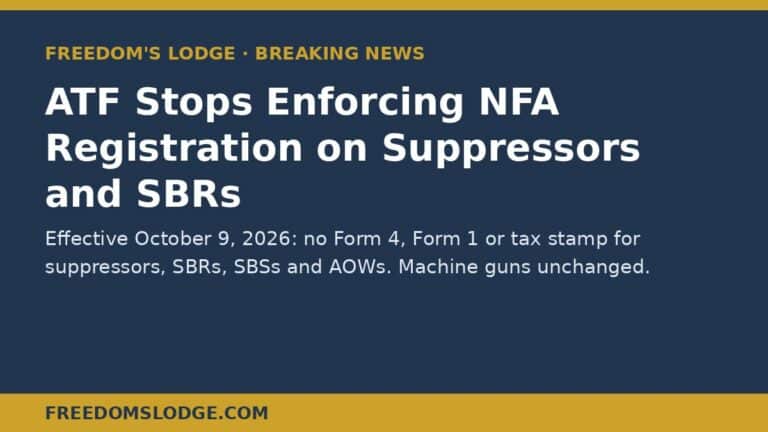
The court that struck down NFA registration for suppressors never touched the Second Amendment. The opinion dismisses the plaintiffs’ Second Amendment claims “without prejudice as abandoned”. Judge Hendrix ruled on taxing power: for 90 years the NFA survived because it raised revenue, and once Congress zeroed the tax in 2026, “a tax set at $0” produces no revenue and can no longer justify the registration machinery built to collect it. It is the same constitutional logic that decided the Obamacare cases, now pointed at the National Firearms Act.
Most coverage of the August 5 ruling in Silencer Shop Foundation v. BATFE (N.D. Tex., consolidated with Jensen v. ATF) framed it as a gun-rights victory. It is one. But it is not a gun-rights ruling, and as an 07/02 manufacturer whose business runs on this paperwork, I care a great deal about the difference, because it decides what happens on appeal. Here is the actual legal theory, drawn from the memorandum opinion itself.
Why Is This Not a Second Amendment Case?
Because the plaintiffs dropped that argument. The challengers originally raised Second Amendment claims; the August 5 opinion dismisses those claims “without prejudice as abandoned,” and the plaintiffs won entirely on Article I grounds, the argument that Congress never had a constitutional power supporting the challenged NFA provisions once the tax hit zero. That was strategic, and smart. A 2A ruling on suppressors would have collided with decades of precedent treating NFA items differently, while the taxing-power argument gave the court a clean, narrow question with the government’s own statute as the star witness. (The Fifth Circuit separately held in June 2026 that suppressors are “arms”, a parallel track, not this case.)



How Does a $0 Tax Kill a 90-Year-Old Law?
The NFA of 1934 lives in the Internal Revenue Code, Title 26, not the criminal code, because it was enacted, and always defended, as a tax. In Sonzinsky v. United States, 300 U.S. 506 (1937), the Supreme Court upheld it precisely as a “taxing measure,” with registration provisions “obviously supportable as in aid of a revenue purpose.” That was the constitutional deal: Congress can bolt registration machinery onto a tax because the machinery helps collect the revenue.
The One Big Beautiful Bill Act zeroed the $200 transfer and making taxes for suppressors, SBRs, SBSs, and AOWs effective January 1, 2026. Judge Hendrix’s opinion draws the straight line: under NFIB v. Sebelius, 567 U.S. 519 (2012), “the essential feature of any tax” is that it “produces at least some revenue for the government.” His key sentence, at page 29 of the opinion: “A tax cannot assist in paying debts or providing for the general welfare or defense if it raises no money.” With the tax at $0, the registration provisions “no longer can … be justified — as they have been for nearly 90 years — under Congress’s taxing power.” Basically, Congress sawed off the branch the NFA was sitting on.
The Precedent Lineage, in One Table
| Case | Year | What it held | Role in the Jensen/SSF ruling |
|---|---|---|---|
| McCulloch v. Maryland | 1819 | Federal power must trace to an enumerated source | The foundation: no enumerated power, no statute |
| United States v. Butler | 1936 | A tax is an exaction that raises revenue | Definition the $0 stamp can’t meet |
| Sonzinsky v. United States | 1937 | Upheld the NFA as a taxing measure | The 90-year shield — which now cuts the other way |
| Haynes v. United States | 1968 | Described the NFA as an “interrelated statutory system for taxation” | Confirms registration exists to serve the tax |
| United States v. Lopez | 1995 | Commerce Clause has limits; gun-possession statutes need a commerce hook | Blocks the government’s fallback argument |
| NFIB v. Sebelius | 2012 | A tax must produce “at least some revenue”; a mandate isn’t saved by a power Congress didn’t invoke | The engine of the whole opinion |
| Texas v. United States (5th Cir.) | 2019 | Zeroed ACA penalty could no longer be sustained as a tax | The direct template: $0 tax = no taxing power |
Citations per the memorandum opinion in Silencer Shop Foundation v. BATFE, No. 6:25-cv-00056 (N.D. Tex. Aug. 5, 2026).
Why Did the Commerce Clause Rescue Fail?
The government’s fallback was that even if the taxing power is gone, the registration scheme could be re-founded on the Commerce Clause. Judge Hendrix rejected that for three interlocking reasons. First, courts cannot save a statute “based on an enumerated power that Congress never invoked.” Congress passed the NFA “clearly and exclusively” as a tax (p. 40). Second, the NFA contains no jurisdictional element tying its provisions to interstate commerce (p. 42), unlike the Gun Control Act, enacted four years after Haynes, which is full of them. Third, the statute’s very placement in Title 26, the Internal Revenue Code, signals its tax-based authority (pp. 43–44). The court also rejected the government’s occupational-tax theory, the argument that registration still aids collection of the $500–$1,000 annual dealer/manufacturer tax (the one I still pay every year, by the way), noting that only 0.03% of transfers involved occupational-tax enforcement issues (p. 36), and warned that the government’s Necessary and Proper Clause theory would create an effectively unlimited federal police power (pp. 37–38).
Where Is the Ruling Vulnerable on Appeal?
Three pressure points, in rough order of risk. (1) The Commerce Clause holding. An appellate court could accept that the taxing power is gone but hold that modern commerce doctrine, which has sustained federal firearms statutes for decades, independently supports registration of items moving in interstate commerce. This is the most likely ground for reversal, and it is why the opinion spends so many pages fortifying it. (2) The occupational-tax theory. The special occupational tax on dealers and manufacturers was not zeroed; a reviewing court could find the registration machinery still “aids” that surviving revenue stream. (3) Severability and remedy scope. Even a court that agrees on the merits could narrow which provisions fall. Take note: the district court itself left 26 U.S.C. § 5861(j), interstate transport of unregistered items, un-enjoined, which is why crossing state lines with a no-Form-4 suppressor remains a separate legal problem. No notice of appeal appears on the docket as of September 8, 2026, and the deadline remains October 5, 2026.
What Does This Mean Going Forward?
Two things. First, because the ruling is statutory-power based rather than 2A based, Congress could in theory “fix” it by re-imposing a nominal tax, a politically explosive move nobody has proposed, but a structural weak spot a constitutional 2A holding would not have. Second, the same $0-tax logic is now being pressed in two parallel cases, Brown v. ATF in Missouri and Roberts v. ATF in Kentucky, which could put the theory in front of three different circuits; our three-case circuit tracker follows all of them. For what the ruling means at the gun-shop counter today, see the practical hub at our sister site Popular Suppressors, part of the Brand Avalanche network. Background from our own coverage: the original Jensen v. ATF filing story, the $0-tax SBR explainer, and the 2A legal glossary for any unfamiliar terms.
What I am watching: whether DOJ files an appeal by October 5, 2026 (none as of September 8), the Fifth Circuit docket, rulings in Brown (under submission) and Roberts (briefed), and any move in Congress to reinstate a nominal tax. Written from the memorandum opinion and the cited Supreme Court precedents directly, with page references to the opinion; attorney commentary was used for context only.
Frequently Asked Questions
Is the suppressor NFA ruling a Second Amendment case?
No. The plaintiffs originally raised Second Amendment claims, but the August 5 opinion dismisses those claims “without prejudice as abandoned.” The plaintiffs won entirely on Article I taxing-power grounds instead.
How does a $0 tax kill a 90-year-old law?
The NFA of 1934 lives in the tax code and was always defended as a revenue-raising tax; in Sonzinsky v. United States (1937) the Supreme Court upheld it precisely as a “taxing measure.” The One Big Beautiful Bill Act zeroed the transfer and making taxes effective January 1, 2026. Under NFIB v. Sebelius (2012), a tax has to raise at least some revenue to count as a tax, and Judge Hendrix ruled that with the tax at $0, the registration provisions can no longer be justified under Congress’s taxing power.
Does this ruling affect the Fifth Circuit’s decision that suppressors are “arms”?
No. That is a separate, parallel Fifth Circuit ruling from June 2026, not part of this case.
Has DOJ appealed the ruling?
Not as of September 8, 2026. The appeal deadline is October 5, 2026.
This article is legal news and analysis, not legal advice.


Reader Favorites
- Virginia’s Gun-Hating Governor vs. Virginia
- Los Angeles Gun-Grabbers Confused, Terrified by Bill of Rights
- Guns at Coronavirus Quarantine Protests: Listen For the Loudest Scream
- Supreme Court Second Amendment Cases: Careful What You Wish For
- Has COVID-19 Secured the Second Amendment’s Future?
- Defending the Defensive Blade: New Knife Rights App
Gun-owner reference desk
Plain-English references worth bookmarking — NFA rules, carry law, and the gear terms behind every review.
| 2026 at a glance | |
|---|---|
| NFA tax stamp | $0 |
| Permitless carry | 29 states |
| Suppressors legal | 42 states |
50+ NFA, carry and gun-law terms in plain English, updated for 2026.
Open the glossary → Network| Term | Category |
|---|---|
| Striker-fired | Action |
| MOA | Optics |
| Twist rate | Ballistics |
30 gun, ammo and optics terms, from Guns & Gadgets Daily.
View full chart →